The Anatomy of Curiosity: Feynman's Prescription for Unconventional Genius
Golden Hook & Introduction
SECTION
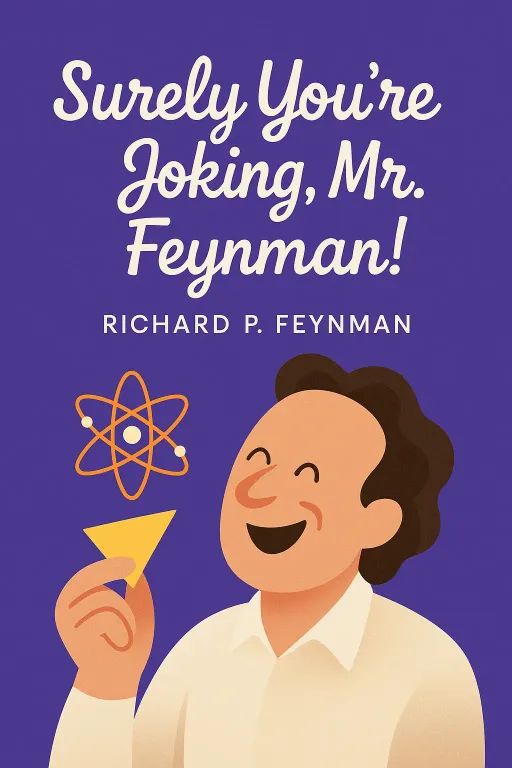
Nova: Imagine you’re holding a broken radio in 1930, during the height of the Great Depression. Instead of immediately tearing it apart, pulling out tubes, or swapping wires, you just stand there. Hands in your pockets, pacing the room, muttering to yourself. The owner of the radio is watching you, getting more and more annoyed, thinking you’re a complete fraud who has no idea what he's doing. But you’re doing something revolutionary: you’re fixing it by. Welcome to our show! Today, we are diving into the wild, hilarious, and deeply profound world of Richard Feynman’s classic memoir, We’re exploring a fascinating theme today: the intersection of genius and character. And to help us dissect this, we have a wonderful guest, Alex, who is a healthcare professional. Alex, welcome!
Alex: Thanks, Nova! I am so excited to be here. You know, when I first read that radio story, it immediately struck a chord with me. In healthcare, we are constantly faced with complex, broken systems—except in our case, those systems are human bodies. The temptation to just start "swapping parts" or running a massive battery of tests without truly thinking first is incredibly real. Feynman’s approach to problem-solving isn't just a lesson in physics; it’s a masterclass in diagnostic reasoning.
Nova: Oh, absolutely! And that is exactly why we wanted you on the show today, Alex. We want to look at Feynman’s life not just as a series of funny anecdotes, but as a blueprint for how we can all think better, work with more integrity, and keep our curiosity alive. Today, we’re going to tackle this book from three different angles. First, we’ll dissect the diagnostic mindset of troubleshooting systems from first principles. Second, we’ll examine what Feynman called "Cargo Cult Science" and the ethical prescription of absolute integrity. And finally, we’ll look at the playful polymath—how embracing mischief, art, and cross-disciplinary curiosity can actually protect us from professional burnout. Let's dive right in!
Deep Dive into Core Topic 1
SECTION
Nova: So, let’s go back to that radio story. Feynman was just a kid in Far Rockaway, New York, during the Depression. He had a little home lab in his house, made out of an old wooden packing box, where he’d play with batteries, switches, and spark coils. Word got around the neighborhood that this kid could fix radios for cheap. One day, a man calls him over to fix this massive radio. Feynman gets there, turns it on, and it starts making this horrendous, deafening screeching noise. Then, after a minute, it quietens down and plays normally. The man is skeptical because Feynman is so young. Feynman starts pacing the floor, thinking. He realizes: okay, why would it screech first and then stop? He reasons that the tubes must be heating up in the wrong order. The pre-amplifier tube is getting hot before the amplifier tube is ready, causing a feedback loop. He swaps the tubes around, turns the radio on, and—silence, followed by perfect music. The owner was stunned and started telling everyone, "He fixes radios by thinking!"
Alex: It’s such a beautiful story, Nova. And what’s hilarious is that the owner’s reaction—"He fixes radios by thinking!"—implies that thinking is an unusual way to fix things! But in a way, it is. In modern professional life, we are often trained to rely on algorithms, protocols, and checklists. In healthcare, when a patient presents with a complex set of symptoms, there’s a strong cognitive bias called "diagnostic anchoring." We see a couple of familiar signs, we anchor onto a common diagnosis, and we start treating it without pausing to look at the whole system. Feynman’s genius was his refusal to anchor. He didn't just look at the symptoms—the screeching noise—he mapped out the chronological process of the system. He asked the timing of the heat-up mattered.
Nova: Yes! He wanted to understand the underlying mechanism, not just follow a manual. And he carried that exact same hands-on, first-principles approach all the way to Princeton. There’s this other great story from his graduate years about the S-shaped lawn sprinkler. You know, the classic sprinkler that spins as it sprays water out. The big debate in the physics department was: what happens if you submerge the sprinkler entirely under water, and instead of spraying water, you suck water? Which way does it turn? Does it turn the same way as when it sprays, or the opposite way, or not at all?
Alex: Oh, I remember this one! The theoretical physicists were arguing about it endlessly, writing down equations on blackboards, completely split on the answer. And Feynman, being Feynman, got frustrated with the pure theory and decided to actually build an experiment to test it.
Nova: Exactly! He went into the Princeton cyclotron lab, got a giant glass carboy—basically a massive glass bottle—filled it with water, bent some copper tubing into an S-shape, and hooked up an air pressure supply to simulate sucking the water in. He started increasing the air pressure to get a stronger flow, trying to get a clear measurement. But as he kept pumping in more air, the pressure inside the carboy built up too much. And suddenly— The giant glass bottle exploded, sending glass and gallons of water flying across the high-tech laboratory, soaking a bystander and ruining some delicate cloud chamber pictures. The head of the lab, Professor Del Sasso, was furious and told him, "The freshman experiments should be done in the freshman laboratory!"
Alex: I love that story because it highlights the messy, sometimes dangerous reality of empirical testing. But more importantly, it shows his character. Feynman wasn't afraid to look foolish, and he wasn't afraid to get his hands dirty to find the truth. In medicine, we have clinical guidelines, which are incredibly important. But every single patient who walks through the door is, in a way, an empirical experiment of one. Their genetics, their lifestyle, their comorbidities—they don't always fit the textbook equations. If we rely solely on the "pure theory" of guidelines without closely observing the unique, messy reality of the patient in front of us, we risk making catastrophic errors. We have to be willing to test our assumptions, even if it means our metaphorical "carboy" might occasionally crack.
Nova: That is such a powerful connection, Alex. It’s about having the humility to let reality correct your beautiful theories. Feynman always said that if your theory doesn't agree with experiment, it’s wrong. It doesn't matter how smart you are, or who came up with the theory—it’s just wrong.
Alex: Exactly. And that requires a level of character that is actually quite rare. It’s the willingness to prioritize truth over ego.
Deep Dive into Core Topic 2
SECTION
Nova: And that brings us perfectly to our second major topic, which is the absolute core of Feynman's philosophy on science: "Cargo Cult Science." This was the title of his famous 1974 commencement address at Caltech. Feynman explained that during World War II, the people on certain islands in the South Pacific saw airplanes land with tons of valuable cargo—food, materials, medicine. The islanders loved this. But after the war, the military left, and the planes stopped coming. So, the islanders decided to bring the planes back. They cleared runways, built mock control towers out of wood, made headphones out of bamboo, and sat there, waiting for the planes to land. They did everything right on the surface. The form was perfect. But, of course, the planes never landed. Feynman used this as a metaphor for research that looks like science, follows all the protocols of science, but is missing the one essential ingredient: absolute scientific integrity.
Alex: Wow. When you describe that, Nova, it gives me chills because "Cargo Cult Science" is a massive challenge in modern healthcare and clinical research. Think about how much pressure there is on researchers to publish positive results. If you want funding, if you want tenure, if you want your drug approved, you need a clean, successful trial. So, what happens? People start going through the motions of the scientific method—they run the trials, they use the statistical software, they write the papers—but they engage in "p-hacking," or they selectively report only the data that supports their hypothesis, while burying the negative results in a drawer. They are building the bamboo headphones, but the planes of true medical progress aren't landing.
Nova: Yes! Feynman called this "leaning over backwards" to show how you might be wrong. He said that when you conduct an experiment, you have an ethical duty to report not just what went right, but every single detail that could potentially invalidate your results. If you know of a loophole, or a variable you couldn't control, you have to publish it.
Alex: That "leaning over backwards" is the ultimate test of character. In medicine, we call this evidence-based practice. But evidence is only as good as the integrity of the research behind it. If a clinical trial for a new blood pressure medication only reports the successful drops in pressure but hides the fact that ten percent of the patients developed severe kidney issues, that is Cargo Cult Science. It’s a betrayal of the public trust. And it’s not just in research; it happens in daily clinical practice too. Sometimes, a healthcare provider might order a test just to "cover their bases" legally, or because "that's how we've always done it," without a clear clinical rationale. That’s mimicking the form of medicine without the substance.
Nova: It really is. And Feynman gave a classic historical example of this in his address: Robert Millikan’s famous oil drop experiment, which measured the charge of an electron. Millikan got a value that was slightly off because he had an incorrect value for the viscosity of air. When subsequent scientists repeated the experiment, they got values that were slightly higher. But instead of publishing their high numbers immediately, they looked at their results and thought, "Oh, this must be wrong, it’s too far from Millikan’s number." So they looked for reasons why their experiment might have failed, found some minor errors, and adjusted their data. But when they got a number closer to Millikan’s, they didn't look as hard for errors! Over time, the published values gradually crept up to the correct number.
Alex: That is a mind-blowing example of confirmation bias! And it happens in medicine all the time. If a patient comes in with chest pain, and the initial EKG is normal, a clinician might think, "Oh, it’s just acid reflux," and ignore subtle signs of a atypical heart attack because it doesn't fit the "normal EKG" narrative. We actively look for reasons to discount the data that contradicts our initial assumption, while accepting the supporting data without question. Feynman’s warning is so vital: "The first principle is that you must not fool yourself—and you are the easiest person to fool."
Nova: "And you are the easiest person to fool." I think that should be carved into the wall of every laboratory, every hospital, and honestly, every office in the world. We are so incredibly good at self-deception, especially when our egos or our livelihoods are on the line.
Alex: Absolutely. It takes immense character to look at your own work, your own diagnosis, and actively try to tear it apart. But that is the only way we actually keep patients safe.
Deep Dive into Core Topic 3
SECTION
Nova: So, how do we cultivate that kind of character? How do we keep ourselves from falling into the trap of self-deception and professional rigidity? Well, Feynman’s secret weapon was his relentless, almost childlike playfulness. He refused to be put in a box. He was a physicist, yes, but he was also a safe-cracker, a bongo player, a Mayan hieroglyphics expert, and an artist. There’s this wonderful story about his time at Princeton when he decided to sit at the biology table in the graduate dining room. He ended up taking a course in cell physiology. He was assigned a paper on nerve impulses in cats, but because he hadn't taken basic biology, he didn't know where the different muscles were. So he went to the biology library and asked the librarian for "a map of the cat."
Alex: "A map of the cat!" That is hilarious. I can only imagine the librarian’s face!
Nova: Oh, she was absolutely horrified! She said, "You mean a zoological chart!" But the rumor spread through the department about this "dumb physics graduate student" looking for a map of the cat. But when Feynman gave his presentation, he drew a beautiful diagram of a cat on the blackboard and labeled all the muscles. He pointed out to the biology students that they had spent years memorizing all these complex anatomical names, which they could easily look up in fifteen minutes, while neglecting the actual, fascinating physics of how the nerve impulses worked.
Alex: Gosh, that hits so close to home! In healthcare education, there is an overwhelming amount of rote memorization. You memorize drug names, anatomical structures, metabolic pathways. And yes, you need that foundation. But Feynman’s point is so sharp: memorization is not the same as understanding. We can get so caught up in the jargon and the labels that we lose sight of the actual, living system. Feynman’s willingness to step into a completely different domain—to be a beginner again, to ask "dumb" questions like "where is the map of the cat?"—that is what kept his mind so incredibly flexible.
Nova: Yes! He had no fear of looking stupid. And that playfulness is actually what saved his career when he was feeling completely burned out after World War II. He had spent years working under intense pressure on the Manhattan Project at Los Alamos. His first wife, Arlene, had tragically died of tuberculosis during that time. When he got to Cornell as a professor, he felt completely drained. He felt like he had lost his creative spark. He received this incredibly prestigious offer from the Institute for Advanced Study in Princeton, and instead of feeling honored, he felt paralyzed by the expectation to do "important" work.
Alex: That kind of burnout is something so many healthcare professionals can relate to, especially after the intense pressure of the last few years. You feel like you’re carrying the weight of the world, and the joy of why you got into the field in the first place just gets completely crushed under the burden of expectations.
Nova: Exactly. And Feynman’s breakthrough came when he made a firm decision. He said to himself, "You know what? I am burned out. I am not going to do anything important ever again. I am just going to play with physics, purely for my own amusement, without worrying about its importance whatsoever." And just a few days later, he was in the Cornell cafeteria, and some guy threw a blue plate in the air. As the plate flew, Feynman noticed it was wobbling, but he also noticed that the red Cornell medallion on the plate was rotating faster than the rate of the wobble. He got curious. He went back to his office and started calculating the dynamics of rotating, wobbling plates, just for the fun of it. He showed his calculations to Hans Bethe, who asked, "Feynman, that’s very interesting, but what’s the importance of it?" And Feynman replied, "It has no importance at all! I’m just doing it for fun!" But that simple, playful calculation about a wobbling cafeteria plate started a chain of thought that eventually led him to develop the diagrams and equations of quantum electrodynamics—which won him the Nobel Prize!
Alex: That is honestly one of the most beautiful stories in the history of science. The Nobel Prize-winning work didn't come from a place of grim, serious duty; it came from a place of pure, unadulterated play. For someone in my field, this is a profound lesson. Burnout happens when we lose our "wobbling plates." When the daily grind of charting, administrative tasks, and high-stakes pressure turns our work into a chore. We have to find ways to keep that sense of play alive. Maybe it’s taking five minutes to really talk to a patient about their life, or researching a rare condition just out of curiosity, or connecting with colleagues across different departments to see how they solve problems. We need that cross-disciplinary play to keep our minds alive and our empathy intact.
Nova: I love that, Alex. "Finding your wobbling plate." It’s about realizing that curiosity isn't a luxury; it’s a survival mechanism. It’s what keeps our character from becoming rigid and our genius from burning out.
Synthesis & Takeaways
SECTION
Alex: It really is. When we look at the intersection of genius and character in Feynman’s life, it’s clear that his genius wasn't just about his high IQ. It was about his courage to think from first principles, his absolute, uncompromising honesty with himself and others, and his refusal to stop playing. His character was the engine of his genius.
Nova: Well said, Alex. As we wrap up today, let’s leave our listeners with some practical takeaways. First, when you’re faced with a complex problem this week, don’t just run to your standard checklist. Take a breath, hands in your pockets, and try to "fix it by thinking" from first principles. Second, practice that "leaning over backwards" honesty. If you’re presenting an idea, a project, or a diagnosis, actively point out where you might be wrong. It builds trust and keeps you from fooling yourself. And finally, Alex, what is your challenge for our listeners regarding the "wobbling plate"?
Alex: My challenge to everyone listening is this: find one thing in your daily routine this week—something completely simple, trivial, or unrelated to your main job—and investigate it just for the sheer joy of it. Ask a "dumb" question. Look for your own "map of the cat." Reclaim your right to play, because you never know where that curiosity might lead you.
Nova: I love that so much. Alex, thank you for bringing your incredible analytical mind and warm perspective to this conversation. This has been absolutely electrifying.
Alex: Thank you, Nova! It’s been an absolute pleasure.
Nova: And to all our listeners, go out there, stay curious, don't fool yourselves, and surely, keep joking! We’ll see you next time!