Personalized Podcast
Golden Hook & Introduction
SECTION
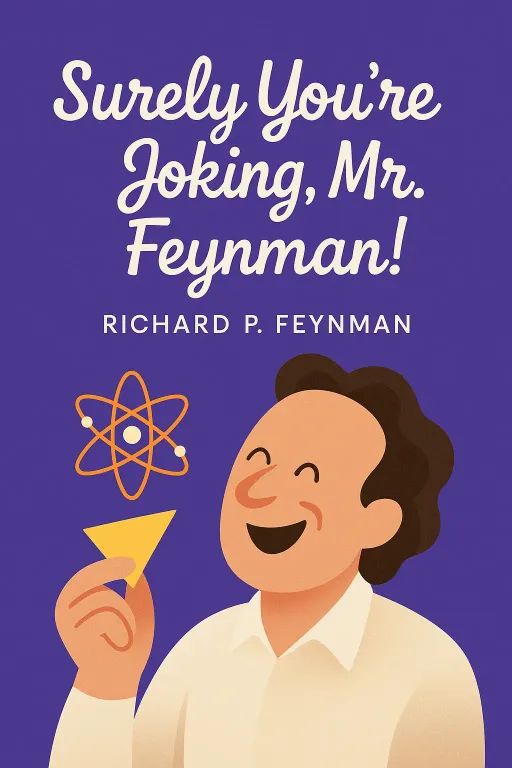
Albert Einstein: Imagine waking up at five o'clock in the morning in your college dorm, only to find that someone has completely removed your heavy wooden door from its hinges. In its place, they have hung a neat little sign that reads: You would probably start searching for clues, right? You would ask around, look for suspicious characters. But when the fraternity president gathers everyone in the living room and asks, on their word of honor, if anyone knows who took it, one young man steps forward and says, "Yeah, I took the door." And do you know what happens? Nobody believes him! They think he is joking because he is too direct, too honest. That mischievous student was none other than Richard Feynman, a future Nobel laureate in physics. Welcome to our conversation today, where we are exploring the wild, brilliant, and deeply joyful world of a man who proved that you do not have to lose your sense of play to change the world.
Farheen-Barbie: It is so fascinating to look at that story, because it highlights something fundamental about how our minds work. We are so conditioned to look for complex, hidden motives that when someone hands us the absolute, unvarnished truth, we completely dismiss it as a joke. It is like a cognitive blind spot! And that really is the essence of Richard Feynman, isn't it? He had this uncanny ability to strip away all the social pretense, the academic jargon, and the intellectual snobbery to look directly at the core of reality. As a college student navigating a world that often feels incredibly structured and high-pressure, I find his approach to life incredibly liberating.
Albert Einstein: Ah, yes! The beauty of simplicity is a rare and precious thing. Feynman understood that nature is a wonderful puzzle, and the moment we begin to treat it with too much solemnity, we lose the very key to understanding it. Today, we are going to tackle his philosophy of living an impactful yet joyful life through three distinct lenses. First, we will explore how a simple, wobbling cafeteria plate rescued him from intense academic burnout and paved the way for his greatest scientific breakthrough. Second, we will dissect his warning against what he called "Cargo Cult Science"—the dangerous habit of mimicking the appearance of knowledge without actually understanding the underlying principles. And finally, we will discuss the radical courage it takes to protect your personal joy by saying "no" to prestigious distractions and societal expectations.
The Power of Playful Curiosity
SECTION
Albert Einstein: Let us begin with a moment of deep crisis in Feynman's life. Shortly after the second World War, having spent years working under immense pressure on the Manhattan Project at Los Alamos, and grieving the tragic loss of his first wife, Arlene, Feynman arrived at Cornell University as a young professor. But he was completely burned out. He felt a paralyzing weight of expectation. Every time he sat down to do research, he thought, "I must do something important. I must live up to this great reputation." And of course, when you force the mind to be brilliant, it freezes. Have you ever felt this kind of creative paralysis, Farheen-Barbie?
Farheen-Barbie: Oh, absolutely. I think almost every college student today can relate to that. We live in this hyper-optimized culture where every project, every class, even every hobby has to be a stepping stone to a resume builder or a career milestone. You start to feel like if you aren't working on something "disruptive" or "impactful," you are wasting your time. It creates this constant background noise of anxiety, which completely drains the joy out of learning. You end up debugging your life instead of living it! How did Feynman break out of that loop?
Albert Einstein: He made a magnificent decision. He said to himself, "You know what? I am burned out. I am never going to accomplish anything important again. So, I am going to play with physics. I will do things purely for my own amusement, without worrying about any importance whatsoever." And shortly after making this pact with himself, he was sitting in the Cornell cafeteria when a student, in a moment of typical student exuberance, threw a dinner plate up into the air. As the plate flew, Feynman noticed it was wobbling. But because there was a red Cornell medallion printed on the rim of the plate, he saw that the medallion was rotating faster than the plate was wobbling. He thought to himself, "I wonder what the relationship is between the rate of rotation and the rate of wobble?"
Farheen-Barbie: Wait, so he just saw a plate spinning in a cafeteria and decided to write down the equations for it? Just like that?
Albert Einstein: Exactly! He did it purely for the fun of it. He brought the problem to his colleague, Hans Bethe, who was amazed by the calculations but asked, "Feynman, that's very interesting, but what is the importance of it?" And Feynman replied, "It doesn't have any importance! I don't care if it's important. I am just doing it because it is fun." But here is the beautiful twist of the story: as he played with the equations of that wobbling plate, it led him to think about how electron orbits rotate in relativity. He began to apply the same mathematical methods to quantum electrodynamics. And that playful, useless calculation about a cafeteria plate was the exact spark that led to his Feynman diagrams and the Nobel Prize!
Farheen-Barbie: That is mind-blowing! It is a perfect example of what psychologists call the "sandbox effect." When you remove the pressure of the final outcome, you give your brain the psychological safety to make wild, creative connections. In technology, we talk about "sandboxes" as isolated environments where you can run messy experiments without breaking the main system. Feynman basically built a sandbox in his own mind. He allowed himself to play with a "useless" problem, and because his mind was relaxed, he stumbled upon a fundamental truth of the universe.
Albert Einstein: Yes! Nature does not reveal her secrets to those who approach her with a demanding attitude. She requires a light touch, a sense of wonder. I remember when Feynman was at Princeton, he wanted to solve a classic hydrodynamics puzzle about an S-shaped lawn sprinkler. He wanted to know: if you submerge the sprinkler in water and instead of spraying water out, you suck the water in, which way will the sprinkler turn? Will it turn the same way as when it sprays, or the opposite way? To find out, he set up a giant glass carboy of water in the cyclotron laboratory, hooked up an air pressure supply, and started pumping air to create a vacuum. He kept increasing the pressure to get a stronger effect, until... The giant glass bottle exploded, covering the entire laboratory in water and glass, ruining some cloud chamber pictures, and getting him banned from the lab by the director!
Farheen-Barbie: Oh no! That is hilarious. But you know what I love about that? Even though the experiment ended in a minor disaster, he didn't care about the mess; he cared about the. He was willing to get his hands dirty, to look foolish, and to fail publicly. Today, we are so afraid of failure that we often stick to safe, predictable paths. We only write code we know will compile, or we only take classes where we are guaranteed an A. But Feynman's sprinkler explosion shows that real, deep understanding comes from the willingness to run the experiment, make a mess, and learn from the wreckage.
First-Principles Thinking vs. Cargo Cult Science
SECTION
Albert Einstein: This brings us naturally to our second theme: the vital difference between real, structural understanding and what Feynman called "Cargo Cult Science." You see, Feynman had a deep disdain for rote memorization and intellectual pretense. Even as a young boy in Far Rockaway, he built a reputation in his neighborhood as the boy who "fixes radios by thinking!" While other repairmen would just blindly swap out parts hoping to stumble on the fix, Feynman would sit quietly in front of a broken radio, listen to the strange noises it made when it warmed up, and trace the logical sequence of the tubes in his head until he diagnosed the exact point of failure. He understood the, not just the manual.
Farheen-Barbie: That is a classic engineering mindset! It is what we call "first-principles thinking." You don't just accept a system as a black box; you deconstruct it to its most basic truths and build your understanding from the ground up. It reminds me of a hilarious story in the book where Feynman decided to sit with the biology students at Princeton. He wanted to broaden his horizons, so he joined their advanced cell physiology course. He was assigned to give a presentation on a paper about nerve impulses in cats. But because he hadn't spent years in the biology department, he went to the librarian and asked for a "map of the cat."
Albert Einstein: Ah, yes! The "map of the cat!" The biology students were absolutely horrified, were they not?
Farheen-Barbie: They were! They thought he was incredibly ignorant because he didn't know the Latin names of all the muscles and nerves. But Feynman realized something profound during that class. He noticed that the biology students spent all their time memorizing massive lists of complex terms—information that anyone could look up in a book in fifteen minutes—but they didn't actually understand how the nerve impulses worked on a physical level. They were confusing the of something with the of something. In tech, we see this all the time. People memorize the syntax of a programming language or the latest trendy framework buzzwords, but they can't design a basic database architecture from scratch. It is semantic mimicry.
Albert Einstein: You have hit upon a very deep truth. To know the name of a bird in ten different languages does not mean you know anything about the bird itself. You only know about the humans who named it! Feynman articulated this beautifully in his famous commencement address at Caltech, where he introduced the concept of "Cargo Cult Science." He described the indigenous people of the South Seas islands who, during the second World War, saw airplanes land with wonderful cargoes of food and supplies. After the war, the soldiers left, and the cargo stopped coming. So, the islanders decided to recreate the scene. They cleared runways, built a wooden control tower with a man sitting in it wearing bamboo headphones with antennas made of coconut leaves, and lit fires along the runway. They did everything perfectly. The form was exact. But do you know what happened? The planes did not land!
Farheen-Barbie: It is such a powerful, haunting metaphor. They mimicked the outward appearance of an airfield, but they completely missed the entire global industrial and military infrastructure that actually caused those planes to fly. And Feynman argued that a lot of academic research, especially in fields like educational psychology or mysticism, is exactly like that. Researchers go through all the motions—they use scientific jargon, they publish papers, they compile statistics, they design elaborate experiments—but they are missing the core integrity of science because they aren't actively trying to prove themselves. They are just looking for data that confirms what they already want to believe.
Albert Einstein: Yes! The first principle of scientific integrity is that you must not fool yourself—and you are the easiest person to fool! To avoid being a cargo cult scientist, you must "lean over backwards" to show how your experiment might be wrong, to publish the data that contradicts your hypothesis, and to explain every alternative explanation. It is a level of utter honesty that is incredibly rare, because it requires us to swallow our pride.
Farheen-Barbie: It really does. And it is especially hard in a world driven by metrics, funding, and social media validation. If you are a researcher or a developer, there is this massive pressure to present your work as flawless and revolutionary. But if you are constantly polishing the surface to look good, you end up building a cargo cult. You are wearing the bamboo headphones, but no planes are landing. Feynman's lesson is that we have to value the messy, inconvenient truth over the beautiful, comfortable illusion. We have to be willing to say, "My code is buggy," or "My hypothesis failed," because that is the only way to build something that actually works.
The Courage to Live Unconventionally
SECTION
Albert Einstein: This brings us to our final, and perhaps most challenging, theme: the courage to live an unconventional life. As Feynman's fame grew, especially after his work on the Manhattan Project and his rising status in the physics community, he was hounded by prestigious institutions. After the great physicist Enrico Fermi passed away, the University of Chicago desperately wanted Feynman to fill his vacancy. They offered him an absolutely astronomical salary. But Feynman did something that shocked the academic world. He refused the offer without even letting them tell him the exact number! Why do you think he did that, Farheen-Barbie?
Farheen-Barbie: It sounds almost crazy on the surface, doesn't it? Who turns down a blank check from one of the top universities in the world? But when you read his explanation, it is incredibly beautiful and self-aware. He realized that if he accepted that massive salary, his life would become incredibly complicated. He said to himself, "With that kind of money, I would finally be able to do what I've always wanted to do—get a wonderful mistress, put her up in an apartment, buy her nice things... and then I know what would happen. I'd worry about her, what she's doing; I'd get into arguments when I come home. All this bother would make me uncomfortable and unhappy. I wouldn't be able to do physics well, and it would be a big mess!" He literally realized that his own desires, if funded, would destroy his peace of mind and his love for science.
Albert Einstein: Ah! What magnificent self-knowledge! He understood that wealth and prestige are often just gilded cages. They promise freedom, but they deliver complications, social obligations, and administrative burdens that eat away at your mental bandwidth. By saying "no" to the money, he was saying "yes" to his freedom to think, to play, and to remain a happy man. He did the same thing with the Nobel Prize! When he first received the early morning phone call from Sweden informing him that he had won, his initial reaction was not triumph, but deep annoyance. He seriously considered refusing the prize because he dreaded the pomp, the celebrity status, and the fact that he would never again be treated as a normal human being in public.
Farheen-Barbie: It takes an incredible amount of courage to resist the "prestige trap." For college students, this is a massive struggle. There is this intense societal pressure to climb the ladder—to get the highest-paying job at the most famous tech company, or to get into the most prestigious graduate school, even if the actual day-to-day work is soul-crushing or uninteresting. We chase the badge of honor because we want others to think we are successful. But Feynman showed that true success is entirely internal. It is about having the freedom to spend your afternoons tracing the path of ants on your windowsill, or playing the bongos, or drawing a model in a local cafe.
Albert Einstein: Yes! He was a man of a thousand interests. He learned to draw in his forties, not to be a famous artist, but because he wanted to express the deep, silent awe he felt for the mathematical beauty of nature. He played in a samba band in Brazil, took part in theatrical plays, and even testified in a local court case in support of a topless restaurant he frequented, simply because he enjoyed sitting there, working on physics equations on paper placemats, and chatting with the dancers. He refused to let society dictate what a "dignified professor" should look like.
Farheen-Barbie: I love that so much. He completely dismantled the stereotype of the stuffy, unapproachable academic. He was just a guy who was endlessly curious about the world, whether that meant deciphering Mayan hieroglyphics, cracking high-security safes at Los Alamos to point out security flaws, or learning how to speak fake Italian to entertain a group of Girl Scouts. He lived his life as a series of joyful, mischievous experiments. And because he didn't waste his energy trying to maintain a false persona of "dignity," he had all this leftover cognitive capacity to actually solve the deepest mysteries of the universe.
Synthesis & Takeaways
SECTION
Albert Einstein: As we draw our conversation to a close, let us look at the beautiful tapestry we have woven today. We have seen that an impactful and joyful life is not a contradiction; in fact, they are deeply dependent on one another. Playful curiosity is the very engine of discovery. First-principles thinking keeps us honest and prevents us from building empty cargo cults. And the courage to remain unconventional protects our freedom to do what we love.
Farheen-Barbie: It really is a beautiful blueprint for living. If there is one actionable takeaway I want to leave our listeners with—especially my fellow students and builders out there—it is this: find your "wobbling plate" this week. Find one small, completely "useless" problem or project that fascinates you. It could be writing a silly script to automate a trivial task, learning a weird historical fact, or drawing something in your room. Do it with zero expectation of profit, grades, or career advancement. Do it purely for the joy of finding things out.
Albert Einstein: What a wonderful challenge. Let us all allow ourselves to step into the sandbox of life, to make a little mess, and to wonder. Thank you, Farheen-Barbie, for this delightful journey through the mind of Mr. Feynman. And to our listeners, remember: do not take yourselves too seriously, but take your curiosity with absolute, unwavering devotion. Until next time!