The Art of Explanation: How to Truly Understand by Teaching
Golden Hook & Introduction
SECTION
Nova: I was today years old when I realized that confidently nodding along in a lecture doesn't mean I actually understand anything until I try to teach it to my imaginary cat.
Atlas: Oh man, the amount of times I’ve walked out of a meeting thinking, "Yeah, I totally got that," only to try and explain it to a colleague and just…. It's like my brain goes blank!
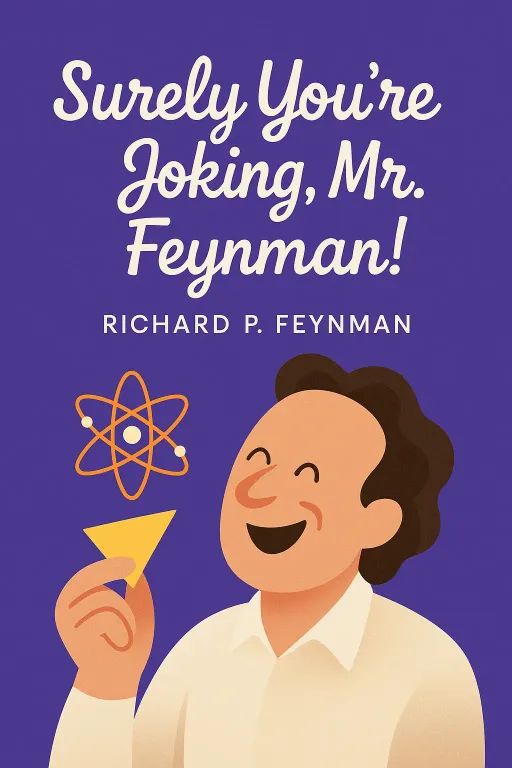
Nova: Exactly! That moment of awkward silence when you realize your "understanding" was more of a polite agreement. And that's precisely the profound insight we're diving into today, inspired by timeless principles exemplified by thinkers like the brilliant physicist Richard Feynman and refined by classic guides to clear communication. It's about how the act of explaining is truly the ultimate test of our own knowledge.
Atlas: So, we're talking about the art of explanation not just for others, but for ourselves? That's fascinating.
Nova: Absolutely. Because the cold, hard fact is: we often we understand something until we try to articulate it to someone else. It's in that moment of attempted explanation that the glaring gaps in our own knowledge are brutally, beautifully revealed.
Deep Dive into Core Topic 1: The Cold Fact & Feynman's Approach
SECTION
Atlas: But why does trying to explain something suddenly expose all these holes? I thought I knew it! Is it just performance anxiety, or is there something deeper going on?
Nova: It’s definitely deeper, Atlas. It’s the difference between surface-level familiarity and deep, conceptual mastery. When you just consume information, you can trick yourself into thinking you know it. You recognize terms, you follow the narrative. But when you have to it, you can't just repeat words. You have to actively recall, synthesize, simplify, and connect ideas. You have to answer the "why" and "how."
Atlas: So it's not just about repeating information, it's about it for someone else? That sounds like a lot more work than just memorizing.
Nova: It is. And that’s where the genius of the "Feynman Technique" comes in. Richard Feynman, Nobel laureate and one of the most brilliant minds of the 20th century, had this incredible approach to learning. He believed in questioning assumptions and building understanding from first principles. He wasn't about rote memorization; he was about dismantling complex ideas and then reassembling them in the simplest possible terms.
Atlas: Give me an example. How did he actually do that?
Nova: Imagine you're trying to understand, say, a complex economic theory. Feynman wouldn't just read the textbook. He'd try to explain it to someone who knew nothing about economics. If he got stuck, if he used jargon, if he felt confused, he knew didn't truly understand it yet. He'd go back to the source material, re-learn it, simplify it further, until he could explain it without any technical terms, in a way a child could grasp.
Atlas: Wow. So, it's like building a house. You can look at a blueprint and think you understand the house. But if you then try to it, or even instruct someone else to build it, you quickly find out if your understanding of the foundation, the plumbing, the wiring, is actually solid.
Nova: Precisely! If you can't explain the foundation to someone, your house of knowledge is going to collapse under the slightest intellectual tremor. Feynman's technique forces you to confront those weak spots. It turns passive learning into active creation. It’s a powerful cognitive process of active recall, synthesis, and ruthless self-assessment.
Deep Dive into Core Topic 2: Tactical Insights & "The Elements of Style"
SECTION
Nova: And this brings us to the tactical side, because it's not just about to explain, but you explain. This is where something seemingly unrelated, like "The Elements of Style" by Strunk and White, becomes incredibly relevant.
Atlas: Wait, "Elements of Style"? That's for writing, right? How does a classic guide to clear writing help me understand quantum physics better, or, you know, explain my new marketing strategy?
Nova: That’s a great question, and it highlights the hidden connection between clarity in writing and clarity in thought. "The Elements of Style" focuses on conciseness, precision, and structuring thoughts for effective communication. To write clearly, you think clearly. If your thoughts are muddled, your writing will be muddled. The same goes for explanation. If you can't articulate an idea with precision and conciseness, it’s a strong signal that your internal understanding is still a bit fuzzy.
Atlas: So, it's like if you can't write it down simply, you probably don't it simply? That makes sense. I’ve definitely experienced that. You think you know something, then you sit down to write an email about it, and suddenly you’re staring at a blank screen, realizing you don't even know where to begin.
Nova: Exactly! And that realization is valuable. It's a prompt to go back and solidify your own understanding. As we say in Aibrary, "Teaching what you've learned forces you to confront your knowledge gaps and solidify your understanding." It's a feedback loop. Think of a student who’s struggling with a math concept. They might read the textbook, watch videos, but it doesn't click. Then, their teacher asks them to explain it to a peer who missed the class. In that act of breaking it down, finding the right words, drawing diagrams, the original student suddenly sees the concept clearly themselves. They're not just recalling; they're the understanding.
Atlas: That’s actually really inspiring. So, the act of trying to make something clear for someone else inherently makes it clearer for you. It’s like a cheat code for learning.
Nova: It really is. It shifts you from being a passive recipient of information to an active architect of knowledge. You're building mental models, not just storing facts.
Synthesis & Takeaways
SECTION
Nova: So, in essence, the art of explanation isn't just a communication skill; it's a powerful learning strategy. It’s about leveraging the very human need to clarify for others as a mechanism to deepen our own cognitive grasp. From Feynman's first principles to the precision demanded by clear writing, the message is consistent: true understanding blossoms when you teach.
Atlas: This is huge for anyone who's constantly trying to learn new things, whether it's a new skill for work, a complex hobby, or just trying to keep up with the world. What's the absolute smallest way someone could start applying this right now? Because it can feel daunting to "teach" something.
Nova: It absolutely can feel daunting. So, here’s your tiny step, and it requires no audience except yourself. Pick a concept you're currently learning—anything, from how a specific app works to the basics of photosynthesis—and try to explain it out loud to an imaginary 10-year-old in simple terms.
Atlas: An imaginary 10-year-old? I love that! No judgment, just pure, unadulterated need for simplicity.
Nova: Exactly! It forces you to strip away jargon, avoid assumptions, and break it down to its most fundamental components. If you find yourself stumbling, or reaching for complex terms, that’s your signal. Go back, re-learn that specific part, and try explaining it again. You’ll be shocked at how quickly it solidifies your understanding. It's a humble yet incredibly powerful path to true mastery.
Atlas: I’ve been there. I thought I understood how my car engine worked, until my nephew asked me how the spark plugs actually. Suddenly, my confident nod turned into a frantic Google search. This makes perfect sense. It’s about being truly honest with yourself about what you know.
Nova: It’s the ultimate intellectual honesty, isn't it? The willingness to admit, "I don't quite get this yet," and then using explanation as your tool to bridge that gap. It's not just about knowing more; it's about truly what you know.
Atlas: That’s a fantastic way to put it. For all our curious learners out there, give that tiny step a try today. You might just surprise yourself with what you truly understand.
Nova: This is Aibrary. Congratulations on your growth!