Beyond Equations: The Unseen Art of Scientific Discovery
Golden Hook & Introduction
SECTION
Nova: What if the very thing we're taught about science—its unwavering precision, its strict adherence to logic—is actually holding us back from its deepest truths?
Atlas: Whoa, that’s a bold claim, Nova. I think many of us, especially those meticulously building their knowledge base, see that precision as the very foundation of scientific integrity. It’s what makes the equations work, right?
Nova: Absolutely, Atlas. Precision is critical. But there's an unseen art to scientific discovery, a vibrant, human element that often gets overshadowed by the rules. It's about how we approach those rules, and sometimes, how we learn to playfully bend or even break them in our pursuit of understanding.
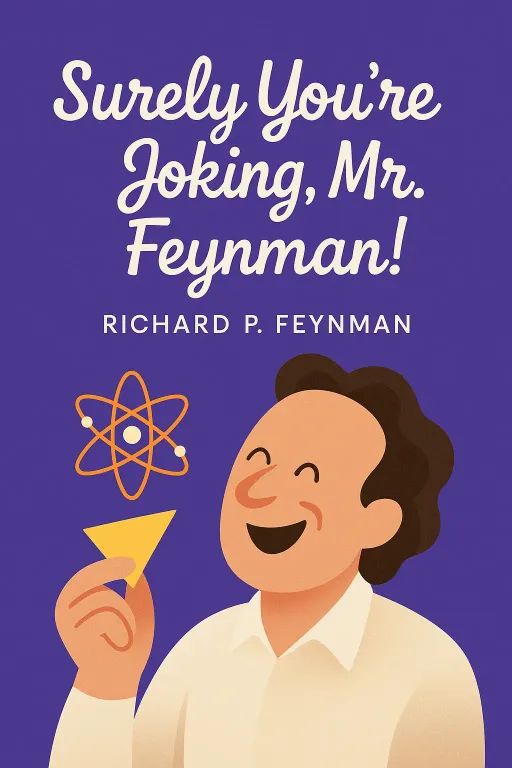
Atlas: Okay, so we’re talking about moving beyond just the mechanics. That makes me wonder about the thinkers who truly embodied this. I'm thinking of two incredible books that really dive into this: "Surely You're Joking, Mr. Feynman!" by Richard Feynman, and "The Structure of Scientific Revolutions" by Thomas S. Kuhn.
Nova: Exactly! And what’s fascinating about Richard Feynman is that here was a Nobel laureate, a titan of physics, yet he was equally famous for his unconventional teaching methods, playing the bongo drums, and approaching complex problems with a childlike wonder. He truly believed in the joy of figuring things out. And then Kuhn, he didn’t just write about science; he fundamentally reshaped how we even about scientific progress, showing it’s not always a straight line.
Atlas: That’s a powerful duo right there. It sounds like we’re about to explore how mastery in science, and really in any complex field, isn't just about accumulating facts.
The Playful Pursuit of Scientific Breakthroughs
SECTION
Nova: You've hit the nail on the head. Let's start with Feynman. His life was a masterclass in what we’re calling "the playful pursuit of scientific breakthroughs." He wasn't just a brilliant mind; he was an independent explorer with an insatiable curiosity that led him to question everything.
Atlas: I can see that. But how does that "playfulness" integrate with, say, the rigorous analytical demands of stoichiometry or the foundational building blocks of organic chemistry? For someone who thrives on breaking down complex ideas with detailed explanations, "playful" might sound almost… undisciplined.
Nova: That’s a great point, and it’s a common misconception. Feynman's playfulness wasn't a lack of discipline; it was a deeper form of engagement. Take his famous anecdote about the wobbling plate. He wasn't trying to solve a grand problem; he was just observing a spinning cafeteria plate, noticing the wobble and the rotation. He started playing with the equations, just for the sheer intellectual fun of it.
Atlas: So he just… watched a plate? And that led somewhere?
Nova: Precisely. That seemingly trivial observation led him to explore the relationship between the wobble and the spin, which, incredibly, he later realized had direct parallels to the behavior of electrons in orbit. This playful, almost recreational exploration of a simple phenomenon unexpectedly unlocked insights into quantum electrodynamics, an area he eventually won a Nobel Prize for. His mind wasn’t constrained by a rigid curriculum; it was driven by pure, unadulterated curiosity. He wasn’t just learning facts; he was the universe.
Atlas: Wow. That gives me chills. That’s such a hopeful way to look at it. It’s like he saw the rules as a playground, not a prison. But how can someone like our listeners, who are foundational builders aiming for mastery, cultivate that "healthy disregard for conventional boundaries" without losing their grip on established knowledge? It sounds like a tightrope walk.
Nova: It absolutely is a tightrope walk, but it’s a necessary one. It’s not about ignoring foundational knowledge; it's about how you that knowledge. Feynman had a deep understanding of physics, but he wasn't afraid to ask "stupid" questions or try unconventional methods. He'd strip problems down to their essence, visualize them in unique ways, or even draw cartoons if that helped him understand. For an analytical architect, it means trusting your inherent ability to break down complex ideas, but then also giving yourself permission to explore those ideas from unconventional angles, to see the connections that aren't immediately obvious in the textbook. It's about seeing the rules as tools for exploration, not rigid confines for your thinking.
Atlas: I like that: "rules as tools for exploration." It reframes the whole idea of rigor. It’s like, once you’ve built the house, you can start playing with the interior design, maybe even add a secret room.
The Revolutionary Nature of Scientific Progress
SECTION
Nova: Exactly! And that naturally leads us to the second key idea we need to talk about, which often acts as a counterpoint to simply adding more knowledge. It’s Thomas Kuhn’s concept of "paradigm shifts" from "The Structure of Scientific Revolutions." He argued that major scientific advancements often arise not from gradual accumulation of facts, but from these seismic intellectual shifts—moments when established frameworks are questioned and overthrown by new, often radical, perspectives.
Atlas: Okay, but for a foundational builder, who strives for a robust knowledge base and solidifying quantitative problem-solving skills, the idea of "overthrowing established frameworks" might sound… disruptive, maybe even counterproductive. Isn’t the goal to build what’s already known, not to shatter it?
Nova: That’s a perfectly valid concern, and it highlights the tension at the heart of true mastery. Kuhn showed us that science isn't just a linear progression. Think about the shift from the Ptolemaic geocentric model to the Copernican heliocentric model. For centuries, the earth was definitively the center of the universe. It was an established paradigm, supported by observations and intricate mathematical models that, to a certain degree, worked.
Atlas: Right, and it made intuitive sense. We like we’re stationary.
Nova: Exactly. But anomalies started to accumulate—planetary movements that were increasingly difficult to explain within the geocentric framework. More and more complex epicycles and deferents were added, making the model incredibly convoluted. It was like trying to patch a leaky boat with increasingly elaborate bandages.
Atlas: So, the data was there, but the of the data was flawed because the fundamental assumption was wrong.
Nova: Precisely. Copernicus didn’t just add new data; he proposed a radically different way of the universe—the sun at the center. This wasn't merely an incremental improvement; it was a complete conceptual overhaul. It challenged deeply held beliefs, both scientific and philosophical, and it wasn't immediately accepted. It was a true revolution, a dismantling of one framework to build an entirely new one that better explained reality. It validated the feeling that true mastery involves challenging existing norms, not just accepting them.
Atlas: Wow, that’s a powerful example. It makes me wonder, though, how does someone in a field like advanced dimensional analysis, or even organic chemistry, identify potential "paradigm shifts" in their own work? How do you know when to question the fundamental assumptions you’ve built your entire knowledge base upon?
Nova: That’s the million-dollar question, isn't it? It requires a blend of rigorous analytical thinking—which you, the analytical architect, already possess—and that independent explorer spirit. It's about cultivating a healthy skepticism, not just towards new ideas, but towards the very foundations you've been taught. It means being acutely aware of the "anomalies," those pieces of data or observations that just don't quite fit the current model. It means daring to ask, "What if we're all looking at this the wrong way?" It's about being open to radical new perspectives, even if they initially seem to contradict everything you “know.”
Atlas: So, it’s not just about solving problems within the existing framework, but sometimes, it’s about questioning the framework itself. That’s a much deeper level of mastery.
Synthesis & Takeaways
SECTION
Nova: Absolutely. What Feynman and Kuhn both show us is that true scientific mastery, and by extension, mastery in any field, isn't a rigid, rule-bound process. It’s a dynamic interplay between deep analytical rigor and a profound sense of curiosity, playfulness, and the courage to challenge established paradigms. The playful spirit of Feynman and the revolutionary mindset Kuhn described are two sides of the same coin, both essential for true innovation.
Atlas: That’s actually really inspiring. For our listeners who are foundational builders and independent explorers, it’s a powerful reminder that their quest for mastery isn't just about accumulating facts. It's about cultivating a mindset. It reminds me of the "healing moment" from the book content: "Recall a moment of pure, unadulterated curiosity from your past. How can you intentionally bring that sense of playful exploration into your current studies?"
Nova: That’s a perfect way to put it, Atlas. Think about what first sparked your interest in your field. Was it a complex formula, or the sheer wonder of how something worked? That initial spark, that pure curiosity, is a powerful engine for deeper understanding. We encourage all our listeners to intentionally seek out those moments of playful exploration, to trust their inherent ability to break down complex ideas, but also to allow themselves the freedom to explore beyond the conventional boundaries.
Atlas: So, it’s about balancing the precision with the play, the structure with the disruption. It’s about being both the architect and the artist of your own knowledge.
Nova: Exactly. Embrace that inner independent explorer. Let that curiosity be your compass.
Atlas: This has been incredibly insightful, Nova. It really shifts the perspective on what "mastery" truly means.
Nova: My pleasure, Atlas. Always a joy to explore these profound ideas with you.
Nova: This is Aibrary. Congratulations on your growth!