

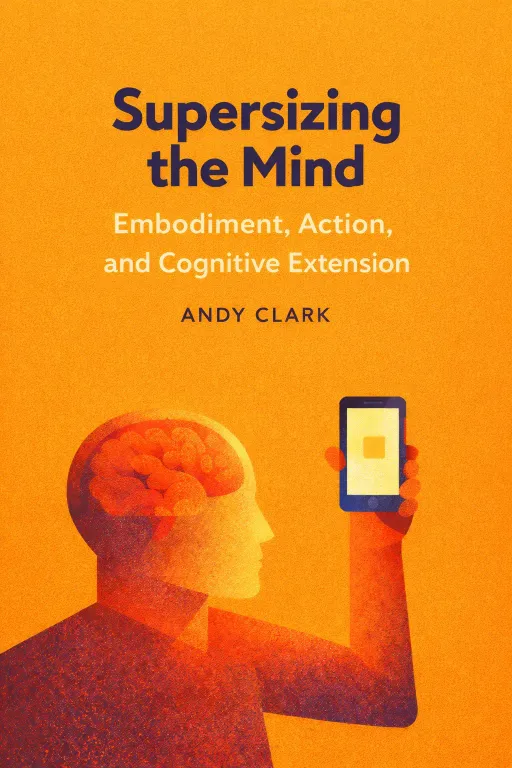
Supersizing the Mind
Embodiment, Action, and Cognitive Extension
Introduction
Nova: Think about the last time you felt that sudden, cold spike of panic because you could not find your phone. It is not just about the cost of the device, is it? It feels like you have lost a limb, or maybe even a piece of your memory.
Atlas: It is definitely more than just losing a gadget. I feel like I lose my ability to navigate, my schedule, and half my contacts. It is like my brain just stops working properly without it.
Nova: Well, according to philosopher Andy Clark in his groundbreaking book Supersizing the Mind, that feeling is not just an exaggeration. He argues that your phone, your notebook, and even the way you use your environment are not just tools for your mind. They are actually part of your mind.
Atlas: Wait, so you are saying my mind is not just trapped inside my skull? That it is actually leaking out into the world?
Nova: Exactly. Clark calls this the Extended Mind Thesis. Today, we are diving into how we have been supersizing our cognitive abilities for centuries and what it means for the future of being human.
Key Insight 1
The Parity Principle
Nova: To understand Clark's argument, we have to start with something called the Parity Principle. It is a simple but radical idea he developed with David Chalmers back in the late nineties.
Atlas: Okay, I am ready. What is the principle?
Nova: It says that if a process in the world functions in a way that we would call cognitive if it happened inside the head, then that part of the world is part of the mind. Period.
Atlas: That sounds like a very low bar. Give me an example because I am struggling to see how a piece of paper is the same as a neuron.
Nova: Clark uses the famous story of Otto and Inga. Inga wants to go to the museum. She thinks for a second, remembers it is on 53rd Street, and goes there. That is biological memory, right?
Atlas: Right. Standard brain stuff.
Nova: Now meet Otto. Otto has Alzheimer's, so he carries a notebook everywhere. When he wants to go to the museum, he looks it up in his notebook, sees it is on 53rd Street, and goes there. Clark argues that for Otto, the notebook plays the exact same functional role that biological memory plays for Inga.
Atlas: But Inga's memory is always with her. Otto has to physically open a book. Is that really the same?
Nova: Clark says yes, as long as the resource is reliably available, easily accessible, and automatically trusted. If Otto always has that book, it is his memory. If you take it away, you are not just taking a tool; you are effectively giving him a lobotomy.
Atlas: That is a heavy way to put it. So, the medium doesn't matter? Whether it is neurons or paper, if it does the job of thinking, it is the mind?
Key Insight 2
Thinking by Doing
Nova: It goes deeper than just storage, though. Clark talks about how we use the world to actually perform calculations. Have you ever played Tetris?
Atlas: Too many hours of my life, honestly. Why?
Nova: Think about how you play. Do you sit there, look at the falling block, and mentally rotate it three hundred and sixty degrees before moving it?
Atlas: No way. I am tapping the button as fast as I can to see how it fits. It is much faster to just see it happen on the screen.
Nova: That is exactly what researchers David Kirsh and Paul Maglio found. They called these epistemic actions. We are not just acting to move the world; we are acting to help us think. By rotating the block on the screen, you are using the computer to do the mental rotation for you.
Atlas: So the computer screen becomes a sort of external workspace for my brain?
Nova: Precisely. Clark argues that we are natural-born cyborgs. We have always been looking for ways to offload difficult mental tasks onto our environment. Whether it is using your fingers to count or using a complex spreadsheet to manage a budget, we are constantly supersizing our processing power.
Atlas: It makes sense. I definitely think better when I am sketching on a whiteboard than when I am just staring at a wall. The whiteboard feels like it is holding the ideas so my brain can focus on connecting them.
Nova: That is what Clark calls scaffolding. We build these cognitive niches—environments filled with tools and labels that make us smarter than we could ever be in a vacuum.
Key Insight 3
The Bloated Mind Objection
Atlas: I can hear the skeptics already, Nova. If my notebook is my mind, and the Tetris screen is my mind, where does it stop? Is the entire internet my mind? Is the library my mind?
Nova: You have hit on the biggest criticism of the book, often called the Bloated Mind objection. Philosophers like Fred Adams and Ken Aizawa argue that Clark is committing the coupling-constitution fallacy.
Atlas: That is a mouthful. What does it mean in plain English?
Nova: It means just because something is coupled to a process doesn't mean it constitutes that process. A plumber is coupled to his wrench, but the wrench isn't part of the plumber. They argue that there is a mark of the cognitive—something special about how neurons work that paper and silicon just don't have.
Atlas: Like what? What makes a neuron so special?
Nova: They point to things like intrinsic content. Your thoughts have meaning to you automatically. The words in Otto's notebook only have meaning because a brain reads them. Without the brain, the notebook is just dead ink.
Atlas: That feels like a strong point. If there is no one to read the notebook, the notebook isn't thinking.
Nova: Clark's rebuttal is that we shouldn't care about the internal mechanics as much as the results. He argues that if we insist the mind must be biological, we are just being bio-chauvinistic. If an alien came to Earth with a silicon brain, we wouldn't say it doesn't have a mind just because it lacks neurons, right?
Atlas: Fair point. But I still feel like there is a line somewhere. If I use Google to find a fact, did I know that fact, or did I just find it?
Nova: Clark would say that if the access is seamless enough, the distinction starts to vanish. We are moving toward a world where the boundary between knowing and finding is incredibly blurry.
Key Insight 4
The Plasticity of the Self
Nova: One of the most fascinating parts of Supersizing the Mind is how Clark discusses our brain's plasticity. Our brains are literally wired to incorporate tools into our body schema.
Atlas: I have heard about this with monkeys and rakes, right? If a monkey uses a rake long enough, its brain starts treating the rake like an extension of its arm.
Nova: Exactly! And humans are the masters of this. When you drive a car, you don't think about the wheels as separate objects; you feel the road through the car. Your sense of self expands to include the vehicle.
Atlas: So, if our brains are this flexible, then the Extended Mind isn't just a philosophical theory. It is a biological reality of how we evolved.
Nova: That is Clark's core message. We didn't evolve to be smart in isolation. We evolved to be the ultimate tool-users. Our greatest strength is our ability to outsource our thinking to language, to culture, and now to digital technology.
Atlas: It really changes how you think about things like education or even disability. If a student uses a calculator, they aren't cheating; they are using a cognitive extension. If someone loses their phone, they might actually be experiencing a temporary cognitive impairment.
Nova: It even has legal implications. If your smartphone is literally part of your mind, does the police searching it without a warrant count as a search of your person, or even your thoughts? Clark's work forces us to rethink the very boundaries of the individual.
Conclusion
Nova: We have covered a lot today, from Otto's notebook to the high-speed world of Tetris. The big takeaway from Andy Clark is that we are not just brains in vats or spirits in machines. We are embodied, active agents who use the whole world as our canvas for thinking.
Atlas: It is a bit humbling, honestly. To realize that so much of what I call my intelligence actually lives in my pocket or on my bookshelf. But it is also empowering. It means we can literally design ourselves to be smarter by designing better environments.
Nova: That is the beauty of supersizing the mind. We are not limited by our biology. We are limited only by our tools and our imagination. By understanding how we extend ourselves, we can be more intentional about the digital and physical scaffolds we build for our lives.
Atlas: I think I am going to go organize my notebook now. Or maybe just appreciate my phone a little more for the brain-part it is.
Nova: Just don't drop it in the sink. That would be a very literal brain drain. Thank you for joining us on this deep dive into the philosophy of the extended mind.
Atlas: This is Aibrary. Congratulations on your growth!