

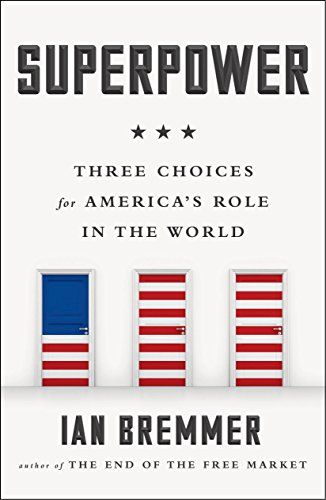
Superpower
Three Choices for America's Role in the World
Introduction
Nova: Picture this. It's 2015. The United States is the most powerful nation on Earth. It spends more on its military than the next seven countries combined. It has bases in over 70 countries. It leads the world's most important alliances. And yet, if I asked you what America's foreign policy actually is, what its grand strategy is, could you give me a clear answer?
Nova: Exactly. And that's precisely the problem Ian Bremmer tackles in his 2015 book Superpower: Three Choices for America's Role in the World. Bremmer, who's the founder and president of the Eurasia Group, the world's largest political risk consultancy, argues that since the end of the Cold War, American foreign policy has been fundamentally incoherent. It's been directionless, reactive, and as a result, it's become prohibitively expensive and increasingly dangerous.
Nova: That's what makes this book special. Bremmer doesn't just diagnose the problem. He lays out three distinct paths America can take, and he asks the reader, the American electorate, to choose. He even opens the book with a ten-question quiz so you can figure out where you stand before you dive in. By the end, he reveals his own choice too. It's part self-help for voters, part foreign policy manifesto.
How America Lost Its Foreign Policy Compass
The Crisis of Incoherence
Nova: Let's rewind to understand what Bremmer means by incoherence. He argues that during the Cold War, the United States had a crystal-clear foreign policy. Contain the Soviet Union. Every decision, every alliance, every military deployment was measured against that single organizing principle.
Nova: Exactly. But when the Berlin Wall fell in 1989, that framework vanished overnight. And Bremmer argues that no president since has replaced it with anything coherent. He walks through the failures of Clinton, Bush, and Obama. Clinton stumbled in Somalia, then pulled out so hastily after the Black Hawk Down incident that it emboldened groups like al Qaeda. Bush launched the enormously costly global war on terror, nation-building in Iraq and Afghanistan at staggering expense. Obama had what Bremmer calls a sound strategic instinct, but events kept overtaking him: the Arab Spring, Russia's aggression in Crimea, the rise of ISIS.
Nova: Precisely. And Bremmer's point is that this isn't just an academic complaint. Incoherence has real costs. When allies don't know what America will or won't do, they hedge their bets. When adversaries can't predict American responses, they probe and test boundaries. The world becomes more dangerous for everyone.
Nova: Yes. Bremmer argues that ordinary Americans too often base their foreign policy preferences on allegiance or opposition to whichever party holds the White House, rather than on a consistent set of principles. We're reactive voters. And we consistently elect presidents who promise to focus on domestic issues, only to see them consumed by international crises they weren't prepared for.
Independent, Moneyball, and Indispensable America
Three Paths Forward
Nova: That's a perfect analogy. So what does Bremmer propose? Three distinct strategic frameworks. The first is Independent America. The core idea is that America should declare independence from international burdens. Stop being the world's policeman. Stop trying to solve everyone else's problems. Instead, lead by example by rebuilding America from within.
Nova: Bremmer is careful to distinguish Independent America from isolationism. He frames it more like what Eisenhower talked about in his Chance for Peace speech. The argument is that America would actually have more influence globally if it focused on fixing its own problems: crumbling infrastructure, underfunded education, veterans' care. Show the world what a functioning democracy looks like rather than trying to impose it abroad. Independent America would still trade globally. It would still engage diplomatically. But it would dramatically reduce its military footprint and stop nation-building.
Nova: Moneyball America. And this is where Bremmer gets clever with his naming. If you've seen the movie or read the book Moneyball, you know it's about Billy Beane using data analytics to build a winning baseball team on a budget. Bremmer applies that mindset to foreign policy. Moneyball America is about maximizing America's value, not its values.
Nova: It is. And Bremmer is upfront about that. Moneyball America means every foreign engagement gets a cold-blooded cost-benefit analysis. Does this serve American interests? What's the return on taxpayer investment? It would use the Powell Doctrine as a checklist for military action: is there a clear objective, overwhelming force, an exit strategy? It would rely heavily on drones, on burden-sharing with allies, on economic tools like sanctions and trade deals. And crucially, it would be willing to negotiate with anyone, including adversaries, if it serves American interests.
Nova: Exactly. Then there's Indispensable America. This is the argument most Americans will recognize because it has dominated political rhetoric since World War II. Only America has the resources, the values, and the global reach to defend freedom and democracy worldwide. In an interdependent, hyper-connected world, turning inward would undermine America's own security. Indispensable America means maintaining military dominance, aggressively promoting free markets and democratic institutions, and being the guarantor of global stability.
Nova: By far. But the argument is that the cost of not doing it, of allowing a vacuum that gets filled by authoritarian powers, is even higher. It's the most ambitious, the most idealistic, and frankly, the most traditionally American of the three. Bremmer notes it's what American presidents almost always say they believe, even when their actions don't match.
Why Question Mark America Is the Worst Option
The Danger of Doing Nothing
Nova: And here's where Bremmer makes his most urgent argument. He says the worst possible choice is no choice at all. He calls this Question Mark America. It's what we have right now: a foreign policy that tries to be all three things at once, inconsistently, depending on the crisis of the moment.
Nova: Bremmer would say that's exactly what we've been doing for twenty-five years, and it's not working. He quotes something often attributed to Theodore Roosevelt: In any moment of decision, the best thing you can do is the right thing, the next best thing is the wrong thing, and the worst thing you can do is nothing.
Nova: The logic is that even a wrong decision creates clarity. Allies and adversaries can adjust. Lessons get learned. But perpetual ambiguity, constantly sending mixed signals, that creates maximum uncertainty. And in geopolitics, uncertainty is dangerous. It invites miscalculation. Think about Obama's red line on chemical weapons in Syria. He drew a line, then didn't enforce it. That didn't just fail to deter Assad, it sent a message to Putin, to China, to North Korea, that American threats might be empty.
Nova: That's exactly it. He argues that regardless of which of the three options America chooses, the world will be more stable simply because American intentions will be predictable. Allies can plan. Markets can price in risk. Adversaries know the boundaries. The current fog of incoherence benefits no one.
Nova: That's a great way to put it. And Bremmer extends this to the American electorate. He believes that ultimately, in a democracy, foreign policy reflects what the public supports. The problem is, the public hasn't been asked to think seriously about what it wants. Politicians don't campaign on coherent foreign policy visions because it's complicated and doesn't fit in thirty-second ads.
Why the Author Chooses Independent America
Bremmer Reveals His Hand
Nova: Right. And this is where the book takes a really interesting turn. Throughout the first two-thirds, Bremmer plays it remarkably straight. He makes the strongest possible case for each of the three options. Readers have said they genuinely couldn't tell where he stood.
Nova: Exactly. But in the final section, Bremmer reveals he's Team Independent America. And his reasoning is fascinating. He rules out Indispensable America first. His argument is blunt: America cannot play the same role in 2020 that it played in 1945, 1970, or even 1990. The world has changed. America's relative power has diminished. The American public no longer has the appetite for sustained global engagement. And much of the world doesn't actually want American leadership.
Nova: Bremmer rejects Moneyball for a different reason. Not because it wouldn't work technically, but because he doesn't believe Americans would ever truly embrace it. Moneyball requires a cold-blooded realpolitik that American political culture has never tolerated for long. Americans, Bremmer argues, want their country to stand for something. We have a deep streak of exceptionalism. A purely transactional foreign policy would feel morally empty to most voters, and they'd eventually rebel against it.
Nova: That's Bremmer's pitch. He believes Independent America actually honors American values more authentically than Indispensable America, because it focuses on perfecting democracy at home rather than exporting it at gunpoint. And he's careful to note this isn't a flip of a switch. America would need to transition slowly, giving allies like Germany and Japan time to build up their own defense capabilities. Trade would remain essential. It's a recalibration, not a retreat.
Nova: Good question. One Foreign Affairs review pointed out that Bremmer would need to demonstrate more persuasively that American non-involvement wouldn't lead to another global crisis comparable to the world wars or the Cold War. After all, that's what many Americans thought in the 1930s too. Other reviewers noted the book is more of a thought experiment than a deeply researched academic work. And some argued the three-category framework is too simplistic to capture the nuance of real foreign policy.
Conclusion
Nova: And that might be exactly what Bremmer intended. At its heart, Superpower isn't a book that demands you agree with Ian Bremmer. It's a book that demands you think seriously about what kind of country you want America to be in the world. It's a conversation starter, designed for an election season when voters should be asking hard questions of their candidates.
Nova: That's the core insight. Decisiveness itself has value in international relations. Clarity reduces miscalculation. And Bremmer's challenge to the American electorate remains as relevant today as it was in 2015: stop outsourcing your foreign policy thinking to whichever party you happen to support. Do the work. Figure out where you stand. Then demand that your leaders articulate and follow a coherent strategy.
Nova: Which is both a blessing and a warning. The luxury of indecision, Bremmer argues, is running out. The world is more volatile than ever, caught in what Bremmer famously calls the G-Zero world, a power vacuum where no single country or alliance can drive a global agenda. In that environment, a directionless superpower is a danger to itself and everyone else. So the question isn't whether America should have a strategy. It's which strategy it should be. Independent. Moneyball. Indispensable. Pick one. But pick.
Nova: Same here. And that's exactly the point of the book.
Nova: This is Aibrary. Congratulations on your growth!