

The Alpha Signal: Decoding Superforecasting for Market Dominance
Golden Hook & Introduction
SECTION
Socrates: John, every trader knows the feeling. You've done the research, the charts align, the narrative is perfect. You're not just confident, you're. This trade is a sure thing. And then, the market rips in the opposite direction, and your account takes a devastating hit. Is that a familiar pain?
John: Painfully familiar. It's a humbling experience that the market delivers regularly. It makes you question everything you thought you knew.
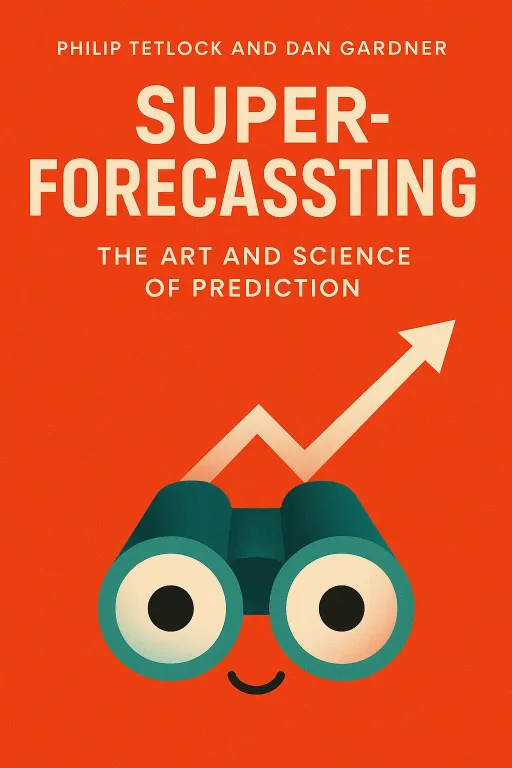
Socrates: Exactly. And what if that wasn't just bad luck? What if it was a flaw in the very of how we predict? That's the core question in Philip Tetlock's groundbreaking book,. It argues that forecasting isn't some mystical gift, but a skill we can measure and tangibly improve.
John: A skill you can improve... That's the holy grail in my world. Any repeatable edge is.
Socrates: Precisely. And today we'll explore how to gain a real edge in a world of uncertainty, looking at it from two powerful angles from the book. First, we'll uncover the critical difference between two types of thinkers—the 'Hedgehog' and the 'Fox'—and why one consistently fails in forecasting.
John: Hedgehog and the fox... I'm intrigued.
Socrates: Then, we'll dive into a practical tool used by intelligence agencies that can revolutionize how you measure your own predictive skill, moving beyond simple wins and losses. It’s about knowing you were right or wrong.
John: Okay, that sounds incredibly useful. Let's get into it.
Deep Dive into Core Topic 1: The Hedgehog and the Fox
SECTION
Socrates: So John, in trading, we often hear about people with a 'grand theory' of the market, right? The person who is all-in on tech, or the one who believes gold is the only real asset. Tetlock has a name for this kind of thinker, borrowed from the philosopher Isaiah Berlin. He calls them 'Hedgehogs.'
John: Hedgehogs. Why hedgehogs?
Socrates: Because the hedgehog knows one big thing. They view the entire complex world through the lens of a single, powerful, organizing principle. Everything that happens either confirms their big idea or is an irrelevant anomaly. They are confident, clear, and often very persuasive.
John: I know dozens of these people. They're the permabulls or the permabears. They have one story—'The Fed is printing money, so the market must go up,' or 'Debt is too high, so a crash is inevitable.' They stick to that story no matter what the market is actually doing.
Socrates: And that's the danger. The book is filled with examples of how this hedgehog-like conviction leads to disastrous forecasts. There's a fantastic, almost tragic, story about the economist and pundit Larry Kudlow. He was a passionate advocate for supply-side economics—the 'one big thing' for him was that tax cuts always lead to economic booms.
John: A classic hedgehog theory.
Socrates: Exactly. So when President George W. Bush enacted major tax cuts in the early 2000s, Kudlow was certain a massive boom would follow. He dubbed it "the Bush boom." But the data was lukewarm. Growth was okay, but not spectacular. Yet, year after year, Kudlow insisted the boom was happening, calling it "the biggest story never told."
John: He was in love with his own narrative.
Socrates: Completely. It gets worse. In December 2007, as the first tremors of the great financial crisis were being felt, Kudlow went on record and wrote, "There is no recession. In fact, we are about to enter the seventh consecutive year of the Bush boom." We all know what happened next. His one big idea made him blind to the overwhelming evidence of a collapsing economy.
John: Wow. That's a catastrophic failure of analysis. And it's so relatable. In the market, we call that 'confirmation bias' on steroids. You have a thesis, your 'big idea' for a stock, and you only seek out news that confirms it. You ignore the bad earnings report, the new competitor, the changing macro environment. You hold on, averaging down, because your story to be right. The hedgehog gets wiped out.
Socrates: So what's the alternative? Tetlock champions the 'Fox.' The fox knows many little things. They are intellectually nimble, skeptical of grand theories, and comfortable with complexity and nuance. They'll borrow ideas from different disciplines, stitch them together, and are perfectly willing to abandon a model if the data proves it wrong.
John: That sounds like a survivor. In trading, that's the pragmatist. A fox-like trader isn't ideologically committed to being a 'value' or 'growth' investor. They'll use whatever works. They might look at technical chart patterns, but they'll also read the company's 10-K. They'll check sentiment on social media, but they'll also look at options flow. They aren't trying to prove one big theory right; they're trying to get the next trade right.
Socrates: And they're not afraid to say "I was wrong"?
John: Not at all. For a fox, being wrong and cutting a losing trade quickly is a sign of strength. It means your process is working. You've identified new information and adapted. The hedgehog holds a losing trade to zero because his ego is tied to his 'big idea.' The fox takes a small loss and lives to trade another day. It's a completely different mindset.
Socrates: It's a mindset of survival over certainty. And that idea of pragmatism and survival is the perfect bridge to our second topic. It's not enough to just be flexible; you have to know your flexibility is actually working. This brings us to the thorny problem of keeping score.
Deep Dive into Core Topic 2: Beyond P&L
SECTION
John: Right. For a trader, the ultimate score is your P&L—your profit and loss. It's brutally honest.
Socrates: It is. But does it tell the whole story? Could you make a trade for all the wrong reasons and get lucky? Or make a brilliant trade and get unlucky?
John: All the time. That's the core dilemma of trading. You can buy a stock based on a rumor, with no real analysis, and a surprise buyout offer sends it soaring. You feel like a genius, but you were just lucky. Conversely, you can do weeks of deep research, build a solid thesis, and then a random geopolitical event tanks the entire market. Your process was good, but your outcome was bad. The P&L doesn't distinguish between skill and luck.
Socrates: And that is precisely the problem the book tackles. If you can't distinguish skill from luck, you can't reliably improve. Tetlock tells a fantastic story from the early days of the CIA. An analyst named Sherman Kent was on a team trying to forecast the likelihood of a Soviet invasion of Yugoslavia. Their official report concluded an invasion was a "serious possibility."
John: Okay, sounds important. But what does "serious possibility" actually mean?
Socrates: That's the million-dollar question! A senior official asked Kent the same thing. Kent, being a good fox, was bothered by the ambiguity. So he went back and polled his own team of analysts. What he found was shocking. To some, "serious possibility" meant a 20% chance. To others, it meant an 80% chance. The forecast was effectively meaningless.
John: It's just noise. You can't make a decision based on that. It's like a stock analyst saying a company has "upside potential." It means nothing without numbers.
Socrates: Precisely. So the solution, Kent and later Tetlock argued, is to force ourselves to use numbers. To attach a probability to every forecast. And once you have a number, you can score it. The book introduces a tool called the Brier score. It's a simple way to measure the accuracy of a probabilistic forecast. A score of 0 is a perfect score—you assigned 100% to something that happened. A score of 0.5 is the same as random guessing, like flipping a coin.
John: Hold on. So... you're not just scoring the outcome, you're scoring how well-calibrated your confidence was.
Socrates: You've hit the nail on the head. It's about measuring the quality of the judgment itself. Over hundreds of forecasts, you can see if you're a good forecaster. When you say you're 70% sure of something, does it happen about 70% of the time? Or are you, like most people, wildly overconfident?
John: This is... a complete game-changer. I've spent my entire career tracking my P&L. It tells me happened. It doesn't tell me. I could be on a winning streak purely due to a bull market, not because my forecasting skill has improved. My P&L is the outcome, but this Brier score... it feels like it's measuring the quality of the itself.
Socrates: So how could you, as a trader, practically use this?
John: You'd have to start a dedicated journal. Before every trade, you'd write a clear, probabilistic forecast. Not just 'I think Apple will go up.' But something like, 'I believe there is a 70% probability that Apple's stock will close above $175 by this Friday's expiration.' Then, after the event, you go back and calculate your Brier score for that prediction.
Socrates: And over time?
John: Over hundreds of trades, a pattern would emerge. You'd get a brutally honest look at your own mind. Am I systematically overconfident in my short-term calls? Am I underestimating tail risk? It's like building a personal analytics engine for your own brain. It separates the signal of your skill from the noise of market luck.
Synthesis & Takeaways
SECTION
Socrates: That's a powerful way to put it. And it really synthesizes the two big ideas we've discussed from. First, to survive and thrive, you must abandon the single 'big idea' of the hedgehog for the adaptable, multi-tool approach of the fox.
John: You have to be willing to be wrong, and change your mind fast.
Socrates: And second, to actually improve, you have to move beyond just tracking outcomes—your P&L—and start rigorously tracking the quality of your predictions with probabilistic scoring. You need to know if you're good or just lucky.
John: It's about building a process, not just chasing results. A good process will eventually lead to good results, but good results can happen randomly without a good process.
Socrates: So, if you were to give one piece of actionable advice to our listeners, especially those who operate in high-stakes, uncertain environments like you do, what would it be?
John: I'd say this: for one week, try it. For every major decision or trade you consider, write down a probabilistic forecast. Don't just say 'I think this project will succeed.' Write down, 'I believe there is a 65% chance this project will hit its Q3 target.' Don't worry about the money or the outcome for a moment. Just make the forecast, and after the fact, go back and score it. You will learn more about your own thinking, your own biases, and your own blind spots in that one week than you might in a year of just watching the results roll in. It's the first step to becoming a superforecaster in your own field.
Socrates: A powerful challenge. Be a fox, and keep score. John, this has been incredibly insightful. Thank you.
John: My pleasure. A lot to think about.









