

The Unseen Force: How Data Analytics Drives Strategic Innovation.
Golden Hook & Introduction
SECTION
Nova: What if your gut instinct, the very thing you've leaned on for every big strategic decision, is actually your biggest blind spot?
Atlas: Whoa, Nova. That's a bold claim right out of the gate. Are you telling me my finely-tuned intuition, honed over years, is potentially sabotaging me? That sounds a bit out there.
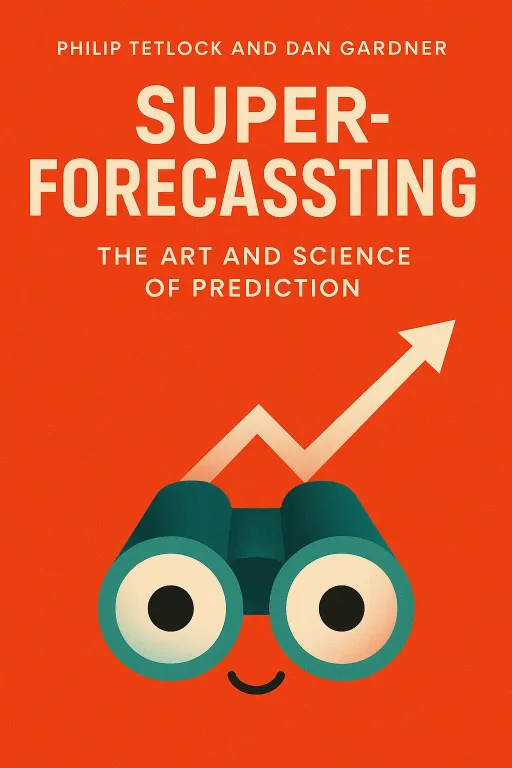
Nova: Well, Atlas, it's less about sabotaging and more about simply not being the tool in your strategic innovation arsenal. Today, we're diving into a fascinating realm, heavily influenced by the groundbreaking work of Philip E. Tetlock and Dan Gardner in their book,.
Atlas: Ah, Tetlock. I remember hearing about his work. Didn't he famously prove that many so-called political experts were no better than chance at predicting future events? That’s a pretty humbling thought for anyone who prides themselves on foresight.
Nova: Exactly! Tetlock's initial research was a seismic event in the world of forecasting. He essentially showed that the average expert, the pundit on TV, was often no more accurate than a dart-throwing chimpanzee. But what he discovered, and what reveals, is a small group of individuals consistently beat the odds. It's not magic; it's a systematic approach. And that, my friend, is where strategic innovation truly begins to shift from a leap of faith to an informed journey.
From Intuition to Informed Foresight: The Superforecasting Edge
SECTION
Atlas: Okay, so if my gut isn't the North Star, what is? For a strategic innovator, the stakes are incredibly high. We need to project confidence, make big bets. How do you embrace uncertainty while still making decisive moves?
Nova: That’s the paradox, isn't it? The superforecasters aren't fearless; they're just better at managing and understanding risk. They operate on a few core principles. First, they think probabilistically. Instead of saying, "This will happen," they say, "There's a 70% chance this will happen, and here's why." It’s a subtle but profound shift.
Atlas: So you're saying it’s about quantifying your hunches? Like, putting a numerical value on a gut feeling? That sounds like a lot of work when you're trying to move fast.
Nova: It is work, but it pays off. Think of it like this: instead of relying on a single, strong intuition, they break down complex problems into smaller, testable components. They actively seek out information that their initial hypothesis, not just confirms it. They're constantly updating their probabilities as new data comes in. It’s a continuous feedback loop.
Atlas: That makes me wonder, how does this translate to someone trying to predict, say, the next big market trend or a competitor's move? Because in business, it feels like everyone's just trying to out-guess each other.
Nova: Precisely. A superforecasting approach in strategic innovation would look like this: instead of announcing "Our next product will be X because I feel it in my bones," you'd say, "Based on these market signals, customer feedback, and competitor analysis, there's a 65% chance product X will succeed if we launch it by Q3, and here's our contingency for the other 35%." It’s about building a robust, flexible strategy rather than a rigid prediction. They embrace the fact that the future is inherently uncertain, but you can get at estimating its contours.
Atlas: I can definitely relate to the pressure of having to be "right." But this sounds like it's about being "less wrong" more often, which is actually a much more powerful position for a strategic leader. It's like a scientific method for decision-making.
Nova: Exactly! And the beauty of it is that it's a skill that can be cultivated. It’s not about innate genius, but about systematic thinking, intellectual humility, and a relentless pursuit of better information. This ability to continuously update your worldview based on evidence is crucial for navigating complexity, and it helps you avoid those costly mistakes that come from relying solely on intuition.
Unmasking the Unseen: Data Analytics and Hidden Incentives
SECTION
Nova: Now, while superforecasting helps us predict what happen, we also need to understand things happen. And that naturally leads us to the second key idea we need to talk about, which often acts as a counterpoint to what we just discussed, uncovering the hidden truths that even superforecasters need to factor in.
Atlas: You mean, getting past the surface-level explanations to what's really driving behavior? Because in the innovation space, we often assume we know what customers want, but the data often tells a different story.
Nova: Absolutely. This is where by Steven D. Levitt and Stephen J. Dubner comes in. They brilliantly demonstrate how data analytics can uncover hidden incentives and counter-intuitive truths that completely upend our assumptions. They show that understanding data deeply can reveal the real drivers behind human behavior and market trends.
Atlas: So you're saying, like, if you want to understand why people are doing something, follow the incentives? Even if those incentives are hidden or unspoken?
Nova: Precisely. Take their famous example of the drop in crime rates in the US during the 1990s. Conventional wisdom pointed to innovative policing strategies or a booming economy. But Levitt and Dubner, by meticulously analyzing data, posited a controversial, counter-intuitive explanation: the legalization of abortion twenty years prior. They argued that fewer unwanted children, who statistically were more likely to grow up in poverty and commit crimes, led to a significant reduction in crime two decades later.
Atlas: Wow, that’s kind of heartbreaking, but also incredibly insightful. It's a perfect example of how the obvious answer isn't always the right one, and how data can reveal a deeply uncomfortable truth. How does a strategic innovator apply that kind of thinking?
Nova: It means constantly questioning your assumptions about what motivates your customers, your employees, even your competitors. For example, you might assume your sales team is motivated by quarterly bonuses. But if you analyze their data closely, you might find that the real motivator is peer recognition, or the opportunity to work on innovative new projects, and the bonuses are just a hygiene factor.
Atlas: That gives me chills. So, what data point are we currently overlooking that could significantly alter our next strategic decision? That’s the deep question, isn't it? It's about finding those hidden levers.
Nova: Exactly! Or consider the example of sumo wrestlers. The data showed that wrestlers on the cusp of an important promotion, when paired with an opponent who had already secured their position, won an unusually high percentage of their matches. On paper, it looked like sheer grit. But the data, when meticulously analyzed, suggested that the already-secure wrestlers were implicitly allowing their opponents to win, due to a complex web of social and financial incentives within the sumo world.
Atlas: That’s a fascinating insight into human nature, and how incentives can skew outcomes in unexpected ways. It highlights the need for a truly objective, data-driven lens, especially when you're trying to foster potential and drive meaningful outcomes, not just surface-level results. It’s about building futures, not just products.
Synthesis & Takeaways
SECTION
Nova: So, bringing these two powerful ideas together – the systematic, probabilistic thinking of superforecasting and the data-driven incentive analysis of Freakonomics – we get a formidable toolkit for strategic innovation. It's about moving beyond that initial blind spot of intuition, and actively seeking out the unseen forces.
Atlas: I guess that makes sense. It’s about not just predicting might happen, but understanding it happens, and then using that insight to shape your strategy. It empowers you to be proactive, to really dig in and find those crucial data points you might be overlooking in your next strategic decision.
Nova: Precisely. It allows you to build a strategy that isn't just a guess, but a rigorously tested, continuously updated, and deeply informed prediction of the future. You're not just making a leap; you're building a bridge, brick by data-driven brick. It’s a mindset shift that allows strategic innovators to navigate complexity with far greater precision and impact.
Atlas: That’s actually really inspiring. For anyone navigating the complexities of strategic innovation, constantly trying to balance ambition with fostering potential, this framework offers a powerful way to ensure your efforts are truly impactful.
Nova: We'd love to hear from our listeners: What's one data point you've recently uncovered that completely shifted your perspective, or what's a hidden incentive you suspect is at play in your industry? Share your insights with us on social media; we're always eager to engage with the Aibrary community.
Atlas: This is Aibrary. Congratulations on your growth!









