

The Simulation Trap: Why Your Models Need Real-World Feedback.
Golden Hook & Introduction
SECTION
Nova: Atlas, rapid-fire. 'Forecast.'
Atlas: Crystal ball. Usually cloudy.
Nova: 'Model.'
Atlas: Spreadsheet delusion. Or, you know, the opposite of reality.
Nova: 'Reality.'
Atlas: Ouch. Definitely ouch.
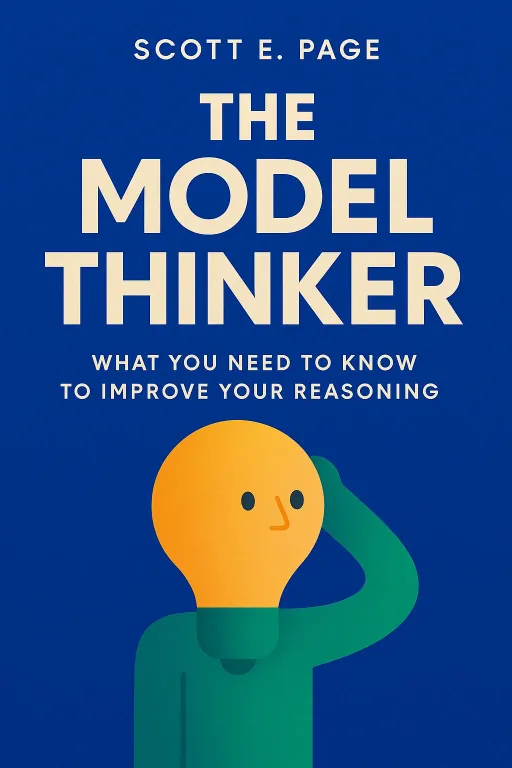
Nova: And that 'ouch' is exactly what we're talking about today on Aibrary as we dive into "The Simulation Trap: Why Your Models Need Real-World Feedback." We’re pulling insights from two profound books: "The Model Thinker" by Scott E. Page and "Superforecasting: The Art and Science of Prediction" by Philip Tetlock and Dan Gardner.
Atlas: Whoa, those are some heavy hitters. What makes them so critical for understanding this 'simulation trap'?
Nova: Well, Scott Page, for instance, is this incredible polymath – an economist, political scientist, and complexity theorist all rolled into one. He pioneered this interdisciplinary approach to show how different, even simple, models can collectively outperform single, more complex ones. And Philip Tetlock? He's a renowned political psychologist who spent decades researching expert predictions, famously finding that most experts were no better than chance. That research led him to identify what makes 'superforecasters' so effective. Both, from entirely different fields, converged on the absolute necessity of integrating real-world feedback.
Atlas: That’s fascinating. So, it's not just some abstract academic theory. These are people trying to figure out why smart people make bad predictions.
The Inherent Flaw of Models & The "Simulation Trap"
SECTION
Nova: Precisely. And it boils down to what we call "The Cold Fact." Complex systems rarely behave as perfectly as our theoretical models suggest. Relying solely on elegant equations without real-world feedback can lead to fundamentally flawed decisions.
Atlas: But wait, how can we make strategic decisions without models? Aren't they supposed to simplify things, reduce complexity so we can actually something?
Nova: That’s the seductive part, isn't it? Models are indeed powerful tools for understanding. Scott Page makes that clear. But here’s the crucial part: they are maps, not the territory. They are abstractions, simplified representations of a far messier reality. The danger, the "simulation trap," comes when we forget that distinction and start treating the map as gospel.
Atlas: So, we build these beautiful, intricate maps, and then we assume the terrain will just conform to them?
Nova: Exactly! Imagine a company pouring millions into developing a new product, based purely on an internal market model. Their simulations show enthusiastic consumer adoption, stellar growth, perfect timing. They launch with confidence, only to find that real consumers behave unpredictably. A competitor releases something unexpected. A global event shifts priorities. Their elegant equations, isolated from the messy, dynamic market, led them straight into a wall. The cause was relying on an isolated model. The process was blind execution. The outcome was market failure and significant losses.
Atlas: Oh, man. For someone driven by tangible impact, who trusts their analysis and seeks efficiency, that sounds like a nightmare. You’re efficient, you trust your numbers, and then reality hits you with a brick. How do you even begin to trust your own strategic planning if these sophisticated models are so inherently flawed? It feels like it undermines the very foundation of data-driven decision-making.
The Power of Iterative Feedback & Diverse Perspectives
SECTION
Nova: It’s a legitimate concern, Atlas. But this is where the insights from "Superforecasting" by Tetlock and Gardner become absolutely essential. They show us how to escape that trap, not by abandoning models, but by radically changing how we interact with them.
Atlas: So it's not about having perfect model, but about having a process to constantly your model? Like a living, breathing prediction?
Nova: That’s a brilliant way to put it. Tetlock's decades of research revealed that the best forecasters – the "superforecasters" – aren't necessarily those with the highest IQs or the most complex algorithms. What sets them apart is their relentless commitment to updating their beliefs with new information. They treat their predictions not as static pronouncements, but as dynamic hypotheses that need continuous calibration with reality.
Atlas: So it's about proactive doubt, almost. Always looking for data that might prove your model wrong, rather than just confirming it.
Nova: Exactly. And Scott Page's work from "The Model Thinker" adds another layer here: the power of diverse models. He argues that combining simple models, looking at a problem from multiple, even contrasting, perspectives, often leads to better predictions than relying on one single, overly complex model. It’s like having a diverse jury rather than one brilliant, but potentially biased, judge.
Atlas: Okay, so give me an example. How does a 'superforecaster' actually this? What does iterative refinement look like in practice?
Nova: Take, for instance, a superforecaster predicting the outcome of a complex geopolitical event, like a trade negotiation. They don't just run one economic model. They might start with a base probability, then actively seek out news from different sources, look for disconfirming evidence, consult with experts holding opposing views, and continuously adjust their probabilities as new information comes in. They ask themselves: "What would have to happen for my current prediction to be wrong?" They’re humble, constantly questioning, and open to being proven incorrect. Their process is a continuous loop of prediction, observation, and adjustment.
Atlas: That's fascinating. So for our "Practical Analyst" listeners, it's not about building the most beautiful, intricate spreadsheet that you then blindly trust. It’s about building a where you're always challenging those numbers with what's actually happening on the ground. It’s about proactive, almost scientific, doubt applied to your own work.
Nova: Absolutely. It’s about engaging with reality, not just simulating it. And this fundamentally solves the problem of the simulation trap. Models are tools for understanding, not perfect representations, and they require continuous calibration with reality. The insights from Page and Tetlock fundamentally show us that the best decisions come from this dynamic interplay.
Synthesis & Takeaways
SECTION
Nova: So, to synthesize this, the core message is clear: models are incredibly powerful, but they are also dangerous if used in isolation. The most elegant equation, the most sophisticated algorithm, is worthless without a constant, humble engagement with reality.
Atlas: It sounds like a fundamental mindset shift for anyone who wants to master their craft and make a real impact. It’s about moving from seeking certainty models to embracing uncertainty and building resilience our decision-making process by always looking for that real-world 'ouch' moment.
Nova: Exactly. True mastery comes from adapting, not just predicting a static future. It’s about being a continuous learner, using models as guides, but never mistaking them for the destination.
Atlas: So, if there's one tiny step our listeners, especially those who love connecting dots and seeking tangible impact, should take away today, it's that your models are only as good as their last reality check.
Nova: Couldn't have said it better, Atlas. Your tiny step this week? Take a recent forecast or model you used. Identify one key assumption within it. Then, find a small piece of real-world data that could either support or challenge that assumption. See how it shifts your perspective.
Nova: This is Aibrary. Congratulations on your growth!









