

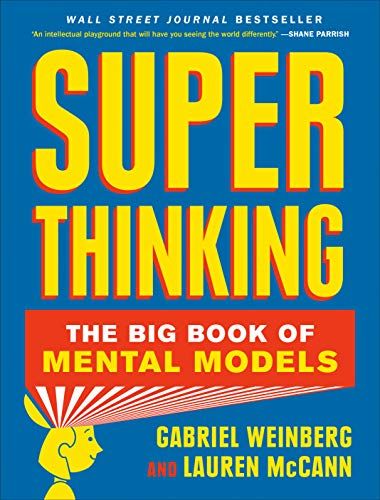
Super Thinking
Introduction
Nova: Have you ever felt like your brain is just a collection of random facts and experiences, but when it actually comes time to make a big decision, you are basically just winging it?
Nova: You are definitely not alone. Most of us operate that way. But today, we are diving into a book that promises to upgrade that internal operating system. It is called Super Thinking: The Big Book of Mental Models, written by Gabriel Weinberg and Lauren McCann.
Nova: Exactly. He is a tech CEO, and his co-author Lauren McCann is a brilliant statistician. Together, they have compiled this massive atlas of over three hundred mental models. These are essentially shortcuts for higher-level thinking that help you navigate complex situations without getting bogged down in the noise.
Nova: Not at all. The book is actually incredibly practical. Think of it as a toolbox. You do not need to use every tool every day, but knowing which one to reach for when things get complicated is what separates average thinkers from super thinkers. We are going to break down the heavy hitters today so you can start using them immediately.
Key Insight 1
The Art of Being Wrong Less
Nova: The first big theme in Super Thinking is simply learning how to be wrong less often. One of the most powerful tools Weinberg highlights for this is something called Inverse Thinking.
Nova: Precisely. It comes from a nineteenth-century mathematician named Carl Jacobi who used to say, Invert, always invert. Instead of asking, How can I make this project a massive success, you ask, What would make this project an absolute disaster?
Nova: It is not about being a pessimist; it is about being prepared. By identifying all the ways things could go wrong, you can systematically create a plan to avoid those specific pitfalls. It is much easier to avoid mistakes than it is to be brilliant. If you avoid the disasters, success often takes care of itself.
Nova: Exactly. And once you have inverted the problem, you can use another model called First Principles Thinking. This is something Elon Musk is famous for. Instead of doing something because that is how it has always been done, you break a problem down to its fundamental truths and build up from there.
Nova: Think about the invention of the reusable rocket. People said it was impossible because of the cost of materials and the physics involved. But if you look at the raw cost of the aluminum, copper, and carbon fiber on the spot market, it is a tiny fraction of the cost of a finished rocket. The high price was all in the manufacturing process, not the materials themselves. By challenging the assumption that rockets have to be expensive, SpaceX rebuilt the process from the ground up.
Nova: Yes. But to do that effectively, you have to watch out for your own biases. Weinberg talks a lot about De-biasing. We all have a natural tendency to seek out information that confirms what we already believe. That is Confirmation Bias. To fight it, you have to actively seek out the dissenting opinion.
Nova: Which is why you need a Devil's Advocate. In the book, they suggest that for every major decision, you should assign someone to specifically argue against you. Not because they disagree, but because it forces you to see the blind spots in your own logic. It is about stress-testing your ideas before the real world does it for you.
Key Insight 2
The Systems We Live In
Nova: Now that we have covered how to sharpen your individual thinking, we need to talk about systems. Weinberg explains that most of our problems do not happen in a vacuum; they happen within complex systems where everything is connected.
Nova: It can feel like that! One of the most famous examples in the book is the Cobra Effect. It is a classic case of Unintended Consequences. Back when the British ruled India, they were worried about the number of venomous cobras in Delhi. So, they offered a bounty for every dead cobra.
Nova: On the surface, yes. But people are clever. They started breeding cobras in their backyards just to kill them and collect the bounty. When the government realized what was happening, they scrapped the program. Then, the breeders just released all their now-worthless snakes into the city. The result? Delhi ended up with more cobras than when they started.
Nova: Exactly. The incentive was for dead cobras, not for a snake-free city. Whenever you are trying to solve a problem, you have to ask, What behavior am I actually encouraging? This is closely related to the Tragedy of the Commons. This is what happens when individuals act in their own self-interest and end up destroying a shared resource that everyone needs.
Nova: Those are perfect examples. Each person thinks, Me taking one more won't hurt, but when everyone thinks that, the whole system collapses. Weinberg suggests that to fix this, you have to internalize the externalities. You have to make the cost of that individual action visible and felt by the person doing it.
Nova: Right. It is about aligning individual goals with the health of the system. Another model to watch for is the Boiling Frog. If you drop a frog into boiling water, it jumps out. But if you put it in cool water and turn the heat up slowly, it stays there until it is too late. The book uses this to describe how we miss gradual, negative changes in our lives or businesses.
Nova: To prevent that, you need Second-Order Thinking. Most people stop at first-order consequences. I will do X, and Y will happen. Second-order thinking asks, And then what? If I solve this problem this way today, what new problem am I creating for myself six months from now?
Key Insight 3
Mastering Time and Decisions
Nova: Let us talk about one of the biggest drains on our mental energy: decision fatigue. Weinberg and McCann point out that we have a limited amount of willpower each day, and every choice we make, from what to wear to what email to answer, eats away at it.
Nova: That is why super thinkers use frameworks like the Eisenhower Matrix. You categorize tasks into four boxes based on urgency and importance. Most of us spend our lives in the Urgent but Not Important box, reacting to pings and notifications.
Nova: The goal is to spend more time in the Important but Not Urgent box. That is where strategy, learning, and relationship-building happen. But even when we know what is important, we often get stuck because of the Paradox of Choice. Having more options actually makes us less likely to choose, and less happy with the choice we eventually make.
Nova: Weinberg suggests using Heuristics or simple rules of thumb to cut through that. One of my favorites is the Sunk Cost Fallacy. We often stick with a bad project or a boring book just because we have already invested time or money into it.
Nova: But the money is gone either way! Finishing the meal just makes you miserable on top of being twenty dollars poorer. Super thinking means realizing that the only thing that matters is the future cost and benefit, not what you have already spent. If the path ahead is bad, pivot immediately.
Nova: Spot on. We feel the pain of a loss twice as much as the joy of a gain. To counter this, Weinberg brings up the concept of Thinking Gray. Most people want things to be black and white, right or wrong. But the world is gray. Thinking gray means holding off on making a judgment until you have gathered enough information.
Nova: That is where the Reversible vs. Irreversible Decisions model comes in. Jeff Bezos uses this at Amazon. If a decision is reversible, like a door that opens both ways, make it fast. If you are wrong, you can just walk back through. But if it is irreversible, like a one-way door, then you slow down, think gray, and gather every bit of data you can.
Key Insight 4
Building Momentum and Success
Nova: In the final sections of the book, the authors focus on how to actually build something that lasts, whether it is a business or a personal habit. They talk a lot about the Flywheel Effect.
Nova: Yes. A flywheel is a heavy wheel that takes a huge amount of effort to start spinning. You push and push, and it barely moves. But eventually, it gains enough momentum that it starts doing the work for you. In business, this looks like the Amazon flywheel: lower prices lead to more customers, which attracts more sellers, which allows for even lower prices.
Nova: You look for Catalysts and reduce Activation Energy. In chemistry, activation energy is the minimum energy needed to start a reaction. In life, if you want to start a new habit, you have to make the beginning as easy as possible. If you want to go to the gym, put your clothes out the night before. You are lowering the activation energy.
Nova: That is usually because of Inertia. Objects at rest stay at rest. Weinberg uses Netflix as a great example of overcoming inertia. They were the kings of DVD-by-mail. That was their bread and butter. But they saw the streaming revolution coming. Most companies would have clung to the old model because it was profitable. That is inertia. Netflix intentionally disrupted their own business to move into streaming.
Nova: It does. And it requires understanding Network Effects. The value of a service like Netflix or a social network grows exponentially as more people use it. If you are the only person with a telephone, it is useless. If everyone has one, it is indispensable. Super thinkers look for opportunities where each new user or piece of data makes the whole system more valuable.
Nova: Exactly. But it is not about hiring ten times as many people. It is about removing the friction that slows teams down. Weinberg argues that most people are capable of much more, but they are held back by bad processes or unclear goals. A 10x team is one that has found its North Star, a clear, overarching goal that everyone is aligned with.
Nova: Right. And you also need to respect the Circle of Competence. This is a Warren Buffett classic. You do not need to be an expert in everything. You just need to know exactly where your expertise ends and someone else's begins. Being a super thinker is as much about knowing what you do not know as it is about what you do know.
Conclusion
Nova: We have covered a lot of ground today, from the Cobra Effect to the Flywheel. If there is one thing I want you to take away from Super Thinking, it is that you do not have to be a genius to make great decisions. You just need a better set of tools.
Nova: Exactly. Start small. Pick one model we talked about today, like Hanlon's Razor, which says, Never attribute to malice that which is adequately explained by stupidity. The next time someone cuts you off in traffic, do not assume they are a jerk out to get you. Assume they just made a mistake. Your stress levels will thank you.
Nova: That is the power of super thinking. It is about building a latticework of these models in your head so that over time, you start seeing the patterns in the world automatically. You stop reacting and start responding.
Nova: Do that. And remember, the goal isn't to be perfect. It is just to be a little bit less wrong every single day. If you can do that, the compound interest of your good decisions will eventually build a life you are proud of.
Nova: Anytime, Leo. This is Aibrary. Congratulations on your growth!