

The Material Revolution: Building Tomorrow's Vehicles
Golden Hook & Introduction
SECTION
Nova: You know, it's pretty wild to think about, but every single day, we interact with materials that are so fundamental, so ingeniously designed, yet we rarely give them a second thought. From the phone in your hand to the chair you're sitting on, it's all "stuff."
Atlas: Oh, I love that. It’s like we’re surrounded by these silent, unsung heroes of engineering, doing incredible work, and we just… take them for granted. It makes me wonder, what kind of unseen material magic are we talking about today?
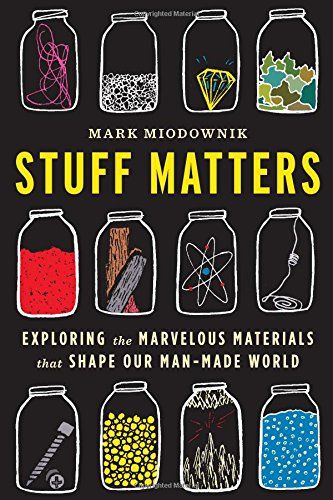
Nova: Exactly! And that's precisely what we're diving into with Mark Miodownik's absolutely brilliant book, "Stuff Matters: Exploring the Marvelous Materials That Shape Our Man-Made World." Miodownik, a true materials scientist and engineer, has this incredible knack for making the mundane magnificent. He’s not just telling us what materials are, but they matter, and the stories behind their creation are truly captivating.
Atlas: That sounds like a fascinating perspective. I mean, we're building tomorrow's vehicles, right? So, how does understanding the everyday stuff help us innovate for something as complex as an electric car or even a flying taxi?
Nova: Well, the core of our podcast today is really an exploration of how understanding the very essence of materials, down to their atomic structures, is revolutionizing how we build everything, especially vehicles. Today we'll dive deep into this from two perspectives. First, we'll explore how seemingly simple materials hold the key to incredible breakthroughs in vehicle design. Then, we'll discuss the delicate balance between innovation and sustainability in the material revolution.
The Unseen Heroes: From Everyday to Extraordinary
SECTION
Nova: So, let's start with the idea that "stuff matters." Miodownik really makes you appreciate the science and engineering behind materials we encounter daily. He unpacks the hidden properties that could, and often do, revolutionize vehicle design. Think about it: lightweight composites, advanced battery components—these aren't just buzzwords. They're the result of meticulous material science.
Atlas: That makes me wonder, how does he make something like steel or plastic sound exciting? Because honestly, when I think of materials, my mind goes to, well, just….
Nova: He does it by telling stories. He brings the materials to life. Take something as seemingly simple as paper. He'll talk about how its cellulose fibers interlock to give it strength, and how that understanding can inform new composite materials that are both strong and flexible. Or consider chocolate – it’s a material, right? He explains the precise crystal structures that give it that perfect snap and melt-in-your-mouth quality, and then he draws parallels to how engineers manipulate crystal structures in metals for specific performance.
Atlas: Oh, I like that. It’s like he’s inviting us to look at the world with a scientist's eyes, seeing the hidden complexity and potential in everything. So, when we talk about revolutionizing vehicle design, what's a fantastic example of a material that went from "just stuff" to a game-changer?
Nova: One of the most compelling examples Miodownik explores, and one that directly impacts vehicles, is the evolution of aluminum. For a long time, it was just a lightweight metal. But with advances in metallurgy, we've learned to create aluminum alloys that are incredibly strong, durable, and still lightweight. This is crucial for vehicles, especially electric ones, where every gram saved translates to better range and efficiency.
Atlas: Right, like those hyper-efficient cars you see, where they brag about using aerospace-grade aluminum. It’s not just aluminum, it’s aluminum.
Nova: Exactly. And the engineering goes beyond just strength. Think about impact absorption. Modern vehicles use a complex cocktail of materials designed to crumple in specific ways during a collision, absorbing energy and protecting occupants. That’s not accidental; that’s material science at its finest, understanding how different structures and compositions behave under stress.
Atlas: That’s actually really inspiring. It’s not just about making things lighter, but safer, too. It’s deeply purposeful. So, what about the cutting edge? What's a material that Miodownik, or the broader field, points to as having truly revolutionary potential for the future of vehicles?
Nova: A material that Miodownik himself is deeply fascinated by, and one that's constantly making headlines, is graphene. It's essentially a single layer of carbon atoms arranged in a hexagonal lattice. It's incredibly strong—200 times stronger than steel—yet astonishingly lightweight and an excellent conductor of electricity.
Atlas: Wow, whoa. Stronger than steel lightweight? That sounds like the holy grail for vehicle manufacturing. So, where would that even fit into a car?
Nova: Well, imagine graphene-reinforced composites for car bodies, making them incredibly tough yet shedding hundreds of pounds. Beyond structural components, its electrical conductivity could revolutionize batteries, making them charge faster and hold more energy. We’re also talking about supercapacitors, advanced sensors, even smart coatings that could change color or self-heal.
Atlas: That sounds a bit out there, honestly. Like something from a sci-fi movie. Are we really anywhere close to seeing graphene cars on the road?
Nova: It’s true that there are significant challenges. Scaling up production of high-quality graphene is complex and expensive. Integrating it into existing manufacturing processes requires entirely new engineering. But the potential is so immense that research and development are accelerating globally. Think of it as a tiny step, as our prompt suggests, but one with monumental implications. The research into solid-state battery electrolytes is another example – replacing liquid electrolytes with solid ones promises greater energy density, faster charging, and improved safety, and that’s all about material innovation.
Innovation vs. Sustainability: The Ethical Crossroads
SECTION
Nova: And that naturally leads us to the second key idea we need to talk about, which often acts as a counterpoint to the relentless drive for lighter, stronger, and more energy-dense materials: sustainability. How do we balance this incredible innovation with the imperative for sustainable sourcing and end-of-life recyclability?
Atlas: That’s a crucial question. Because what's the point of a super-efficient, cutting-edge vehicle if its creation devastates the environment or leaves behind mountains of unrecyclable waste? For our listeners who are designing these new systems, this tension must be constant.
Nova: Exactly. And Miodownik, while celebrating material ingenuity, is acutely aware of this. He implicitly asks us to consider the entire lifecycle of a material. Take the rare earth elements critical for many advanced technologies, including electric vehicle motors and batteries. Their extraction can be incredibly environmentally damaging.
Atlas: Right, like the ethical questions around sourcing cobalt for batteries, for instance. It's a fantastic material for its properties, but its supply chain can be fraught with issues.
Nova: Precisely. The drive for performance can't ignore the planetary impact. This means innovating not just in the of materials, but in their. Can we design materials that are easily disassembled and recycled at the end of a vehicle's life? Can we develop new materials from abundant, renewable sources?
Atlas: So you’re saying it’s not just about finding the next graphene, but also finding the next way to make the graphene we use infinitely reusable or ethically sourced? That’s a fundamentally different approach.
Nova: It is. It’s a shift from a linear "take-make-dispose" model to a circular economy for materials. This means designing for disassembly from the outset, developing advanced recycling technologies, and fostering a culture of material stewardship. Miodownik’s book, while exploring the marvels, also subtly nudges us to consider the responsibility that comes with such power. He reminds us that materials have a story, a history, and a future impact.
Atlas: That makes sense, because if we're building tomorrow's vehicles, we need to make sure we're not just kicking the can of environmental problems down the road. It’s about building with impact, as you said earlier, and that includes ecological impact.
Nova: Absolutely. It's a deep question that challenges the entire automotive industry. It's about designing materials that are not only high-performing but also inherently regenerative or endlessly recyclable. Imagine a car body that, at the end of its 20-year life, can be fully broken down into its constituent elements and reformed into a new car body, with minimal energy input. That’s the true material revolution.
Synthesis & Takeaways
SECTION
Nova: So, what Miodownik’s "Stuff Matters" really illuminates is that the future of vehicles isn't just about software and AI; it's profoundly about the unseen heroes, the materials themselves. From the everyday to the exotic, understanding their properties, their stories, and their potential is what will unlock the next generation of performance, efficiency, and safety.
Atlas: I guess that makes sense. It’s easy to get caught up in the flashy tech, but it’s the fundamental science of materials that underpins it all. And it’s not just about performance; it's about the ethical imperative to innovate sustainably, to think about the entire lifecycle of every atom we put into a vehicle.
Nova: Precisely. The material revolution is about pushing boundaries with graphene and solid-state batteries, but it's equally about the responsibility that comes with that power. It’s a call to look deeper, to appreciate the wonders around us, and to build tomorrow’s world with purpose and profound respect for our planet.
Atlas: That’s actually really inspiring. It’s like the book reminds us that true innovation isn't just about creating something new, but about creating something better, something that serves humanity and the planet in the long run.
Nova: Exactly. It's a reminder that the future of mobility is literally built atom by atom, with every choice carrying immense weight. It’s a fascinating, complex, and vital conversation.
Atlas: Fantastic. I’m definitely going to look at my car in a whole new light now.
Nova: This is Aibrary. Congratulations on your growth!