

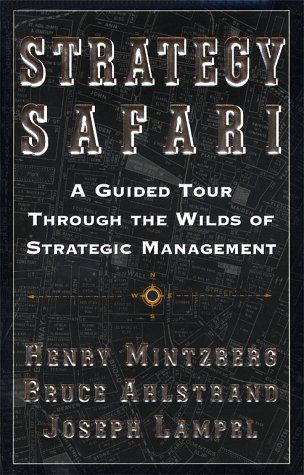
Strategy safari
the complete guide through the wilds of strategic management
Introduction
Nova: Imagine six blind men standing around an elephant. One feels the trunk and says, This is a thick snake. Another touches the tusk and insists, No, it is a sharp spear. A third grabs the leg and claims it is a tree. They are all right, and they are all completely wrong. This is the exact metaphor Henry Mintzberg uses in his classic book, Strategy Safari, to describe how we think about business strategy.
Nova: Exactly. Mintzberg argues that strategy is such a massive, complex beast that no single theory can capture the whole thing. Instead of giving you one perfect formula, Strategy Safari takes us on a literal tour through ten different schools of thought that have dominated the business world for decades.
Nova: It is actually the ultimate antidote to narrow thinking. Most leaders get stuck in just one school. They might be obsessed with data and planning, or they might rely entirely on their gut instinct. Mintzberg shows us that if you only look at the trunk, you are going to get trampled by the rest of the elephant. Today, we are going on that safari to see the whole beast.
The Old Guard of Strategy
The Prescriptive Schools
Nova: We start our safari with the three schools that most people think of when they hear the word strategy. These are the Prescriptive Schools: Design, Planning, and Positioning. They are all about how strategy should be formulated before you actually do anything.
Nova: Precisely. The Design School is the simplest. It is where the famous SWOT analysis comes from. You look at your Strengths, Weaknesses, Opportunities, and Threats, and you try to find a perfect fit between your internal capabilities and the external environment. It is very top-down. The CEO is the grand architect.
Nova: He says they are useful for clarity, but the danger is that they oversimplify. Then you have the Planning School, which took that design and turned it into a massive bureaucratic machine. Think of the 1970s, where companies had huge departments dedicated to five-year plans and thick binders full of checklists.
Nova: That is exactly Mintzberg's critique. He calls it the fallacy of detachment. You cannot sit in a high-rise office and plan every detail of what happens on the ground. But then came the Positioning School in the 80s, led by Michael Porter. This is where we get the Five Forces. It is less about your internal design and more about picking the right spot in the market.
Nova: Right. But the problem with all three of these schools is that they assume the world is stable enough to analyze and plan for. They treat strategy like a chess game where you have all the time in the world to move your pieces. In reality, the board is usually on fire.
Entrepreneurial and Cognitive Schools
The Mind of the Strategist
Nova: If the first three schools were about the process, the next two are about the person. We are moving into the Entrepreneurial and Cognitive schools. This is where strategy lives inside the leader's head.
Nova: Spot on. The Entrepreneurial School says strategy is a visionary process. It is not something you can write down in a manual. It is an intuition, a sense of direction. The leader sees an opportunity that no one else does and just goes for it. It is flexible and fast, but it is also incredibly risky because it depends entirely on one person.
Nova: Exactly. It is the cult of the personality. But then Mintzberg introduces the Cognitive School, which is fascinating. It looks at the actual psychology of the strategist. How do we process information? What biases are we bringing to the table?
Nova: Yes. This school argues that strategy is a mental map. We do not see the world as it is; we see it through our own filters. If you think the market is shrinking, you will find evidence to support that, even if it is not true. Mintzberg points out that our greatest strength as humans—our ability to simplify complex information—is also our greatest weakness because we ignore the data that does not fit our map.
Nova: And that is why these two schools are so important. They remind us that strategy is not just data; it is perception. But as we will see in the next part of the safari, sometimes strategy happens even when no one is thinking about it at all.
Learning, Power, and Cultural Schools
Strategy as an Emergent Process
Nova: Now we get to the heart of Mintzberg's own philosophy: the Learning School. This is the idea of emergent strategy. He famously uses the example of Honda entering the US motorcycle market in the 1960s.
Nova: Exactly. Their plan was to compete with Harley-Davidson using big, powerful motorcycles. It was a disaster. But the employees were riding these tiny 50cc Super Cubs around Los Angeles just to run errands. People saw them and started asking where they could buy one. Honda pivoted, and the Super Cub became a massive success.
Nova: Right. Mintzberg says that sometimes we act first and then make sense of our actions later. Strategy is not just a top-down command; it is something that bubbles up from the bottom. But that leads us to the Power School, which is a bit more cynical. It says strategy is the result of politics and negotiation.
Nova: Precisely. Whether it is internal politics or external lobbying, the Power School views strategy as a game of influence. And then you have the Cultural School, which is the opposite. It says strategy is shaped by the shared beliefs and values of the organization. It is the glue that holds everything together.
Nova: Exactly. The Cultural School explains why some companies are so incredibly hard to change. Their strategy is baked into their identity. It is not a choice; it is just who they are. But while culture is internal, our next school looks at the world outside the office walls.
Environmental and Configuration Schools
The Environment and the Big Picture
Nova: We are nearing the end of our safari. The ninth school is the Environmental School. This one is a bit humbling. it says that the organization actually has very little choice. The environment—the economy, the technology, the regulations—dictates what you must do to survive.
Nova: Exactly. In this view, the strategist is just a passenger. But that brings us to the final, and perhaps most important, school: the Configuration School. This is the meta-school. It says that an organization is a configuration of all these different elements, and it moves through different stages of a lifecycle.
Nova: Yes! That is the big insight. Strategy is not one-size-fits-all. A company might spend years in a stable configuration, using the Positioning School to defend its market. But then a disruption happens, and it needs to go through a transformation—a leap into a new configuration.
Nova: That is the perfect analogy. Mintzberg's point is that you need to know which school you are in and when it is time to switch. You cannot be a blind man forever. You have to step back and see that the elephant is changing over time.
Nova: Exactly. It is about being a generalist in a world of specialists. You need the data of the planners, the vision of the entrepreneurs, the agility of the learners, and the awareness of the psychologists.
Conclusion
Nova: So, what is the ultimate takeaway from our safari? Henry Mintzberg isn't telling us that one school is better than the others. He is telling us that strategy is a messy, multifaceted process. If you rely on just one approach, you are essentially flying blind.
Nova: Exactly. The best strategists are the ones who can walk through all ten schools. They know when to plan, when to learn, when to fight for power, and when to listen to the culture. They see the whole elephant.
Nova: That is the best way to start. Strategy is a journey, not a destination. It is a safari through a wild and unpredictable landscape. And the more tools you have in your kit, the better your chances of survival.
Nova: That is the goal. Keep exploring, keep learning, and never stop looking at the big picture. This is Aibrary. Congratulations on your growth!