

The Art of Influence: Mastering Persuasion through Story
Golden Hook & Introduction
SECTION
Nova: Alright Atlas, quick game. I'll say a historical figure, you give me the title of their imaginary self-help book, focusing on influence. Ready?
Atlas: Oh, I like this! Hit me.
Nova: Cleopatra.
Atlas: "Charm Your Way to Empire: A Guide to Seduction and Statecraft."
Nova: Perfect! Julius Caesar.
Atlas: "Et Tu, Brute? How to Handle Feedback."
Nova: Brilliant! Okay, one more. Sun Tzu.
Atlas: "The Art of the Powerpoint: Winning Without Ever Firing a Shot."
Nova: That's it! Because today, we're talking about a different kind of winning, a different kind of influence, one that uses a power far more ancient and, frankly, more effective than any pie chart or bullet point.
Atlas: Oh, I see where you're going with this. We're talking about the magic of narrative.
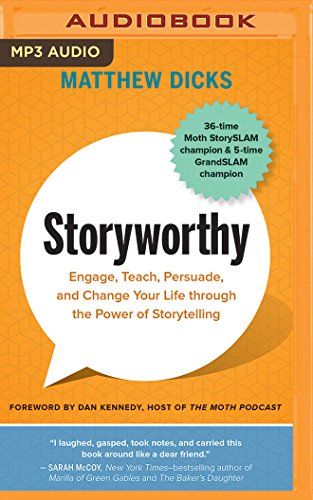
Nova: Exactly. Today, we're diving into the absolute power of storytelling, drawing profound insights from two incredible books: "Storyworthy" by Matthew Dicks, and "The Storyteller's Secret" by Carmine Gallo. Now, Dicks, an acclaimed author and five-time Moth GrandSlam champion, actually teaches writing to fifth graders – which tells you a lot about his ability to distill complex ideas into accessible, actionable techniques. He makes crafting an engaging story feel as natural as breathing.
Atlas: That’s a great way to put it, Nova. For anyone who's ever sat through a presentation full of facts and figures, only to forget them five minutes later, this episode is your antidote. What really matters is how we connect.
Nova: Absolutely. Because influence isn't just about data; it's about connecting with people on an emotional level, and stories are the most potent tool for doing so.
The Core of Connection: Why Stories Trump Data for Influence
SECTION
Nova: So, let's kick things off with our first big idea: the core of connection. Why do you think, Atlas, in an age where we're drowning in data, facts, and analytics, a simple story still holds more power to persuade, to teach, to change minds, than any spreadsheet ever could?
Atlas: That's a great question, and it's something I imagine a lot of our listeners, especially those in leadership roles, grapple with. We're trained to present data, to be logical, to show the numbers. But then you get into a meeting, you lay out all your perfectly rational arguments, and… crickets. Or worse, polite nods and no action. I think it comes down to what Dicks and Gallo both emphasize: the emotional connection. Data informs the head, but stories move the heart.
Nova: Exactly! Matthew Dicks, in "Storyworthy," breaks down how personal narratives create connection and make ideas memorable. He argues that the human brain is hardwired for stories. We remember events, characters, conflicts, and resolutions far better than abstract facts. Think about it: if I tell you the average lifespan of a fruit fly, you might remember it for a minute. But if I tell you a story about a fruit fly who, against all odds, escaped a lab and lived a full, adventurous life…
Atlas: I’d probably remember that fruit fly's name!
Nova: Right? Carmine Gallo, in "The Storyteller's Secret," reinforces this by examining how top leaders use storytelling. He talks about people like Steve Jobs, who didn't just present phone specs; he presented a vision of how the iPhone would change your life. He made it personal, aspirational.
Atlas: That’s a perfect example. I remember hearing about a study where researchers presented two groups with information about a charity. One group got statistics on the number of people helped, the other got a single story about one person. The story group donated significantly more. It's that individual connection, isn't it? It makes the abstract tangible.
Nova: It absolutely does. And it’s not just about philanthropy. Imagine you’re trying to convince your team to adopt a new, perhaps controversial, strategy. You could show them market share projections, growth charts, and competitor analysis. Or, you could tell them a story about a time your company faced a similar challenge, how a small team took a risk, and the unexpected positive outcome that followed. Which one do you think would rally them more?
Atlas: The story, hands down. It builds trust, it creates a shared experience, even if they weren't there. It makes them feel like part of something bigger, something with a narrative arc they can contribute to. That’s actually really inspiring. What’s even more interesting is that Dicks, who is a writing teacher, also highlights the role of vulnerability in storytelling. It’s not just about grand narratives; sometimes it's the small, personal ones that resonate most.
Nova: Precisely. Dicks talks about the 'five-second story' – those tiny, seemingly insignificant moments from your day that, when framed correctly, reveal a deeper truth or emotion. It could be a brief interaction, a moment of frustration, a small triumph. These aren't just anecdotes; they're micro-connections. They show your humanity, which is instantly relatable.
Atlas: So, it’s not always about epic tales of heroism. It can be something as simple as, 'I was trying to get this new software to work all morning, and then I realized I'd just forgotten to plug it in.' That kind of self-deprecating humor and shared struggle builds camaraderie.
Nova: Exactly! And that’s where the power lies. When you, as a leader, share a genuine story, even a short one, you're not just conveying information; you're inviting your audience into your world, creating empathy, and building a foundation for influence that pure logic often can’t achieve. It’s the difference between being understood and being felt.
Crafting Your 'Storyworthy' Message: From Concept to Compelling Narrative
SECTION
Nova: Now, understanding stories work is one thing. But for our listeners, especially those aspiring leaders who need to convey a key message to their team or stakeholders, the crucial part is to transform that message into a compelling story. This naturally leads us to our second core topic: crafting your 'storyworthy' message.
Atlas: Okay, so this is where the rubber meets the road. If I have a critical message—say, we need to completely pivot our product strategy—how do I turn that into a story that actually gets my team on board, rather than just delivering a mandate?
Nova: That's the million-dollar question, and both Dicks and Gallo offer incredible frameworks. Dicks, for instance, emphasizes finding the 'five-second moment' that encapsulates the core emotional truth of your message. It's not about outlining every step of the pivot; it's about finding the singular moment of insight, conflict, or realization that drove the need for change.
Atlas: Can you give an example? Like how would that work for a product pivot?
Nova: Imagine you're leading a tech company, and for months, your team has been pushing a particular product feature, pouring in hours. But then, a key customer interaction reveals a fundamental flaw, or a competitor launches something that makes your feature obsolete overnight. The 'five-second moment' isn't the data analysis; it's the phone call where the customer says, 'This just doesn't solve our real problem,' or the morning you saw the competitor's announcement and realized everything had changed. It's that moment of realization, of falling, before the rise.
Atlas: Whoa, that gives me chills. That's so much more impactful than saying, 'Our Q3 market analysis shows we need to adjust our strategy.' It makes it human. It shows the struggle, the challenge.
Nova: Precisely. Gallo, on the other hand, in "The Storyteller's Secret," talks about the three-act structure and the importance of a clear hero, a clear villain, and a clear resolution. For your product pivot, the hero is your company adapting, the villain is the outdated approach, and the resolution is the innovative new direction and the success it will bring.
Atlas: So, instead of just presenting the new product strategy, I'd frame it as: 'We were on a path, then we faced a giant challenge, and now, with this new approach, we're forging a new path to victory.' That's actually really powerful. It gives people a role in the story.
Nova: It does. And Gallo particularly stresses that great communicators don't just stories; they them and to live them. He also highlights how crucial it is to make the story relatable to your audience. If you're talking to engineers, tell a story about a technical challenge overcome. If it's the sales team, a story about closing a difficult deal. The point is to make the implicit heroes, or at least the beneficiaries, of the narrative.
Atlas: That makes perfect sense. It's about mirroring their experience. And it raises another point: many of us, especially in professional settings, might feel uncomfortable sharing personal stories or even crafting narratives because it feels… unbusinesslike, or maybe even manipulative. How do Dicks and Gallo address that?
Nova: They both emphasize authenticity. Dicks’ entire premise is built on finding genuine 'storyworthy' moments from your own life. It’s not about fabricating; it’s about recognizing and framing the inherent drama and meaning in your everyday experiences. Gallo echoes this, showing that the most effective stories are those that come from a place of genuine belief and experience. It's not about being a slick salesperson; it's about being a genuine human being who has learned something valuable and wants to share it.
Atlas: So, it's about finding the truth in the narrative, not just creating a narrative to obscure the truth.
Nova: Exactly. And the profound insight here is that by embracing storytelling, we're not abandoning logic or data. We're simply giving them a vehicle, a human context, that allows them to land with far greater impact. We're making our messages not just heard, but felt, understood, and ultimately, acted upon.
Synthesis & Takeaways
SECTION
Nova: So, Atlas, as we wrap up, what’s the biggest takeaway for our listeners—especially those aspiring leaders and strategic thinkers—who want to master the art of influence through story?
Atlas: I think it’s this: stop thinking of storytelling as a soft skill, or something only for artists. It is a fundamental, strategic tool for leadership and influence. If you want your team to truly understand, truly connect, and truly act on your vision, you have to move beyond just the data. You have to tell them a story.
Nova: Absolutely. It's about recognizing that every single one of us has 'storyworthy' moments, and every message we need to convey has a narrative waiting to be uncovered. Whether it's a five-second anecdote or a grand vision, the ability to frame your message as a compelling story is the difference between informing and inspiring. It truly is the art of influence.
Atlas: And for anyone feeling like their key messages aren't landing, or their teams aren't fully engaged, this is your call to action. Look for the human element, the conflict, the resolution in your own work. What is that one key message you need to convey, and what's the story behind it?
Nova: That's the challenge for our listeners this week. Find that story. Tell that story. Because when you do, you won't just be communicating; you'll be connecting, persuading, and ultimately, changing lives.
Atlas: This is Aibrary. Congratulations on your growth!