The Hidden Power of Story: How Narrative Shapes Our World.
Golden Hook & Introduction
SECTION
Nova: Atlas, if I told you that everything you believe, from your identity to global politics, is essentially a well-told tale, what's your first thought?
Atlas: Oh, I'd say 'Prove it,' but then I'd immediately wonder if that skeptical thought was just part of a story I'm telling myself.
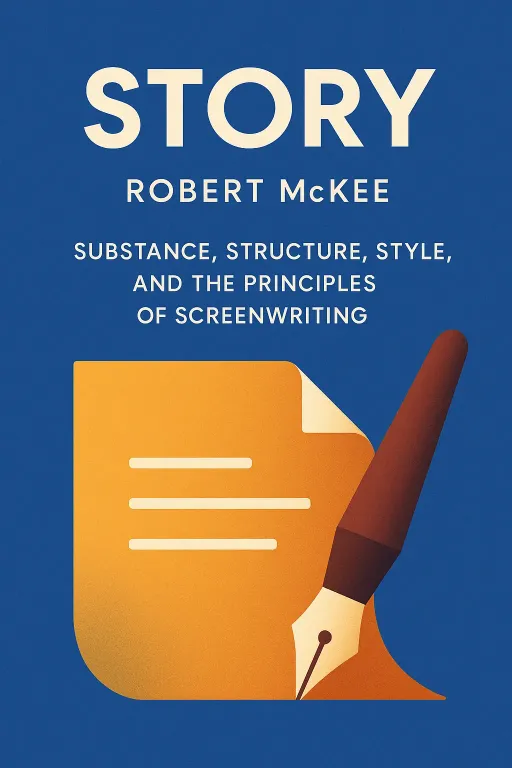
Nova: Exactly! It’s a rabbit hole, isn’t it? Today, we’re doing exactly that: we're pulling back the curtain on the immense, often unseen, power of narrative. We’re drawing heavily from two seminal works: Robert McKee’s legendary screenwriting guide, and Yuval Noah Harari’s groundbreaking historical analysis,.
Atlas: I'm curious. What makes these two books, from such different fields, so crucial for understanding story?
Nova: Well, McKee, a renowned instructor whose alumni roster reads like a who's who of Hollywood, demystified the narrative structures that captivate us, showing how a well-crafted story can exert incredible emotional and intellectual force. Harari, a historian who made deep academic concepts accessible to millions, then reveals that it’s our ability to create and believe in 'shared fictions' that quite literally built our entire world.
Atlas: So, it's like one is the intricate blueprint for telling stories, and the other is the radical blueprint for how stories built us from the ground up. That's a powerful combination.
Nova: Absolutely. And what's fascinating is how often we live within these powerful narratives without ever truly examining them. It's what we call our "blind spot" to story's influence.
The Unseen Architecture of Influence: How Stories Shape Our Beliefs
SECTION
Atlas: A blind spot? I mean, we all know stories are powerful, right? We cry at movies, we get lost in books. But you’re saying it goes deeper than that?
Nova: Oh, much deeper. We often consume stories, whether from a blockbuster film or a family anecdote, without fully understanding their immense power to influence our beliefs, our culture, and even our personal identity. We miss the underlying structures that make them so compelling, and therefore, so influential.
Atlas: I can see how a movie could make me feel something, but shape my? My? That sounds like a stretch. Can you give an example of one of these pervasive, almost invisible stories?
Nova: Think about the 'American Dream' narrative. It’s a powerful story woven into the fabric of society: work hard, play by the rules, and you will achieve success, upward mobility, and a comfortable life. It's got all the elements McKee talks about: a clear protagonist, a goal, obstacles, and the promise of resolution.
Atlas: That’s a common aspiration, for sure. But is it just an aspiration, or is it a story that actively shapes us?
Nova: It absolutely shapes us. This narrative sets expectations, defines what 'success' looks like, and often dictates our life choices – from career paths to financial decisions. It inspires millions, but it can also lead to disillusionment when reality doesn't align with the story's promised 'resolution.' And it’s not just grand cultural narratives. McKee shows how every effective story, even a short anecdote, has a 'controlling idea' – a central premise that drives its meaning. That controlling idea, whether conscious or unconscious, shapes how we interpret events.
Atlas: So, even the stories we tell ourselves about our careers, like 'I'm a content head who has to innovate constantly,' or 'I'm a booktuber whose opinions matter,' are they also operating under these invisible narrative structures?
Nova: Precisely. Those are personal narratives, often mirroring larger cultural ones. They can be incredibly empowering, giving us purpose and direction. But if unexamined, they can also become limiting, dictating choices even when they no longer serve us. When we fail to recognize the narrative at play, we become passive characters in a story we didn't consciously write. What’s really fascinating is how even economic systems are underpinned by stories.
Atlas: Wait, you’re saying economics has a story? I thought that was all numbers and data.
Nova: It is, but it’s built on a shared fiction. The belief in a currency's value, the concept of a nation's economy – these all rely on a collective agreement, a story we all tell each other. Without that shared narrative, the numbers wouldn't mean anything.
Humanity's Operating System: The Evolutionary Power of Shared Fictions
SECTION
Nova: And that naturally leads us to a much grander scale, where these invisible stories don't just shape individuals, but literally built our entire civilization. Harari, in, makes a radical claim: humanity's unique operating system, the thing that allowed us to dominate the planet, isn't our big brains or opposable thumbs. It’s our ability to create and believe in 'shared fictions.'
Atlas: Shared fictions? So, you’re saying things like nations, religions, or even money are essentially make-believe? That sounds a bit anarchic, if not dangerous.
Nova: It’s not about them being 'unreal' in their effects, but about their. Take money. It's just pieces of paper or digital bits. But the we collectively tell about its value allows millions of strangers to exchange goods and services across the globe. Without that shared belief, that shared fiction, trade beyond small tribal groups would be impossible. Laws are just words on paper, but the of justice, rights, and consequences allows societies to function.
Atlas: That makes me wonder about the scale. How did this ability to believe in abstract concepts give us such an evolutionary leg up?
Nova: It allowed for unprecedented cooperation. Other species can cooperate, but usually only in small groups of individuals who know each other. Harari explains that our capacity for shared fictions enabled us to cooperate flexibly in numbers, with complete strangers. This meant we could build complex social structures, form armies of thousands, create intricate supply chains, and eventually, build entire cities and nations.
Atlas: So, it's like a massive multiplayer online role-playing game, but the stakes are, you know, everything from survival to civilization itself. That's a great analogy.
Nova: Exactly! It’s the ultimate narrative game. This ability to invent and propagate stories, like the story of a nation-state or a common god, allowed us to organize ourselves in ways no other species could. It’s why outcompeted other hominids and ultimately became the dominant species. Our collective imagination became our most powerful tool.
Mastering the Narrative: From Passive Consumer to Conscious Creator
SECTION
Nova: This brings us to the crucial part: if stories are this powerful, if they're our operating system, then mastering them isn't just for Hollywood screenwriters. It's a fundamental life skill, whether you're a content head shaping a startup's vision or a booktuber influencing an audience.
Atlas: Okay, so how do we move from just being played by these stories, to actually understanding and maybe even rewriting them? Especially for someone in a fast-paced environment, trying to lead and innovate.
Nova: The first step is awareness. Understanding narrative structure, as McKee outlines, allows us to deconstruct the stories we're told – in advertising, politics, or even our own internal monologues. It helps us identify the 'controlling idea' or the 'deep question' within those narratives.
Atlas: Can you give an example of a 'deep question' within a personal narrative?
Nova: Think about the unexamined story you might be living by. It could be something like, 'I always have to be the strongest one,' or 'I'm not creative enough to make a real impact,' or 'I must always put my team's needs before my own well-being.' These are narratives, and they dictate choices. The deep question is: Is this story serving me? Is it leading me where I truly want to go?
Atlas: That's a powerful challenge. And for those of us leading teams, understanding stories, the narratives they're living by, can be key to unlocking their potential and aligning them.
Nova: Absolutely. A leader’s job is fundamentally to craft a compelling, unifying story for their team or organization. Harari shows us that to get large groups to cooperate, they need a compelling shared fiction – a vision, a mission, a purpose that transcends individual self-interest. It’s about consciously creating the narrative that inspires and moves people forward.
Synthesis & Takeaways
SECTION
Nova: So, we’ve journeyed from recognizing our individual blind spots to story, through humanity’s reliance on shared fictions for civilization, and finally to the empower-ing idea of mastering our own narratives.
Atlas: It's almost unsettling how much of our reality, from the personal to the global, is constructed by these invisible forces. But also, as you said, incredibly empowering once you truly see it. It’s like discovering the source code of human existence.
Nova: Exactly. The power isn't in denying the stories, but in recognizing them. In asking: Is this story serving me? Is it serving us? And if not, what narrative do I want to consciously create instead? Because when you understand the hidden power of story, you move from being a character in someone else’s script to becoming the author of your own.
Atlas: That’s such a hopeful way to look at it. It challenges us to reflect on our own internal narratives and the external ones we consume. For our listeners, I’d encourage you to think about that deep question Nova just posed: What unexamined story are you currently living by, and how might it be shaping your choices? The answer just might be the first step to rewriting your narrative.
Nova: This is Aibrary. Congratulations on your growth!