

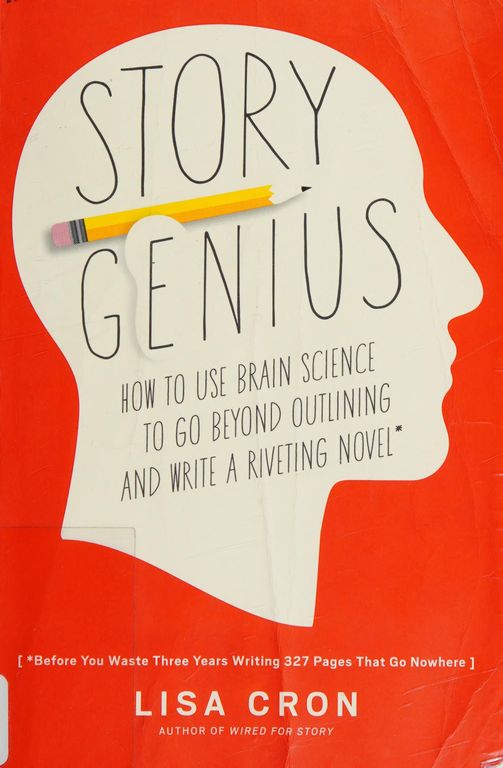
Story Genius
How to Use Brain Science to Go Beyond Outlining and Write a Riveting Novel
Introduction
Nova: Have you ever wondered why you can sit through a two-hour movie and feel like only twenty minutes passed, but trying to read a dry instruction manual for five minutes feels like an eternity? It turns out, your brain is actually physically wired to respond to stories in a way it does not respond to anything else.
Nova: There absolutely is, and that is exactly what Lisa Cron explores in her groundbreaking book, Story Genius. She argues that most writers are actually taught to write stories the wrong way. They focus on the plot—the external stuff like explosions or car chases—when they should be focusing on the brain science of how we process narrative.
Nova: Exactly! She claims that the plot is just the surface. The real story is what is happening inside the character's head. Today, we are diving into the Story Genius method to see how you can use neuroscience to build a novel that is literally unputdownable.
Key Insight 1
The Neuroscience of Narrative
Nova: To understand Story Genius, we have to start with the why. Why did humans evolve to love stories? Lisa Cron explains that story was actually our first virtual reality. It was a survival mechanism.
Nova: Precisely. Our ancestors used stories to pass on critical information about social dynamics and danger without having to experience the danger themselves. When we hear a good story, our brains release dopamine to keep us focused and cortisol to help us feel the tension. It is like a flight simulator for life.
Nova: It does! But here is the kicker: the brain only releases those chemicals if it understands the why behind the action. If a character is running down a dark alley but we do not know their internal motivation or what is at stake for them personally, our brains just tune out. We do not care about the alley; we care about the person in it.
Nova: That is what Cron calls the difference between a situation and a story. A situation is a series of events. A story is how those events change someone. Our brains are looking for that internal change. If there is no change, the brain decides the information is not vital for survival and stops paying attention.
Nova: Exactly. And to keep the brain engaged, you have to tap into what she calls the narrative transport. It is that state where you lose track of time because you are so deeply embedded in the character's perspective. To achieve that, you have to move past the external plot and get into the character's head.
Key Insight 2
The Misbelief and the Origin Scene
Nova: This brings us to the most important concept in the book: The Misbelief. Cron argues that every protagonist starts the story with a flawed worldview—a specific lie they believe about themselves or the world.
Nova: Yes, exactly like that. But it is not just a random thought. It is a deeply ingrained defense mechanism that was formed during a specific moment in their past, which she calls the Origin Scene.
Nova: That is a great way to put it. The Origin Scene is a moment where the character learned a lesson that seemed true at the time but is actually holding them back now. For example, maybe as a kid, the protagonist tried to be vulnerable and got humiliated. Their brain recorded that as: Being vulnerable equals death. So now, as an adult, they refuse to let anyone in.
Nova: Spot on. The plot's job is to provide a series of obstacles that specifically target that misbelief. It is like the universe is conspiring to prove the character wrong. They want to stay safe in their old way of thinking, but the plot makes it impossible to get what they want unless they change.
Nova: They are! And that is why Cron says you cannot start with the plot. If you do not know the misbelief, you cannot know what the plot should be. You are just throwing random obstacles at a character instead of the specific obstacles they need to grow.
Nova: Exactly. The external event is only meaningful because of the internal struggle it triggers. That internal struggle is what Cron calls the Third Rail.
Key Insight 3
The Third Rail of Storytelling
Nova: If you think of a story like a subway system, the plot is the train and the tracks. But the Third Rail is the electrified rail that actually provides the power. Without it, the train is just a hunk of metal sitting in the dark.
Nova: Yes. It is the internal arc of the protagonist as they struggle with their misbelief. Every single scene in your book must have this internal component. If a scene is just action without the character processing that action through the lens of their misbelief, the Third Rail is dead.
Nova: It absolutely does. In the Story Genius method, there is no such thing as killing time. If the character is not actively grappling with their internal conflict, the scene does not belong in the book. Cron is very strict about this. She says that every scene must be a cause-and-effect trajectory.
Nova: It is, because most writers think of cause and effect as: This happens, then that happens. But Cron says it is: This happens, which causes the character to realize X, which then forces them to do Y. The effect is always internal first, then external.
Nova: Right. And this is why she is so against what we call pantsing—writing by the seat of your pants without a plan. She argues that if you do not blueprint this internal journey ahead of time, you will inevitably end up with a plot that wanders off the tracks because it is not anchored to the Third Rail.
Key Insight 4
The Blueprinting Method
Nova: To help writers stay on track, Cron introduces the Blueprinting method. It is a way of mapping out the story before you ever write a single page of the actual draft. And it starts with the Scene Card.
Nova: Not quite. A Story Genius Scene Card is much more rigorous. It has two main parts: the Action and the Realization. The Action is what happens externally. But the Realization is the most important part—it is what the character learns or how their perspective shifts in that scene.
Nova: Exactly. She also uses something called the So What? test. For every scene, you have to ask: So what? Why does this matter to the character's internal struggle? If the answer is just, Because it is cool, or Because I need a chase scene here, it fails the test.
Nova: That is her whole goal. She wants writers to do the heavy lifting of thinking through the story's logic before they get lost in the prose. She also emphasizes the Alpha Plot and the Beta Plot. The Alpha Plot is the external goal—like finding the lost treasure. The Beta Plot is the internal goal—like learning to value yourself without external validation.
Nova: Precisely. They are like two strands of DNA twisting around each other. You cannot pull them apart without destroying the whole thing. The blueprinting process forces you to see where those strands connect in every single scene.
Nova: It does. It turns the writing process from a guessing game into a strategic execution of a psychological arc. You are not just writing a story; you are building a brain-hacking machine.
Conclusion
Nova: We have covered a lot today, from the survival mechanism of the brain to the power of the Misbelief and the necessity of the Third Rail. Lisa Cron's Story Genius really challenges the idea that writing is just about talent or inspiration. It is about understanding the human mind.
Nova: That is the sign of a great craft book! It changes how you see the world. The biggest takeaway is that a story is not about what happens; it is about how what happens affects someone who is trying to overcome a long-held lie.
Nova: Well said, Leo. If you can master the internal arc, the external plot will almost take care of itself. For anyone looking to take their storytelling to the next level, Story Genius is a must-read. It is practical, science-based, and honestly, a bit of a reality check for anyone who thinks they can just wing a masterpiece.
Nova: That is the spirit. Thank you for joining us on this deep dive into the mechanics of story. We hope this helps you craft something truly genius.
Nova: This is Aibrary. Congratulations on your growth!