

The Mind's OS: Decluttering Your Mental Code with Asha Prvt
Golden Hook & Introduction
SECTION
Nova: Have you ever felt like your brain is a computer with way too many tabs open? You're trying to focus on one thing, but a dozen other processes are running in the background, slowing everything down, maybe even leading to that dreaded spinning wheel of death. That feeling, that mental infinite loop, is what we're talking about today: overthinking.
Asha Prvt: That is such a perfect analogy, Nova. As a grad student in tech, I live in a world of open tabs, both on my screen and in my head. And that spinning wheel... it feels very, very real sometimes.
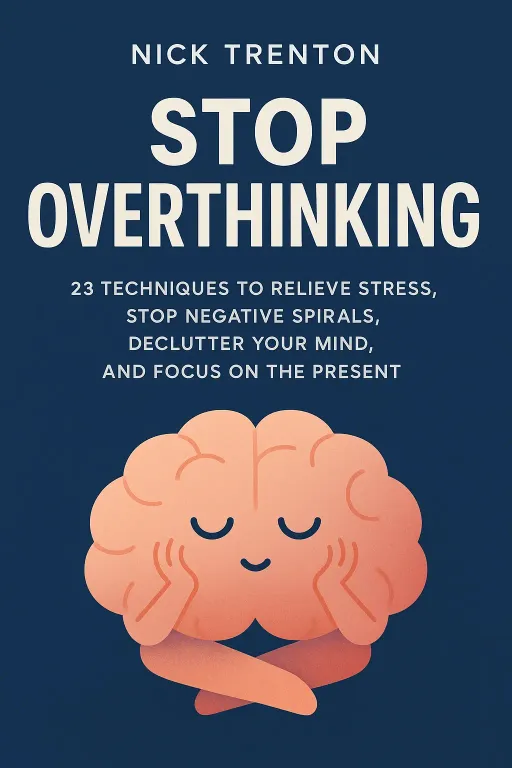
Nova: It really does! And that’s why I’m so excited to have you here, Asha. Welcome! We’re going to be exploring some powerful ideas from Nick Trenton's book, "Stop Overthinking: 23 Techniques to Relieve Stress." And what I love about this book is that it treats our minds not as something broken, but as a system we can understand.
Asha Prvt: A system we can debug, hopefully.
Nova: Exactly! And that’s our plan. Today we'll dive deep into this from two perspectives. First, we'll explore why the thing you're overthinking is almost never the real problem. Then, we'll uncover the real source code of anxiety, looking at the blueprint that makes us prone to these mental loops in the first place. Ready to dive in?
Asha Prvt: Absolutely. Let's open up the terminal.
Deep Dive into Core Topic 1: The Decoy Problem
SECTION
Nova: Alright. So let's start with the first idea, which is kind of a mind-bender. The book argues that overthinking isn't actually about what we we're overthinking. It’s a decoy. To make this real, Trenton tells the story of a young man named James.
Asha Prvt: Okay, I'm listening.
Nova: So, James is a pretty normal guy—intelligent, self-aware. One day, he notices a weird-looking mole on his shoulder. A tiny, specific concern. What does he do? He goes online.
Asha Prvt: Oh no. The classic WebMD rabbit hole.
Nova: The absolute classic. And within minutes, he's convinced it's something terrible. But then, something interesting happens. He stops worrying just about the mole and starts worrying about his. He thinks, "Why am I so anxious? Am I having an anxiety attack? Am I neurotic? Maybe I need therapy."
Asha Prvt: Wow, so he's gone from a physical problem to a psychological one.
Nova: Exactly. He starts spiraling. He remembers a comment a psychologist made years ago. He debates which type of therapy would be best. He questions his own sanity, wondering if he's developing a serious mental illness. An hour goes by, and he's exhausted, depressed, and no closer to a decision about the mole. He just feels awful, telling himself he's a mess.
Asha Prvt: That is so incredibly relatable. It's like you're trying to solve a problem, but you end up creating ten more problems about the way you're trying to solve the first one.
Nova: That's the core of it. The book’s quote that nails this is, "Whether you call it worry, anxiety, stress, rumination or even obsession, the quality that characterizes overthinking is that it feels awful, and it doesn’t help us in any way." James wasn't problem-solving; he was just caught in a loop.
Asha Prvt: You know, this makes me think of debugging code. Sometimes you see a weird output, a 'bug', and you can spend hours, even days, obsessing over that one specific line of code that you think is the problem. You tweak it, you rewrite it, you stare at it until your eyes hurt.
Nova: And is it ever that one line?
Asha Prvt: Almost never. The real issue is usually somewhere else entirely—a flawed logic in a different module, a memory leak, a fundamental architectural mistake. The 'bug' you were staring at was just the symptom. It was the error message. And it sounds like James's mole was just his mind's error message.
Nova: That is the perfect metaphor. The mole isn't the problem. The book says, "The causes of overthinking are seldom the focus of overthinking." The mole is just a convenient, tangible hook for a much deeper, free-floating feeling to latch onto.
Asha Prvt: So the goal isn't to get better at solving the 'mole' problem, or even to ignore it. It's to recognize that the mole isn't the real program we need to be looking at. We need to find the source code for the anxiety itself.
Nova: Exactly! The mole is just the decoy. And that leads us perfectly to our second point. If it’s not about the mole, what it about?
Deep Dive into Core Topic 2: The Anxiety Blueprint
SECTION
Nova: So, if the overthinking spiral isn't about the mole, the book argues the root cause is almost always underlying anxiety. But it's not as simple as just saying "I'm an anxious person." Trenton breaks down the origins of anxiety into a few key factors, creating what you might call an 'anxiety blueprint'.
Asha Prvt: Okay, so we're moving from the error message to the system architecture. I like it. What are the components?
Nova: Well, the first is genetics. Research suggests there is a genetic component to anxiety. A 2019 paper found that anxiety disorders have a heritability rate of about 26 percent.
Asha Prvt: Hmm, 26 percent. That's significant, but it also means that almost three-quarters of the story isn't genetic.
Nova: Right. It’s not a life sentence. It’s more like the 'hardware' you're born with. Some processors run a little hotter than others, but that's only one part of the system. The second factor is our environment—the things that happen to us. The book points to studies showing strong links between traumatic life events—like loss, poverty, or abuse, especially in childhood—and the development of anxiety disorders later in life.
Asha Prvt: So that's like the external input. The 'hardware' of your genetics has to process the 'data' from your life experiences. A stressful environment is like feeding the system a lot of volatile, unpredictable data.
Nova: A perfect way to put it. And that brings us to the third, and maybe most important, factor: our cognitive style. This is our mental model, our personal 'operating system'. It’s how we interpret everything. The book uses the great quote, "It’s not the load, but how you carry it." Two people can experience the exact same event, but their internal 'software' will process it in completely different ways, leading one to feel stressed and the other to feel challenged.
Asha Prvt: I love that. So you have your hardware, which is genetics. You have the input data, which is your environment and life events. And then you have the operating system—your mindset—which runs the whole show and decides what to do with that data. That makes so much sense.
Nova: It really clarifies things, doesn't it? It stops being this big, scary, mysterious cloud of 'anxiety' and becomes a system with interacting parts.
Asha Prvt: And it connects to personality, too. As an ENFJ, my 'operating system' is kind of programmed for empathy and social harmony. That's a feature, but it can also be a bug. It might mean my system is more likely to dedicate processing power to re-analyzing a social interaction, trying to figure out if I upset someone. Another personality type might have an OS that just archives that data immediately and moves on.
Nova: That's such an insightful connection, Asha. You're seeing how your own personal 'software' is configured. And the book's ultimate point is that this is the part we have the most control over. We can't easily change our genetics, and we can't erase our past, but we can absolutely work on our cognitive style.
Asha Prvt: We can update our software. We can patch the bugs in our operating system. That's an incredibly empowering idea. It shifts the focus from "I'm just a neurotic person" to "My current mental model for processing stress isn't very efficient, and I can install a new one."
Nova: Yes! You're not a bad computer; you're just running outdated software. And the rest of the book is essentially a guide to the best new software updates available.
Synthesis & Takeaways
SECTION
Nova: So, let's bring this all together. We started with this idea that overthinking feels like being stuck in a loop, obsessing over a problem like James's mole.
Asha Prvt: But we realized the mole is a decoy. It's just an error message pointing to a deeper issue.
Nova: Exactly. And that deeper issue is anxiety, which isn't just one thing, but a whole system. It's a combination of our genetic 'hardware', our environmental 'data', and our cognitive 'operating system'.
Asha Prvt: And seeing it as a system is the key. It takes the shame out of it. You wouldn't blame a computer for crashing if it had a buggy OS and was being fed corrupted data. You'd just say, "Okay, let's diagnose the system and see where we can make an upgrade."
Nova: That is the perfect summary. It's about shifting from self-blame to compassionate, curious diagnosis. It’s about becoming your own mental IT support.
Asha Prvt: I love that. Be your own IT support.
Nova: So, for everyone listening, for you, Asha, for me... here is the one simple, actionable takeaway from today's discussion. It’s the very first step in debugging your mind.
Asha Prvt: I'm ready.
Nova: This week, when you catch yourself in a thought spiral—when you're obsessing over that one line of code, that awkward thing you said, or that weird-looking mole—just pause. Don't fight the thought. Don't try to solve it. Just get curious for a second and ask yourself one question: "What is the feeling underneath this thought?"
Asha Prvt: Ah, so you’re not engaging with the story of the thought. You’re looking for the emotion that’s powering it. Is it fear? Is it insecurity? Is it sadness?
Nova: Precisely. You're ignoring the decoy and looking for the source. That simple act of noticing the feeling underneath is the first step to taking back control and realizing, "Oh, this isn't about the mole at all. This is just what my anxiety feels like today." And that, right there, is the beginning of freedom.
Asha Prvt: That's a powerful first step. It's not about stopping the thinking, but changing your relationship to it. Thank you, Nova. This has been incredibly clarifying.
Nova: Thank you, Asha. It was a pleasure debugging with you.









