Redefining Success Outside the Approval Trap
Golden Hook & Introduction
SECTION
Nova: Every single time that notification pops up on your screen, a tiny, invisible scoreboard updates in your brain. You see that number climb, and for a split second, you feel grounded. You feel seen. But the moment that number stops climbing, or worse, drops, the floor seems to vanish beneath your feet.
Atlas: Oh, that is the most accurate description of the modern professional anxiety I have heard in a long time. It is like we are all constantly auditioning for a role that does not actually exist, based on a script written by an algorithm that does not care about our actual well-being.
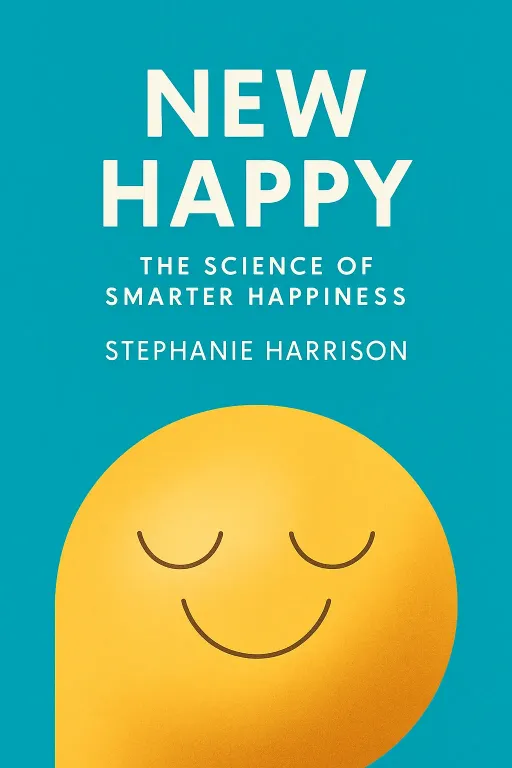
Nova: Exactly. We are living in an era where we have outsourced our internal compass to external metrics. And today, we are going to dismantle that entire system. We are looking at two powerful, complementary frameworks. First, we have Stop Checking Your Likes by Susie Moore, which acts as a masterclass in breaking free from that validation loop. And then, we have New Happy by Stephanie Harrison, which provides the blueprint for shifting from that hollow, individualistic pursuit of success toward something that actually sustains you.
Atlas: That is the perfect pairing. Because you cannot really start building a new definition of success if you are still paralyzed by the fear of what other people think of your current one. It is like trying to renovate a house while you are terrified that the neighbors are going to criticize the paint color. You just end up living in a beige box forever.
Nova: That is a fantastic analogy. And honestly, the work both authors do here is about reclaiming your autonomy. Susie Moore, for instance, writes from the perspective of someone who has navigated the high-pressure world of media and tech, and she really exposes how that anxiety is not just a personality quirk—it is a conditioned response. It is a habit we have been trained to perform.
Atlas: I am curious to see how we bridge these two. Because on one hand, you have the tactical side of silencing the critics, and on the other, you have the philosophical shift of finding purpose. Let’s start with that validation trap. Why is it so hard to just turn off the noise?
The Anatomy of the Validation Trap
SECTION
Nova: The reason it is so difficult is that we have been conditioned to believe that our value is tied to our visibility. We have internalized the idea that if we are not being acknowledged, we are not existing. When Susie Moore discusses the paralysis of seeking validation, she is highlighting that we are effectively handing the remote control of our lives to a crowd that doesn't actually have our best interests at heart.
Atlas: That makes perfect sense. But let’s look at the reality of the professional landscape. If you are a consultant, or a creative, or even a leader in a corporate structure, your entire career trajectory is often tied to external feedback. How do you draw the line between seeking necessary professional feedback and falling into this trap of needing constant approval?
Nova: That is the crucial distinction. The trap is not about feedback; the trap is about identity. When you seek feedback, you are asking, How can I make this work better? When you seek validation, you are asking, Am I a good person? Am I worthy? Am I safe? Moore argues that the latter is a bottomless pit. You can receive a thousand likes on a project, and it will never fill the void if you are using those likes to prove your inherent worth.
Atlas: So, the shift is from performance to process. I imagine for our listeners, who are often building systems and trying to be more efficient, this is a massive productivity hack. If you stop spending your energy managing other people’s perceptions, that energy is suddenly available for the actual work.
Nova: Precisely. And that is where the anxiety comes from. It is the cognitive load of mind-reading. You are constantly running simulations in your head. If I post this, will they think I am arrogant? If I pivot my career, will they think I have failed? You are living in a hypothetical future where everyone is judging you, but in reality, most people are far too busy worrying about their own notifications to pay that much attention to your move.
Atlas: That is a liberating realization. I remember reading about the concept of the spotlight effect, where we massively overestimate how much others are noticing our actions. It is almost arrogant to think we are that important to everyone else’s daily narrative.
Nova: It is, isn't it? And Moore’s approach is about radical self-trust. It is about building a foundation where your own instinct, your own data, and your own results matter more than the consensus. She suggests that you have to actively practice ignoring the noise. It is like training a muscle. You start small. You post the thing, you launch the project, you make the decision, and you do not check the reaction. You let it sit. You sit with the discomfort of silence.
Atlas: That discomfort is the real hurdle. Because silence feels like danger. Our brains are wired for social survival. In the past, being ignored by the tribe meant you were out in the cold. Today, silence just means you are not getting a notification. But the lizard brain does not know the difference.
Nova: That is exactly it. You are fighting millions of years of evolution. And that is why simple willpower is not enough. You need to replace the dopamine hit of the validation with something else. You need to replace it with the satisfaction of completion and the alignment with your own values. And that leads us directly into the second part of our conversation, which is about redefining what that success actually looks like.
From Individualistic Success to Contribution
SECTION
Atlas: Okay, so we have stopped checking the scoreboard. We have silenced the noise. We are standing in the quiet. Now, what do we actually do? This is where I want to bring in Stephanie Harrison’s work. She talks about this shift from the old, individualistic version of success to what she calls the New Happy.
Nova: Yes, and this is a profound shift for the high-achiever. We are taught that success is a zero-sum game. If I get the promotion, you do not. If I have the biggest audience, I win. If I have the most status, I am at the top of the pyramid. Harrison dismantles this. She argues that this model is not just exhausting; it is fundamentally broken because it isolates us from the very thing that makes us human: our capacity to contribute.
Atlas: I can see how that would resonate with someone who has been grinding away at a corporate ladder, only to reach the top and realize the view is not what they expected. What does the alternative look like in practice? How do we move from the me-centered model to the contribution-centered model?
Nova: It starts with self-actualization. You have to understand that your work is not just about what you can extract from the world, but what you can bring to it. Harrison’s path is about finding your unique expression of your talents and using them to serve others. It is not about being a martyr; it is about finding the intersection between what you are good at, what you enjoy, and what the world actually needs.
Atlas: That sounds like a classic Venn diagram approach, but I have a skeptical question here. How does that hold up in a competitive market? If I spend all my time contributing and focusing on self-actualization, am I not just going to get steamrolled by the person who is focused on cutthroat, individualistic winning?
Nova: That is the most common fear. But here is the reality: the person who is only focused on winning is constantly looking over their shoulder. They are stressed, they are burning out, and they are prone to making short-sighted decisions because they are so focused on the immediate win. The person who is focused on contribution is building something that has longevity. They are building trust, they are building a network, and they are building a reputation that is not dependent on a single win or loss.
Atlas: So, it is a long-term play. It is the difference between sprinting and running a marathon. The sprinter burns out, but the marathon runner builds stamina.
Nova: Exactly. And Harrison’s research shows that when you focus on contribution, your own well-being actually improves. You are no longer tethered to the highs and lows of external validation because your success is defined by the value you are creating, not by the applause you receive. It changes the goalpost. Instead of, Did I win? the question becomes, Did I add value?
Atlas: That is a much more stable foundation. I am thinking about our listeners who are in the middle of a career pivot. This is huge for them. If they are trying to transition into a new field, they are probably terrified of losing their status or being seen as a beginner. But if they frame the transition as a chance to contribute in a new way, it changes the entire narrative.
Nova: That is the perfect application. If you are starting over, you are not losing your status; you are expanding your capacity to serve. You are not a failure; you are a student of a new domain. It takes the pressure off the ego and puts it on the work. And that is where the magic happens.
The Deep Question & Synthesis
SECTION
Atlas: I want to circle back to the deep question we touched on earlier. If you were guaranteed that absolutely no one would judge, criticize, or praise your next career move, what path would you choose? That question is the perfect acid test for this entire conversation.
Nova: It really is. It cuts through all the noise. When you remove the fear of the critic and the hunger for the praise, you are left with only your own desire. And that is the place where you want to operate from.
Atlas: I have been thinking about that question. If I really strip away the audience—if I remove the LinkedIn followers, the peers, the family expectations—I think I would be much more willing to take risks that look like failures to the outside world but feel like massive leaps of growth on the inside.
Nova: That is the definition of a conscious architect. You are designing your life based on the blueprints of your own values, not the blueprints of the status quo. And think about the systemic impact of that. If more people did this—if more people stopped playing the comparison game and started playing the contribution game—we would have a totally different culture. We would have fewer people chasing hollow titles and more people building things that actually matter.
Atlas: It is a ripple effect. When one person stops seeking validation, it gives permission to everyone around them to stop as well. It is a quiet revolution. You do not need to announce it. You do not need to post about it. You just start doing it.
Nova: That is the most powerful part. You don't need a manifesto. You just need to change your behavior. Start by ignoring the next notification that triggers a spike of anxiety. Start by asking yourself, Is this next move about me, or is it about the work I am putting into the world?
Atlas: And maybe even start by sharing this perspective with someone who is struggling with the exact same thing. Because we are all in this ecosystem together. If we can shift the focus from the like to the impact, we are all going to be a lot better off.
Nova: That is a perfect place to land. It is not about abandoning ambition; it is about elevating it. It is about moving from a scarcity mindset, where you need others to tell you you are enough, to an abundance mindset, where you know you are enough, and you are ready to give more.
Atlas: That is a powerful takeaway. I feel like we have just stripped away a layer of unnecessary weight. It is refreshing.
Nova: It is. And remember, the goal is not to be perfect. The goal is to be intentional. Every day is a new opportunity to choose your own path over the path of least resistance.
Atlas: I love that. Let’s encourage our listeners to take that 20-minute challenge today. Take a moment, sit with that deep question, and actually write down the answer. Not for an audience, not for a post, but for themselves.
Nova: Exactly. Just for you. Because that is where the real work begins.
Atlas: This has been such a grounding conversation. We have covered a lot of ground, from the mechanics of the validation loop to the philosophy of contribution-based success.
Nova: And it all comes back to the same truth: you are the author of your own story. You might as well write a good one.
Atlas: Couldn't agree more. This is Aibrary. Congratulations on your growth!