

Breaking Free from the External Approval Trap
Golden Hook & Introduction
SECTION
Nova: You know that specific, micro-second hit of dopamine you get when a notification pops up on your phone, telling you someone liked your post or commented on your update? It is easy to dismiss that as just modern convenience or staying connected. But there is a hidden, massive transaction happening underneath that interaction. You are essentially trading a piece of your autonomy for the price of a digital double-tap.
Atlas: That is a brutal way to put it, but honestly, it feels accurate. We talk about social media likes as if they are harmless vanity metrics, but you are suggesting they are actually eroding our ability to define our own value. It makes me realize how much of my day is spent subconsciously measuring my worth against the invisible yardstick of other people's opinions.
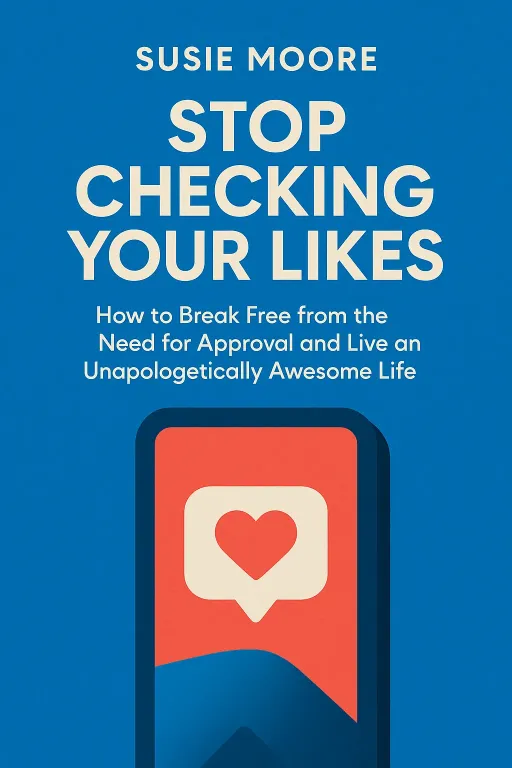
Nova: Exactly. And that is precisely the territory we are mapping out today. We are diving into the book Stop Checking Your Likes by Susie Moore. This isn't just another self-help manual about ignoring social media. It is a deep, no-nonsense investigation into the approval trap—that pervasive, invisible cage we build for ourselves when we prioritize external validation over our own internal compass.
Atlas: I have heard the name Susie Moore in circles that prioritize, well, living on your own terms. What makes her perspective different? Because let's be honest, we have all read the fluff about loving yourself.
Nova: What sets Moore apart is her biography. She grew up in a very tumultuous environment, and she didn't come to these conclusions from a place of comfort. She learned to build inner confidence because the alternative was falling apart. She writes from a place of hard-won experience. Her approach is about shedding that self-doubt and pursuing desires without apology. Today, we are going to break down how to stop living for the audience and start living for the lead actor—which is you.
The Anatomy of the Approval Trap
SECTION
Atlas: That resonates, especially for anyone trying to navigate high-pressure environments, whether that is a corporate career or complex family dynamics. But let's get into the mechanics of this trap. Why do we crave approval so intensely? Is it just a modern, digital-age flaw, or is there something deeper, maybe evolutionary, going on here?
Nova: It is deeply rooted in our biology. We are social animals. For most of human history, being kicked out of the tribe meant death. So, we developed a hyper-vigilance for how we are perceived. That was a survival mechanism on the savanna. But in the modern world, that same mechanism has been hijacked by algorithms and societal expectations. We are constantly scanning for signals that we are "doing it right."
Atlas: That makes sense. It is like the survival instinct is still running, but the threat has changed. Instead of a predator, the threat is an embarrassing social blunder or a critical comment from a boss or a parent. But how does that manifest as a trap? What does it actually look like when someone is caught in this?
Nova: Think of it as a feedback loop that never closes. You do something, you look for a signal that it was good enough, you get that validation, and for a split second, you feel okay. Then, the feeling fades, and you are back to square one, needing the next hit. The trap is the belief that the validation itself is the source of your worth. Moore points out that when you live this way, you are essentially outsourcing your self-esteem to people who are often just as confused and insecure as you are.
Atlas: That is a wild thought. We are handing the remote control of our happiness to people who don't even have their own lives figured out. It reminds me of people who curate their entire lives for an audience that doesn't actually care about them. They are living a performance.
Nova: Precisely. And the danger is that when you live for the audience, you stop taking risks. You stop exploring. You stop doing the things that make you feel alive, because those things might not be "liked" by the people whose approval you are chasing. You start editing your life. You cut out the weird parts, the authentic parts, the parts that might actually be your greatest strengths, just to fit into a mold that someone else created.
Atlas: I can see how that would kill any sense of purpose. If you are constantly checking to see if you are on the right path based on someone else's map, you are never really going to discover your own territory. But how do we distinguish between healthy feedback and this toxic trap? We need mentors, we need feedback at work, we need friends who call us out. Is the goal to become completely indifferent to everyone?
Nova: That is the crucial distinction. Indifference is not the goal. The goal is sovereignty. Think of it as the difference between a compass and a weather vane. A weather vane just spins to show which way the wind is blowing. It has no agency. A compass, however, points to the magnetic north—your internal values, your purpose, your true desires. You can still look at the weather vane to see what is happening around you, but you don't let it dictate your direction.
Atlas: I love that analogy. The compass versus the weather vane. So, we are not trying to become hermits who don't care about anyone. We are trying to become the people who can listen to feedback, evaluate it, and then decide if it serves our internal north star.
Nova: Exactly. And the first step toward that is recognizing the cost. Most people don't realize how much energy they are burning just trying to be palatable to others. If you stop trying to manage everyone else's opinion of you, you suddenly have a massive surplus of mental and emotional bandwidth. That is where the real growth happens.
Strategies for Inner Sovereignty
SECTION
Atlas: That surplus of energy sounds incredible, but let’s talk about the friction. I am imagining someone listening to this who thinks, "Okay, that sounds great, but I work in a company where my boss’s approval is literally my paycheck," or "My family expects me to live a certain way, and if I stop, there is going to be fallout." How does Susie Moore suggest we move from this realization to actual, tangible freedom?
Nova: This is where her no-nonsense, practical approach comes in. Moore emphasizes that the first step is actually identifying the 'who.' Who are you trying to please? Often, we are trying to please ghosts—people from our past, or an abstract idea of 'society' that doesn't actually exist. She argues that we need to audit our approval seeking.
Atlas: An audit of our approval seeking. That sounds like a powerful, if slightly uncomfortable, exercise. How would that work in practice?
Nova: Start with a simple question: If nobody knew about this, would I still want to do it? Or, if I were the last person on earth, would this choice still matter to me? When you strip away the audience, you get down to the core of your own desire. If the answer is yes, you are on the right track. If the answer is no, you are probably doing it for the likes, the applause, or the validation.
Atlas: That is a clarifying question. It exposes the motive immediately. But what about the fear? Because even if I know I am doing something for the wrong reasons, the fear of what happens if I stop is real. The fear of being judged, the fear of being left out.
Nova: That fear is exactly what she addresses. She talks about the necessity of embracing personal freedom as a deliberate act. You have to be willing to be misunderstood. This is the hardest part. You have to accept that not everyone is going to be happy with your choices, and that is okay. In fact, it is a sign that you are moving in a direction that is uniquely yours.
Atlas: That’s a tough pill to swallow. The idea that being misunderstood is actually a sign of progress. Most of us are conditioned to think that misunderstanding is a failure of communication or a failure of character.
Nova: Look at it this way. If you are being perfectly understood by everyone, you are probably just blending in. You are just another reflection of the status quo. When you start living authentically, you inevitably create friction. People who are invested in the old version of you will struggle with the new version. Moore’s strategy is to cultivate a kind of inner confidence that acts as a buffer against that friction. It is not about being arrogant; it is about being anchored.
Atlas: I am curious about the "anchoring" process. How do we build that anchor? Is it just positive thinking, or is there a framework for it?
Nova: It is much more than positive thinking. It is about building a track record with yourself. You start small. Choose one area of your life where you have been seeking approval—maybe it is how you dress, or the hobbies you pursue, or the way you speak in meetings—and do the exact opposite of what you think others want for a week. See what happens. The world usually doesn't end. You realize that the catastrophic consequences you imagined were just stories you were telling yourself.
Atlas: That is a brilliant, low-stakes experiment. It is like stress-testing your own independence. You are basically proving to yourself that the sky won't fall if you are not universally liked.
Nova: Precisely. And with each small success, your confidence grows. You stop looking for external permission. You start giving yourself permission. Moore’s core message is that you are the authority on your own life. You are the one who has to live with the consequences of your decisions, so you should be the one making them.
Atlas: That is empowering. It shifts the burden of responsibility, but it also shifts the power. It sounds like she is advocating for a shift from being a "consumer" of approval to a "creator" of your own life.
Nova: That is a great way to put it. We are usually consuming validation from others to feel full. But when you become a creator of your own life, you are generating your own internal sense of worth. You are not waiting for the applause to know that you are doing a good job. You know it because you are living in alignment with your own values.
Synthesis & Takeaways
SECTION
Atlas: This has been a fascinating shift in perspective. We started by talking about the "approval trap" as a biological survival instinct gone wrong, and we moved to this idea of reclaiming our own internal compass. It feels like the central takeaway here is that we have to be willing to trade the comfort of being liked for the power of being ourselves.
Nova: That is the essence of it. And it is a trade that is always worth making. The most profound insight I take from Moore’s work is that the approval we are so desperately seeking is often a mirage. Even if you get it, it doesn't satisfy you. It is like drinking salt water; the more you get, the thirstier you become. Real satisfaction comes from the internal recognition that you are living a life that is true to who you are.
Atlas: It reminds me that the people who are truly living, who are truly creating, are rarely the ones who are focused on the applause. They are too busy doing the work. They are too busy exploring their own potential.
Nova: Exactly. And for our listeners, the challenge is to take that first step. Don't wait for permission. Don't wait for the likes. Don't wait for the validation of your family or your peers. Start small. Pick one thing this week—just one—that you have been doing for the approval of others, and stop. See what happens. Build that muscle of independence.
Atlas: I love that. It is a practical, actionable challenge. If you are listening to this and you feel that tightness in your chest when you think about making a choice that might upset someone, know that that is your compass pointing you toward your own authenticity. Follow it.
Nova: It is the only path to a life that is actually yours. Thank you for diving into this with me, Atlas.
Atlas: It was a pleasure. To everyone listening, go out there and be your own authority.
Nova: This is Aibrary. Congratulations on your growth!









