

** The Leader's Lost Focus: Reclaiming Deep Thinking in a Distracted World
11 minGolden Hook & Introduction
SECTION
Dr. Celeste Vega: Nick, welcome. I want to start with a thought experiment. Imagine Abraham Lincoln in the final, agonizing days of the Civil War. He's trying to draft the Gettysburg Address, to find the words that will heal a shattered nation. But every thirty seconds, his phone buzzes. A notification from Facebook, a breaking news alert, an urgent email about something utterly trivial. Do you think he could have produced one of the most important speeches in history? Or would his focus, his very ability to think deeply, have been stolen?
Nick: It's a chilling thought, Celeste. And the answer is absolutely not. His superpower, what made him Lincoln, was his ability to hold incredibly complex, conflicting ideas in his mind for long periods. To wrestle with them. That kind of profound thinking is just impossible with constant interruption. It's not just about being distracted from a task; it's about being robbed of the mental space where wisdom is forged.
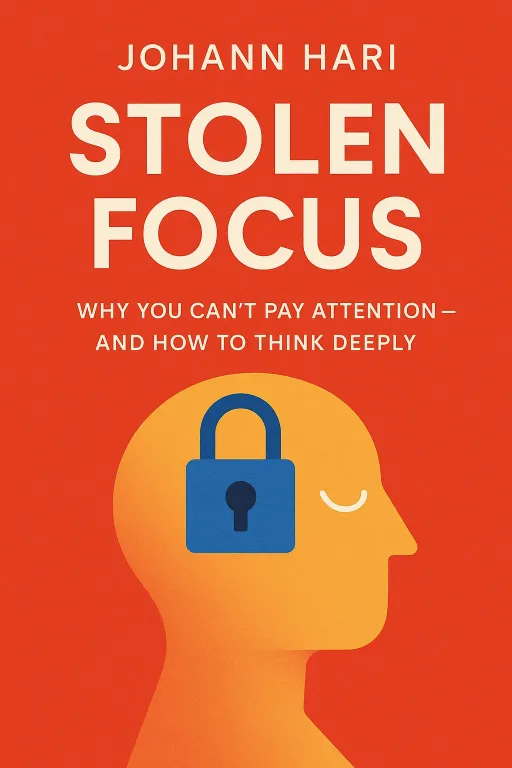
Dr. Celeste Vega: Exactly. And that's the terrifying question at the heart of Johann Hari's book, 'Stolen Focus.' It argues our attention isn't just slipping—it's being systematically taken from us. And for someone like you, Nick, who is interested in leadership and the mindset of great historical figures, this is a critical diagnosis of our times. So today, we'll dive deep into this from two powerful perspectives.
Dr. Celeste Vega: First, we'll expose the myth of personal failure and uncover the real culprits behind our stolen focus. Then, we'll break down the three critical types of attention every leader needs and explore how they are being systematically dismantled.
Deep Dive into Core Topic 1: The Myth of Personal Failure
SECTION
Dr. Celeste Vega: So let's start with that first idea, which I think is incredibly liberating. For years, we've been told that if we can't focus, it's our fault. We're lazy, we lack discipline, we just need to try harder. Johann Hari calls this 'cruel optimism.' It's the belief that you can solve a huge, systemic problem with a small, individual fix.
Nick: It's the 'just pull yourself up by your bootstraps' argument, applied to our brains.
Dr. Celeste Vega: Precisely. And Hari gives this perfect, almost unbelievable example to illustrate it. He talks about a man named Nir Eyal. In the mid-2010s, Eyal wrote a book called 'Hooked,' which became a bible in Silicon Valley. It was, quite literally, a step-by-step manual on how to engineer habit-forming, addictive products. It taught companies how to create those irresistible loops that keep you scrolling.
Nick: I've heard of that book. It's legendary in tech circles.
Dr. Celeste Vega: It is. But then, a few years later, as the public backlash against tech addiction started to grow, Nir Eyal wrote another book. This one was called 'Indistractable.' And it was all about how can fight back against distraction, how to manage your notifications, how to build a focused life.
Nick: Wait, let me get this straight. The same person teaches companies how to build the trap, and then turns around and sells a map of the trap to the people caught in it, essentially blaming them if they can't find their way out?
Dr. Celeste Vega: You've nailed it.
Nick: That's not just cruel optimism; that's an entire business model built on a contradiction. It's like an arsonist selling fire extinguishers.
Dr. Celeste Vega: That's the core of Hari's argument. He says you can't just tell someone to have more willpower when there are literally a thousand of the world's smartest engineers on the other side of the screen whose entire job is to undermine that willpower. He quotes an expert who says telling people to just meditate their way through this is like telling a single mother working three jobs with four kids to just 'change her thoughts' about stress. It completely ignores the environment.
Nick: You know, that reframes it as a leadership issue. If your team is constantly distracted and unproductive, the 'cruel optimism' approach is to send out a memo with '5 Tips to Improve Your Focus.' The real leadership approach, the one Hari is pointing to, is to ask: what in our, in our culture, in the tools we mandate, is actively stealing their attention? Are we, as leaders, the ones handing them the buzzing phones and then getting angry when they're distracted?
Dr. Celeste Vega: That is a powerful and uncomfortable question for any leader to ask. And it leads us directly to what, exactly, is being stolen. It's not just our time. It's something much deeper.
Deep Dive into Core Topic 2: The Leader's Three Lights
SECTION
Dr. Celeste Vega: This brings us to our second point, which I think is the most useful framework in the book, especially for a leader. It comes from a man named James Williams, a former Google strategist who became a philosopher at Oxford. He quit Google because he grew deeply concerned about what the attention economy was doing to humanity.
Nick: A poacher-turned-gamekeeper. I like it.
Dr. Celeste Vega: Exactly. Williams argues that we're not just losing 'attention' in a general sense. We're losing three specific and crucial forms of it. He uses a beautiful metaphor of three kinds of light. The first is your 'Spotlight.' This is your focus in the here and now. It's your ability to concentrate on an immediate task, like reading a report or having a coherent conversation.
Nick: Okay, that's the obvious one. That's what we think of when we say 'I can't focus.'
Dr. Celeste Vega: Right. But then there's the second form: your 'Starlight.' This is your longer-term focus. It's your ability to set and work towards your goals. It's knowing where you want to be in five years, what you're trying to build, what your objectives are. When your starlight is disrupted, you wander aimlessly. You know you should be doing, but you're not sure what.
Nick: I see the leadership parallel immediately. Spotlight is operational management—getting the tasks of the day done. Starlight is strategic vision—the five-year plan, the goal on the horizon.
Dr. Celeste Vega: You're way ahead of me. And that brings us to the third and most profound form of attention: 'Daylight.' Williams says Daylight is your ability to know you have those goals in the first place. It's your capacity to understand your own values, to know what gives your life meaning. It's your self-awareness. When you lose your Daylight, you don't just forget your goals; you forget yourself. You start adopting other people's goals, other people's values, often without even realizing it.
Nick: Wow. So... Spotlight is the 'how.' Starlight is the 'what.' And Daylight is the 'why.' And thinking about the historical figures I admire... Washington at Valley Forge wasn't just thinking about the next battle, the Spotlight. He was holding onto the Starlight of winning the war. But most importantly, he was illuminated by the Daylight of creating a new kind of nation. That 'why' is what gets you through the winter.
Dr. Celeste Vega: That's a perfect analogy. And here's the kicker from the book. James Williams, the ex-Googler, once stood in front of an audience of hundreds of leading tech designers and engineers. He asked them a simple question: "How many of you want to live in the world you are designing?"
Nick: Oh no.
Dr. Celeste Vega: The book says there was a dead silence in the room. People just looked around at each other. Nobody put up their hand.
Nick: That's terrifying. That is one of the most damning stories I've ever heard. The architects don't want to live in the building. That's a catastrophic, society-wide failure of 'Daylight' focus. They're so obsessed with the Spotlight of 'engagement metrics' and the Starlight of 'quarterly profits' that they've completely lost the Daylight of what it means to build a humane, worthwhile world. And we are all living in the consequences of that silence.
Dr. Celeste Vega: That's it. That's the entire crisis in a single, silent moment. Their systems are designed to hijack our Spotlight and Starlight, but in the process, they've lost their own Daylight.
Synthesis & Takeaways
SECTION
Dr. Celeste Vega: So, to bring it all together, Johann Hari's argument is that we're facing a systemic theft of our focus, and it's not our fault. This theft isn't just hurting our productivity; it's actively dimming our Spotlight for daily tasks, our Starlight for long-term goals, and most critically, our Daylight—our very sense of purpose.
Nick: Right. And it's clear the solution can't be another app or a simple life hack. The takeaway for me, especially thinking as a leader, isn't just 'turn off your notifications.' The real first step, the true leadership step, is to stop the cycle of blame. Stop blaming yourself, and stop blaming your team for being distracted.
Dr. Celeste Vega: A shift in mindset.
Nick: Exactly. The action is to start a conversation. To get your team in a room and ask that question: 'What are the forces stealing our focus, in this organization? And how can we,, build a system that protects it?' It's about shifting from a culture of individual discipline, which is that cruel optimism, to a culture of collective defense. That's the real mindset shift this book calls for.
Dr. Celeste Vega: I love that phrase, 'collective defense.' It's not a personal problem to be solved in shame; it's a shared challenge to be met with solidarity. It’s the beginning of what Hari calls an 'attention rebellion.' Nick, thank you for bringing such a sharp and insightful perspective to this.
Nick: Thanks for having me, Celeste. This has given me a lot to think about. It's not just about focus; it's about the foundation of a meaningful life.









