

Beyond Burnout: Reclaiming Your Mental Space in a Demanding World.
Golden Hook & Introduction
SECTION
Nova: Email.
Atlas: Black hole. Definitely a black hole.
Nova: Notifications.
Atlas: Tiny, insistent overlords. They just your attention.
Nova: Multitasking.
Atlas: Oh, that mythical beast that eats your brain. You think you're doing more, but you're just doing everything poorly.
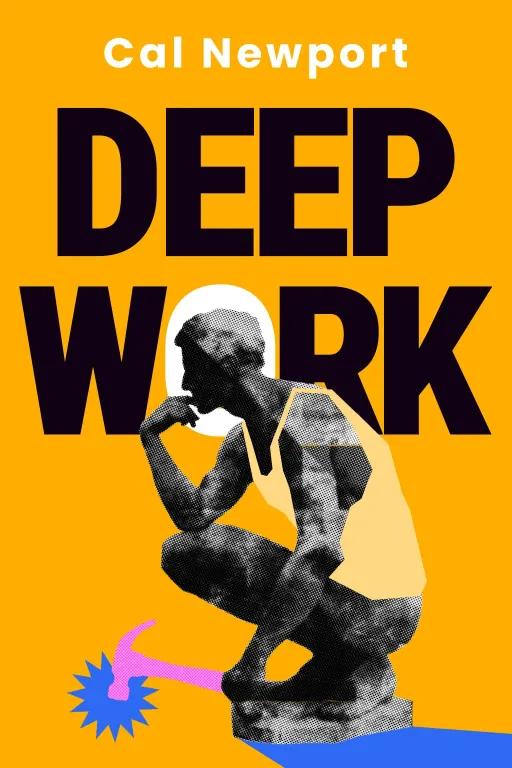
Nova: Exactly! And those beasts are precisely why today, we're diving into two absolute game-changers for anyone feeling constantly pulled in a million directions: Cal Newport’s and Ryan Holiday’s.
Atlas: Oh, books that promise to rescue us from the digital quicksand? I'm listening. Especially when, as a driven professional, the world feels like it's constantly pulling you in a dozen directions. It’s hard to imagine actually achieving.
Nova: Precisely. We're talking about reclaiming your mental space in a demanding world, moving beyond just coping with burnout to actually thriving. Because for ambitious, growth-oriented individuals, protecting that mental space isn't a luxury; it's the ultimate strategic advantage.
The Scarcity of Deep Work: Reclaiming Focused Attention
SECTION
Nova: So, let's start with Cal Newport and his powerful concept of 'deep work.' He argues that the ability to perform focused, uninterrupted work is like a superpower in our increasingly distracted world. Think about it: when was the last time you spent a full hour, let alone a few hours, on a single, complex task without checking your phone, glancing at an email, or getting pulled into a quick chat?
Atlas: That’s a great way to put it. I mean, honestly, that sounds like a vintage dream from a bygone era. My calendar is a battlefield of back-to-back meetings, and my inbox is a constant anxiety trigger. How is a driven professional, say, someone trying to navigate immigration pathways or excel in a demanding career, supposed to carve out this 'deep work' time when the demands are relentless?
Nova: That’s a brilliant question, Atlas, and it gets right to the heart of what Newport addresses. He’s not saying it’s easy; he’s saying it’s. He illustrates this with stories, like a software engineer who, instead of constantly putting out fires, intentionally blocked out a few hours each morning, turning off all notifications, even closing his office door. During those hours, he wasn't just coding; he was for the system.
Atlas: So you're saying he essentially built a fortress of solitude for his brain? I can see the appeal, but what were the actual results? Did his team just let him disappear?
Nova: The results were profound. Not only did his productivity skyrocket in terms of actual, high-value output, but the quality of his solutions dramatically improved. The key was that he wasn't just work; he was about the work. His team quickly saw the value in his focused output, understanding that those dedicated hours led to breakthroughs that saved them days or weeks of future troubleshooting. Newport explains that deep work allows you to push your cognitive capabilities to their limit, creating new value, improving your skill, and making it difficult to replicate your output.
Atlas: That makes me wonder, though, what does 'deep work' actually like? Is it just grinding away, or is there a different quality to it? I imagine a lot of our listeners, especially those driven by self-improvement, want to know if it feels sustainable.
Nova: That’s such an insightful question. It’s not just grinding. When you're in deep work, it often feels like 'flow' – a state where you're so immersed in a task that you lose track of time. It's challenging, yes, but also incredibly rewarding. Think of a surgeon performing a delicate operation, or a writer crafting a crucial chapter. They're not just executing; they're fully present, fully engaged. That's the quality of output Newport champions, and it’s where true, high-impact contributions happen. It protects you from the mental fragmentation that leads to burnout.
Cultivating Inner Stillness: The Foundation for Sustainable Success
SECTION
Nova: And that naturally leads us to the second key idea we need to talk about, which often acts as a foundational counterpoint to deep work: Ryan Holiday’s. Because even if you manage to carve out those deep work blocks, if your inner world is chaotic, if your mind is still buzzing with anxieties and distractions, true focus remains elusive.
Atlas: I can definitely relate to that. I imagine a lot of our listeners hear 'stillness' and immediately think 'meditation retreat,' which isn't exactly compatible with a demanding schedule or the need to plan every next actionable step. How does Holiday suggest we integrate this kind of stillness into a life that's anything but still? Is it just about sitting quietly in a corner?
Nova: That’s a common misconception, and Holiday addresses it beautifully by drawing on ancient philosophy. He shows that stillness isn't idleness; it's a proactive state of calm—in mind, spirit, and body—that unlocks clarity, creativity, and resilience. He uses figures like Seneca, Marcus Aurelius, and even modern leaders who found their own forms of stillness. For example, he talks about how Abraham Lincoln would often retreat to write, or ponder silently, finding his calm amidst the chaos of war, allowing him to make incredibly difficult decisions with a clear head.
Atlas: Wow, that’s actually really inspiring. So, it's less about escaping the world and more about finding a way to process it internally, to create that mental space even when the external environment is demanding? That gives me chills, especially for someone who needs to make critical decisions.
Nova: Exactly. It’s about cultivating an inner sanctuary. Holiday outlines three domains: stillness of mind, which means decluttering your thoughts; stillness of spirit, which involves finding purpose and perspective; and stillness of body, through practices like walking, journaling, or simply being present. He tells stories of leaders who practiced daily walks, not just for exercise, but as a moving meditation, allowing their thoughts to settle and new ideas to emerge. For a driven professional, this isn't about checking out; it's about checking with yourself, allowing for better decision-making and preventing that feeling of being constantly overwhelmed.
Atlas: That’s a perfect example. So, how does this inner stillness connect with the ability to deep work? It feels like they're complementary, but I'm curious about the explicit link.
Nova: They are inextricably linked, Atlas. Deep work is the concentrated effort you put into a task, but stillness is the fertile ground from which that concentration springs. Without stillness, deep work becomes a frantic, exhausting sprint. With stillness, deep work transforms into a calm, powerful flow. Stillness recharges the mental batteries, clears the cognitive clutter, and provides the perspective needed to choose deep work to pursue, and. It’s the resilience that allows you to return to focused effort day after day without burning out. It’s the foundation for sustainable success.
Synthesis & Takeaways
SECTION
Nova: So, what we’ve really explored today is that the path to reclaiming your mental space and achieving sustainable success isn't just about working harder, or even just working smarter. It's about strategically protecting your most valuable resource: your attention and your inner calm. Newport gives us the tools for focused output, and Holiday provides the philosophical and practical framework for the mental resilience required to wield those tools effectively.
Atlas: That’s a great way to put it. It’s about designing your life, not just reacting to it. And for anyone who's a driven professional seeking clarity and actionable steps, this isn't abstract philosophy; it's a strategic imperative. It’s about trusting your process and embracing the journey of self-improvement.
Nova: Absolutely. And the beautiful thing is, you can start small. Our healing moment for this week, straight from the wisdom we’ve discussed, is to schedule just a 30-minute block for uninterrupted, focused work or quiet reflection. Turn off all digital distractions. Just 30 minutes. See what clarity emerges.
Atlas: I love that. It’s a practical, actionable step that doesn’t require a massive overhaul. It’s about acknowledging progress, even in small wins. I’d love to hear from our listeners: what does that 30 minutes look like for you? Where do you find your stillness, or how do you carve out your deep work? Share your experiences with the Aibrary community!
Nova: We’d genuinely love to hear it. Because ultimately, this journey of self-improvement and building an effective, successful life is a shared one.
Nova: This is Aibrary. Congratulations on your growth!









