

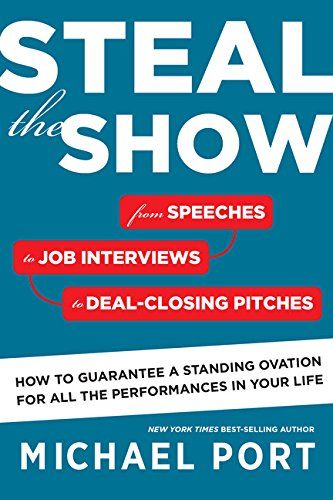
Steal the Show
From Speeches to Job Interviews to Deal-Closing Pitches, How to Guarantee a Standing Ovation for All the Performances in Your Life
Introduction: Beyond Stage Fright
Introduction: Beyond Stage Fright
Nova: Welcome back to the show! Today, we are diving deep into a concept that applies to every single person listening, whether you’re pitching a client, interviewing for a dream job, or just trying to get your kids to eat their vegetables. We’re talking about Michael Port’s game-changing book, Steal the Show.
Nova: Exactly. The core premise is that everything we do where we are the focus—a presentation, a negotiation, even a difficult conversation—is a performance. And if you treat it like a performance, you can stop being terrified of it. Port’s philosophy, which he teaches through his Heroic Public Speaking methodology, is that talent is overrated; preparation and mindset are everything.
Nova: The biggest flip is the shift in focus. Most people prepare by worrying about themselves: How do I look? Will I sound smart? Port demands we stop that self-obsession. He says you must move beyond approval seeking. The moment you focus entirely on what the audience needs, what they need to hear, and what transformation you are delivering for, your own anxiety dissolves. It’s a complete paradigm shift from 'Me' to 'Them.'
Key Insight 1: Everything is a Performance, But It Must Be Authentic
The Actor's Mindset: Embracing the Role
Nova: Let’s start with the foundation. Port insists that we are all actors, whether we realize it or not. He draws heavily on his background in professional theater. What does that mean for the average business professional who has never stepped on a stage?
Nova: That’s the genius of it. He’s not asking you to put on a fake persona. He’s asking you to identify the required by the situation and then play that role with absolute honesty. If the role is 'trusted advisor,' you must embody trust. If the role is 'passionate visionary,' you must embody passion. The key is that the emotion must be real, even if the context is structured.
Nova: Precisely. He identifies the fear of rejection, or the fear of being judged, as the number one killer of performance. Actors train for years to separate their personal self-worth from the character they are playing. When a scene bombs, the actor doesn't go home and decide they are a failure as a human being; they analyze the scene. Port wants us to adopt that same resilience. You are not your pitch. If the pitch doesn't land, you analyze the pitch, not your soul.
Nova: He absolutely does. Rehearsal is non-negotiable. He emphasizes that you must rehearse until the material is so ingrained that you can focus entirely on the audience. He talks about 'blocking'—not just physical movement, but mentally mapping out the emotional arc of your presentation. For example, you rehearse the moment you deliver your Big Idea so many times that it feels like second nature, allowing you to watch the audience’s faces when you actually say it for the first time in front of them.
Nova: It means speaking plainly with conviction. Port often contrasts the dry, informational speaker with the captivating performer. He suggests that the difference often lies in the speaker’s commitment to the material. If you are not fully committed to the truth of what you are saying, the audience senses the artifice. They smell the fear. He wants you to play the role of the person who absolutely believes in the solution you are offering.
Nova: That is exactly the level. And it requires vulnerability. Port champions vulnerability, not as weakness, but as the ultimate connection tool. When you share a genuine struggle or a moment of realization related to your topic, you invite the audience into your world. That’s where the magic happens. It’s the difference between a lecture and a shared experience.
Nova: It is active. It’s intentional. It’s about showing up prepared to something, not just something. And that preparation is what builds the self-possession you need to handle anything that goes wrong.
Key Insight 2: Crafting the Performance Blueprint
The Architecture of Impact: Structure and The Big Idea
Nova: Bullet points are the enemy of performance! Port insists that every successful performance, whether it’s a 5-minute elevator pitch or a 60-minute keynote, must be built around one singular, unforgettable core concept: The Big Idea. This is the one thing you want the audience to remember a week later.
Nova: He frames it as a responsibility. You have to earn the audience’s attention, which is a finite resource. If you give them ten Big Ideas, you’ve given them zero. The process involves ruthless editing. You strip away everything that doesn't directly serve that central thesis. Then, you wrap that Big Idea in The Promise—what will the audience gain by embracing this idea? It’s the benefit statement, the 'What's In It For Me?' answered immediately.
Nova: That’s crucial. Before you even write the Big Idea, you must understand the audience's current reality—their worldview. Port suggests you need to demonstrate that you their struggles, their assumptions, and their current reality better than they might even articulate it themselves. This builds immediate credibility, which is essential for the audience to accept your Big Idea.
Nova: Exactly. You open by describing their world back to them, perhaps with a surprising fact or a relatable anecdote that proves you’ve done your homework. Then, you introduce the Big Idea as the bridge from their current reality to a better future. It’s a narrative arc, not an information dump. Think of it like a movie trailer—it shows the stakes, introduces the conflict, and hints at the resolution.
Nova: Perfect application. And the structure isn't just about the beginning; it’s about pacing. Port emphasizes the use of dramatic tension. You can’t just present evidence linearly. You need peaks and valleys. You build up the problem, you introduce the solution, you demonstrate it with case studies—which are essentially mini-performances within the main performance—and then you bring it home.
Nova: Silence is the most powerful tool in the actor’s arsenal, and Port champions it. Silence is not the absence of sound; it is the of expectation. When you deliver your Big Idea, you must follow it with a deliberate, intentional pause. Let it land. Let the audience process it. If you rush to fill that silence with another sentence, you’ve just told the audience that you don’t trust your own words to have impact.
Nova: Precisely. That pause is where you steal the show. It demonstrates supreme confidence. It forces the audience to lean in. It’s the equivalent of a dramatic close-up in a film. It shifts the power dynamic entirely in your favor because you are controlling the rhythm of the room.
Key Insight 3: The Power of Presence Over Perfection
Mastering the Moment: Vulnerability and Connection
Nova: We’ve covered the mindset and the blueprint. Now we have to talk about the execution on the day. This is where nerves usually derail everything. Port’s advice here seems to revolve around embracing imperfection.
Nova: It’s about connection, not perfection. Port often says, 'Don’t aim for perfect; aim for present.' If you are truly present, focused on the audience’s reaction and ready to adapt, you can recover from any stumble. A stumble handled with grace and a touch of self-aware humor is often more endearing than a perfectly robotic delivery.
Nova: It comes from deep rehearsal, ironically. When you’ve rehearsed the material so thoroughly that you know the behind every sentence, you can improvise around a forgotten word because the intent remains clear. Port calls this 'playing the objective.' Your objective is to make the audience understand the Big Idea. If you forget the exact phrasing, you just state the objective in a different way until you find your footing again.
Nova: It’s about channeling energy, not just generating it. He stresses the importance of physical preparation—breathing exercises, physical warm-ups—just like an actor before a show. But the real secret to sustained energy is the of that energy. If your energy comes from the desire to be liked, it will deplete rapidly. If your energy comes from the desire to serve the audience and deliver a vital message, that energy is renewable because it’s externally focused.
Nova: Port advises against getting defensive or trying to 'win' the argument with a heckler. You treat the interruption as part of the script. You acknowledge the questioner, validate their point—even if you disagree—and then pivot back to your Big Idea. For example: 'That’s a fascinating perspective, and it speaks directly to the challenge we discussed earlier about X. Let’s look at how our solution addresses that specific concern...' You are the director; you control the scene.
Nova: It does. And this discipline is built through practice in lower-stakes environments. Port is adamant that you don't wait for the big conference to practice. You practice in every meeting, every phone call, every time you have to explain something important. You treat every interaction as a chance to hone your presence.
Nova: It has to be this: Identify your Big Idea and your Promise for your next important interaction, write them down, and then rehearse them out loud, standing up, until you can deliver them with genuine conviction, even if you forget every other word. That singular focus is the key to stealing the show.
Conclusion: The Takeaway Performance
Conclusion: The Takeaway Performance
Nova: We’ve covered a lot of ground today, Alex. From realizing that every interaction is a performance to mastering the structural elements like the Big Idea and The Promise, Michael Port offers a complete playbook for commanding attention.
Nova: Absolutely. The performance mindset allows you to be both disciplined in your preparation—through rehearsal and structure—and incredibly free in your delivery—through authenticity and presence. You are not trying to be someone else; you are trying to be the most effective version of yourself for that specific moment.
Nova: And remember that vulnerability is not a weakness; it’s the bridge to connection. Embrace the actor’s discipline, but deliver with the human’s heart. That’s how you move an audience from passive listening to active engagement, and ultimately, how you truly steal the show.
Nova: My pleasure. Keep practicing, keep connecting, and keep delivering your truth with conviction. This is Aibrary. Congratulations on your growth!