

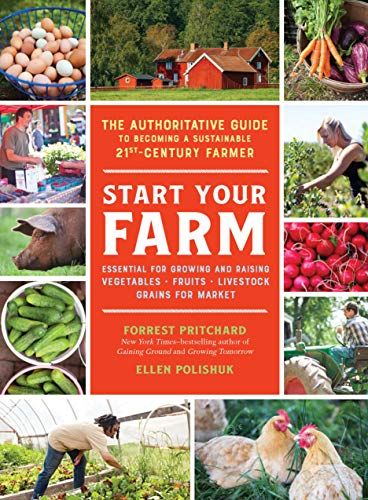
Start Your Farm
Introduction
Nova: Picture this: five tractor-trailer loads of grain, harvested from your family's land, and the paycheck comes back. Eighteen dollars and sixteen cents. That's not a typo. That's what Forrest Pritchard, a seventh-generation farmer, faced in the mid-1990s when he took over his family farm in Virginia's Shenandoah Valley. Today on Aibrary, we're digging into his book Start Your Farm, co-written with Ellen Polishuk, a first-generation vegetable farmer who managed one of the East Coast's most respected sustainable operations for 25 years.
Nova: : Eighteen dollars for five truckloads? That's the kind of moment that either breaks you or completely reorients your life. I have to know what he did next.
Nova: He did something radical. He abandoned industrial commodity farming entirely, transitioned to grass-finished livestock and organic production, and built one of the oldest grass-finished operations in the country. His farm, Smith Meadows, now sells at premier farmers markets around Washington DC. That transformation is really the DNA of Start Your Farm. This book isn't your typical how-to manual on planting seeds or fixing a tractor. It's a philosophical and business guide for anyone who's ever daydreamed about becoming a farmer, and it asks the hard questions most dreamers overlook.
Nova: : So it's for the person stuck in an office cubicle staring out the window, imagining fresh air and tomato vines?
Nova: Exactly. And for the homesteader, the gardener looking to scale up, the career-changer wondering if there's another way to live. Pritchard and Polishuk don't sugarcoat it. They want you to stare down the brutal economics, the physical demands, the emotional toll, and then decide if you still feel the pull. Let's get into it.
Why Farming Still Matters
The Agricultural Inheritance
Nova: The book opens with a striking statistic. A hundred years ago, nearly 40 percent of Americans were full-time farmers. Today, it's less than 2 percent. Pritchard frames this not just as an economic shift but as something almost spiritual. He argues that agriculture is the foundation of civilization itself. Every medical breakthrough, every technological leap, every military victory. None of it happens without a reliable food supply.
Nova: : That puts farming in a completely different light. We tend to think of it as a rustic, maybe even outdated profession. But he's saying it's the original essential work.
Nova: He cites his own grandfather, who was deferred from both World War One and World War Two because his farming was deemed essential to nourishing the nation. And he quotes George Washington, who famously said he'd rather be on his farm than be emperor. There's this thread through history, from Virgil pleading with Roman soldiers to return to agriculture, to Cincinnatus leaving power to go back to his plow. But here's the tension. Despite all that reverence, modern society has systematically devalued the profession.
Nova: : Devalued how?
Nova: Well, Pritchard traces it back to something most people never think about. From the 1600s onward, land in North America was essentially given away. Soldiers got land grants after the Revolutionary War. The Homestead Act of 1862 gave away 270 million acres to 1.6 million farmers. Alaska was still doing homesteading as late as 1986. Generations of Americans never had to account for the true cost of land because they didn't pay for it. That created a cultural blind spot.
Nova: : And that blind spot leads directly to the expectation of cheap food.
Nova: Bingo. When land doesn't appear on the balance sheet as a real cost, food gets priced artificially low. That legacy haunts every farmer trying to make a living today. Pritchard wants aspiring farmers to understand that before they plant a single seed. You're not just battling weather and pests. You're battling centuries of economic distortion.
Do You Have What It Takes?
The Call and the Reality Check
Nova: Chapter one asks bluntly: why be a farmer? Chapter two is even more direct: do you have what it takes? Polishuk and Pritchard break this down into specific categories. Business experience, production capability, marketing skills, and personal temperament. They're not looking for romantic dreamers. They want pragmatists.
Nova: : What's the difference between a romantic dreamer and a pragmatist in this context?
Nova: The authors have a line I love: farming is for pragmatists, not perfectionists. Getting something one hundred percent right in farming is not only rarely possible, it's rarely necessary. It's better to hoe beans quickly with a few casualties than to spend forever hoeing perfectly. There's simply too much to get done. Good enough is better than perfect. Time is as valuable as money.
Nova: : That's counterintuitive. Most of us associate farming with a kind of meticulous care.
Nova: And that care matters for certain things. But the authors argue that perfectionism is actually a liability in agriculture. You'll burn out. You'll miss planting windows. You'll lose crops because you were obsessing over something inconsequential. They also emphasize something most how-to-farm books skip entirely: personal temperament. Leadership, decisiveness, flexibility, joyfulness. If you're a grump, they say, reserve that for when you're working alone.
Nova: : So the book is part personality test?
Nova: Exactly. Each chapter ends with searching questions designed to force honest self-assessment. What are your strengths and weaknesses? Are you comfortable with numbers? Can you sell? Can you lead people? Polishuk is particularly blunt about the financial reality. To earn an annual income of forty to fifty thousand dollars, you need to grow, harvest, and market about a hundred twenty-five thousand dollars worth of agricultural products. That's extremely difficult for one human alone.
Nova: : That puts things in perspective. You're not just growing food. You're running a business that happens to involve biology, chemistry, meteorology, and heavy machinery.
The Business Nobody Teaches
Land, Money, and the Tai Chi of Economics
Nova: Let's talk about land, because this is where Start Your Farm really distinguishes itself. Pritchard argues forcefully that the key is access to land, not acquisition. Buying land with debt should be your last resort, not your first step.
Nova: : Wait. Isn't buying land the whole point of starting a farm?
Nova: Not necessarily. The book lays out multiple models. Leasing from retiring farmers. Land-sharing arrangements. Farm incubator programs. There's a whole generation of older farmers who want to retire, want their land to stay in agriculture, and are looking for the next generation to take over. Pritchard calls debt-financed land purchasing their least-recommended route. If you must borrow, bypass conventional banks and go to the Farm Services Agency, which offers farm-friendly financing.
Nova: : He also introduces what he calls the blind spot about land value, right?
Nova: Yes. Think of land as an investment that must provide a financial return, just like a pile of cash equal to the land's value. You wouldn't leave that cash under a mattress. You'd invest it so it grows at least as fast as inflation. If your land isn't generating a comparable return, it's actually losing value, and you're subsidizing that loss with your labor without even realizing it.
Nova: : That's a sobering way to think about it.
Nova: Then there's the Money Triangle. Financial stability, Pritchard says, depends on balancing three things: your potential to earn money, save money, and give money. He introduces the 10 Percent Plan. Make at least ten percent net profit, save at least ten percent of those profits and invest them at ten percent interest, and give away ten percent of what those investments generate. For debt: never borrow more than ten percent of your gross annual income or pay more than ten percent interest.
Nova: : And Ellen Polishuk contributes something she calls Tai Chi Economics?
Nova: This is one of the most original ideas in the book. The price you can charge for tomatoes in Oregon is affected by the price of natural gas in Pennsylvania, the wages of farmworkers in Florida, international tariffs. Most of these forces you can't control. Tai Chi Economics is about using grace to meet incoming force, engaging that force until it wears itself out, and learning from your opponent. As Lao Tzu put it, the soft and the pliable will defeat the hard and the strong. In practical terms, it means finding sustainable local markets that are less dependent on the global commodity system, identifying a need, and building relationships.
Nova: : So instead of fighting the global market, you sidestep it.
Nova: Precisely. And profit is not a dirty word. The authors are emphatic about this. Profit lets you pay decent wages, invest in the farm, save for disasters, and actually have a life. They talk about the triple bottom line of a sustainable business: ecological stewardship, social justice, and economic viability. All three have to work together.
The Beautiful Paradox
Failure, Resilience, and the Go Chapter
Nova: One of my favorite sections of the book is what Pritchard calls the Beautiful Paradox of Failure. No two farming seasons are the same. Sustainable farming, he writes, is built around the expectation that things change, that adaptability and innovation remain paramount, and that failure, when it occurs, is a critical teaching tool.
Nova: : That sounds philosophical, but what does it look like on the ground?
Nova: A crop you poured months into gets wiped out by an unexpected frost. A market you were counting on collapses. Equipment breaks at the worst possible moment. Pritchard's argument is that without failure, you're less likely to develop the creativity and resourcefulness that define successful farmers. The book is littered with personal stories of mistakes from both authors. They both admit they started with very little knowledge and learned by doing.
Nova: : So they're not positioning themselves as gurus.
Nova: Not at all. They're two farmers who made thousands of mistakes and survived. But they also offer practical tools to reduce failure's frequency. They mention a free tool called Veggie Compass, a spreadsheet-based system developed for diversified vegetable growers that helps you compute the real costs of each crop across different marketing channels. If you're selling eggs at six dollars a dozen but they cost you seven dollars to produce, you'd do better handing out dollar bills and skipping the hens. Record keeping is non-negotiable.
Nova: : What about the human side? Farming sounds incredibly isolating.
Nova: It can be. Polishuk writes a whole chapter called Love, Work, and Harmony. She argues that communication dramas might be the hardest part of farming. If you have more than six people working for you, keeping them happy and productive is a full-time management job. She quotes Jean-Martin Fortier: if you think you can farm and parent small children at the exact same time, you are doing neither activity well. The authors push hard on learning to speak your truth without criticism or blame, and learning to listen without taking offense.
Nova: : And the final chapter?
Nova: It's simply called Go, and it can stand alone as a piece of writing. It walks you through your first day, your first harvest, your first sale, imagining what each will feel like. Then it pulls back with a caution: it's not rainbows and sweet breezes all the time. But here's the closing thought: the only thing we know for sure is that when we pour our passion into what we love, we end up with more than we give.
Conclusion
Nova: So what do we take away from Start Your Farm? First, farming is not a lifestyle escape. It's one of the most demanding professions imaginable, physically, emotionally, financially. The authors want you to know that before you commit. Second, the path in doesn't have to be the traditional buy-the-farm-and-go-broke story. Access to land can come through creative arrangements, and avoiding debt is a competitive advantage, not a sign of weakness.
Nova: : The business wisdom in this book honestly applies far beyond farming. The Money Triangle, the ten percent rules, the idea of Tai Chi Economics, the emphasis on pragmatism over perfectionism, the beautiful paradox of failure. These are life principles.
Nova: Completely. Third, sustainable farming is defined by a triple bottom line: ecology, social justice, and profit. All three must function together. And finally, the book is really a love letter to the profession. Pritchard reminds us that just a century ago, nearly half the population was directly connected to the land. Today it's two percent. Those two percent carry an enormous responsibility, and the authors call them volunteers. People who have chosen this work despite every rational reason not to.
Nova: : And for the listener who's been daydreaming about this, what's the first step?
Nova: The authors are unanimous. Don't buy anything. Don't quit your job. Go work on a farm first. Apprentice, intern, volunteer. Learn by doing, preferably from someone else's mistakes rather than your own. And then ask yourself the hard questions this book puts forward. Dreaming is free. Farming is not. But for the right person, it might just be the most meaningful work there is.
Nova: : This is Aibrary. Congratulations on your growth!