

The Entrepreneurial Journey: Navigating Challenges & Embracing Growth
Golden Hook & Introduction
SECTION
Nova: You know, Atlas, I was today years old when I truly grasped that the biggest enemy to a business's growth isn't a bad product or even a tough market. It’s often the founder themselves, trapped in the very thing they created.
Atlas: Oh, I love that. That’s going to resonate with anyone who struggles with feeling like their business owns them, instead of the other way around. It’s like being a brilliant chef who suddenly finds themselves spending all their time ordering supplies and fixing leaky pipes, instead of cooking.
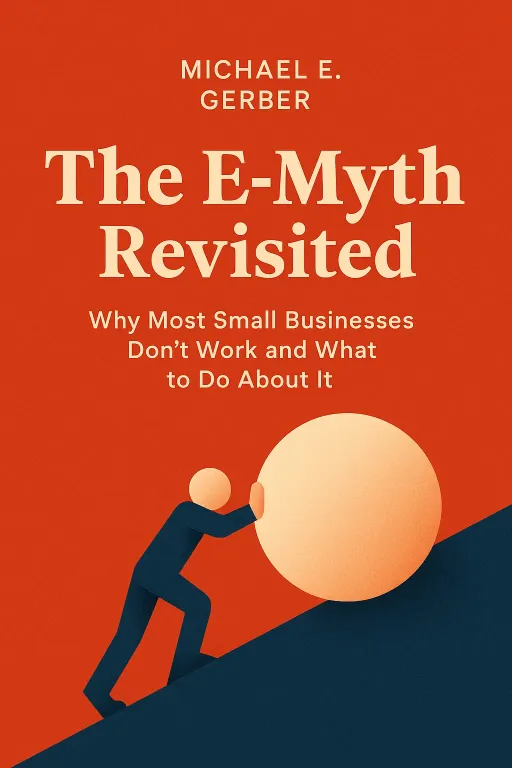
Nova: Exactly! And that’s why today, we’re diving deep into some foundational texts for anyone looking to build something that outlives their direct, everyday toil. We’re talking about "The E-Myth Revisited: Why Most Small Businesses Don't Work and What to Do About It" by Michael E. Gerber, and we’ll weave in the profound insights of Simon Sinek’s “Start with Why” and James Clear’s “Atomic Habits.”
Atlas: That’s a powerful trio. Gerber’s book, you know, it’s one of those rare business books that was actually rejected by over 100 publishers before it became a runaway success. It’s almost an underdog story itself, mirroring the struggles of the small business owners it aims to help. It truly challenges that romantic notion of the entrepreneur as a lone genius.
Nova: It absolutely does, and it's a book that has gained widespread acclaim for doing just that. It forces you to look at your business not as a passion project, but as a system. And that’s where we start our journey today: understanding the critical difference between working your business and working it.
Building for Longevity: The E-Myth and Systems
SECTION
Atlas: So, you’re saying that the romance of the entrepreneurial journey, the whole "follow your passion" vibe, can actually be a trap? That sounds a bit out there.
Nova: Well, it’s not that passion is bad, Atlas. It’s vital. But Gerber argues that most small businesses are founded by what he calls a "technician suffering from an entrepreneurial seizure." Someone brilliant at their craft—a baker, a coder, a consultant—decides to start their own business because they’re good at the.
Atlas: Oh, I’ve been there. You’re great at making the cupcakes, so you think, "I'll open a cupcake shop!" But suddenly you’re also the accountant, the HR department, the marketing team, and the janitor.
Nova: Precisely. And that's where the "E-Myth" comes in. The myth is that people who want to start a business are true entrepreneurs. But often, they’re just technicians who want to be their own boss. Gerber explains that the technician, the manager, and the entrepreneur are three distinct personalities required for a successful business. Most small business owners are 70% technician, 20% manager, and 10% entrepreneur.
Atlas: So basically, you’re saying that if you’re amazing at making those cupcakes, you’re probably terrible at managing the business of selling them, or envisioning how to scale it?
Nova: Not necessarily terrible, but untrained and overwhelmed. Gerber’s core insight, which has earned the book its "cult classic" status and enduring relevance, is that you need to build your business. Not necessarily to franchise it, but to create systems and processes so robust that it doesn't depend on specifically doing everything. It’s about creating a business that runs itself, freeing you to innovate, to be the entrepreneur.
Atlas: That’s a great way to put it. It’s like, instead of just making the best burger, you’re designing the perfect system for consistently making the best burger, no matter who’s flipping it. For our listeners in, say, the food industry, navigating supply chains and regulatory compliance, this must feel incredibly relevant. How do you even begin to systemize something as complex as sourcing ingredients or ensuring food safety?
Nova: It starts with documentation, Atlas. Clear, step-by-step instructions for every single repeatable task. Think of McDonald's. Ray Kroc didn't invent the hamburger, but he perfected the for making and serving it consistently. That consistency, that predictability, is what allows for growth and longevity. It’s about creating a replicable model. When you have a system for quality control, for inventory, for customer service, you move from working the business, constantly putting out fires, to working the business, refining those systems.
Atlas: I guess that makes sense. A lot of our listeners are visionaries, driven by growth and impact. But sometimes that vision can get bogged down in the day-to-day. This sounds like it’s about translating that big vision into practical, repeatable steps. It’s not just about what you do, but you do it consistently.
Your Path to Lasting Impact: Why and Habits
SECTION
Nova: And this is where Simon Sinek’s “Start with Why” beautifully complements Gerber’s systems thinking. Because once you have a system, you need to know it’s all for. Sinek argues that truly inspiring leaders and organizations communicate from the inside out, starting with their 'why'—their purpose, cause, or belief—before moving to the 'how' and 'what.'
Atlas: So you're saying that the "why" isn't just a fluffy mission statement? It's the core belief that drives the entire system?
Nova: Exactly. Think about Apple. They don't just say, "We make great computers." They start with challenging the status quo, empowering creativity. That’s their why. The computers are just they do it. When you understand your 'why,' it informs every system you build, every product you create, every person you hire. It provides direction, especially when navigating challenges like supply chain optimization or understanding consumer psychology.
Atlas: Wow. That gives me chills. It’s like, if Gerber gives you the blueprint for the house, Sinek tells you you’re building it in the first place, what kind of life it’s meant to facilitate. But how does this connect to James Clear’s "Atomic Habits"? Where do habits fit into building for longevity and finding your "why"?
Nova: Great question, and this is where the rubber meets the road. "Atomic Habits" provides the practical, step-by-step framework for implementing those systems and living by your 'why.' Clear demonstrates that true growth, whether personal or business, comes from small, consistent improvements. He calls them "atomic habits" because they are tiny, fundamental changes that, like atoms, are the building blocks of remarkable results.
Atlas: Oh, I see. So if your 'why' is to empower creativity, and your system is to build user-friendly tech, your atomic habit might be to dedicate 30 minutes every morning to user research, or to consistently simplify one feature in your product each week. It’s not about grand gestures, but about the relentless aggregation of marginal gains.
Nova: Precisely! Clear explains that habits are the compound interest of self-improvement. The problem isn’t a lack of motivation; it’s a lack of clear systems. He offers four laws of behavior change: make it obvious, make it attractive, make it easy, make it satisfying. You can apply these to systemizing your business. Want to refine your 'why'? Make it obvious by putting it on your wall. Want to improve a process? Make it easy by breaking it down into tiny steps.
Atlas: That makes so much sense! For our listeners who are trying to optimize their supply chain, instead of trying to overhaul everything at once, they could pick one small, repetitive task in their inventory management, document it, refine it into a clear system, and then apply Clear’s laws to make sure it sticks. It’s a powerful combination: the vision, the structure, and the daily discipline.
Nova: Exactly. True growth, lasting impact, it all comes from this understanding. It’s about understanding your purpose, building robust systems that support your vision, and then consistently applying small, powerful habits to execute those systems. This frees you to innovate, to truly be the entrepreneur, and to make a lasting impact.
Synthesis & Takeaways
SECTION
Atlas: This has been incredibly insightful, Nova. It really reframes the entrepreneurial journey from a chaotic sprint to a deliberate, thoughtful marathon. The idea that most small businesses fail not because of a bad idea, but because the founder is trapped the business, not it, is such a powerful, almost heartbreaking, truth.
Nova: It’s a truth that Michael Gerber laid bare, and it’s why his work continues to resonate. It’s about building a business that works you, not the other way around. And as we’ve discussed, that shift requires understanding your deep 'why' from Simon Sinek, and then implementing it through the consistent, small actions James Clear describes in "Atomic Habits."
Atlas: So, for our listeners who are visionaries, pragmatists, and communicators, driven by growth and impact, the takeaway isn't just to dream bigger, but to systemize smarter. It’s about clearly articulating your 'why' and then identifying one repetitive task in your business today and figuring out how to build a system around it. Move from working your business to working your business. That’s where true empowerment lies.
Nova: Absolutely. It’s about architecting your dream, not just living in it. The journey is embracing growth, but that growth is only sustainable if it's built on a solid foundation of purpose and process.
Atlas: That’s actually really inspiring. It means you don’t have to be a superhero; you just have to be a diligent systems builder.
Nova: Precisely. And that, my friends, is the path to lasting impact.
Atlas: This is Aibrary. Congratulations on your growth!