

Personalized Podcast
Golden Hook & Introduction
SECTION
Nova: You're three years into a flagship project. The budget is ballooning, the market has shifted. Your gut says one thing, the initial projections say another. Do you start over, stay the course, or leave the project entirely?
emma zhu: That's a scenario every analyst and leader lives in fear of. It's the point where all the spreadsheets in the world can't give you a clean answer.
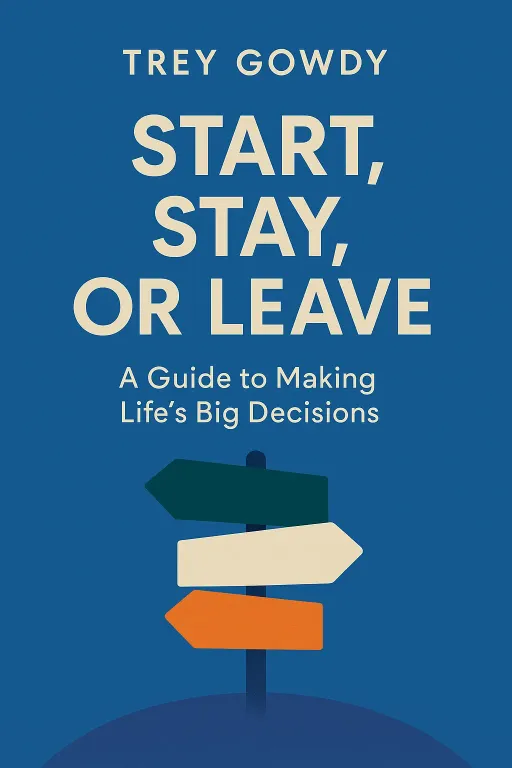
Nova: Exactly. These are the gut-wrenching 'Start, Stay, or Leave' decisions that define our careers. Today, we're cracking open a powerful framework for these moments from a very unlikely source: former prosecutor and congressman Trey Gowdy's book, "Start, Stay, or Leave." And to help us translate this legal-eagle logic into actionable business strategy, we have finance business analyst and strategic thinker, Emma Zhu. Welcome, Emma!
emma zhu: Thanks for having me, Nova. I was fascinated by the idea of applying a prosecutor's mindset to the business world. It's a field obsessed with data, but the biggest decisions are often leaps of faith.
Nova: That's the perfect way to put it. And Gowdy gives us a structure for that leap. So today we'll dive deep into this from three perspectives. First, we'll explore the power of starting at the end, essentially writing the victory speech before the battle begins.
emma zhu: I love that. It’s about defining the win condition.
Nova: Precisely. Then, we'll discuss how to build your personal advisory board, combining radical self-reflection with brutally honest feedback.
emma zhu: The personal and the external. A crucial balance.
Nova: And finally, we'll tackle the toughest decision of all: how to know when it's time to leave. Ready to dive in?
emma zhu: Let's do it.
Deep Dive into Core Topic 1: Start at the End
SECTION
Nova: So, Emma, let's jump right into that first idea, which feels so counter-intuitive: 'Start at the End'. Gowdy tells this incredible story from his days as a prosecutor that really brings this to life.
emma zhu: I'm listening.
Nova: He's assigned a major murder trial. Now, you'd think the first step would be to start gathering evidence, interviewing witnesses, building a timeline, right? That’s what most people would do. But Gowdy does the opposite. Before he does anything else, he locks himself in a room, alone, and he writes the closing argument.
emma zhu: The very last thing the jury hears, he writes first.
Nova: Exactly! He imagines himself standing in front of the jury at the end of a long, grueling trial. He writes out, word for word, the story he needs to tell. He identifies the one piece of evidence that will be the emotional core, the key testimony that will seal the deal, the logic that will leave no room for doubt. He creates the entire narrative of victory before the first witness is even questioned.
emma zhu: That's brilliant. It's a forcing function.
Nova: It is! He argues that if you don't know what the final scene looks like, you're just collecting information aimlessly. You'll waste time on witnesses who don't matter and evidence that doesn't fit the story. The closing argument becomes his filter for everything. Emma, as an analyst, that must resonate. Does that map onto the world of finance?
emma zhu: Absolutely. It's a perfect analogy for defining an investment thesis or an exit strategy. You don't just invest in a company because its technology is cool or the founders are charismatic. That's just collecting information. You invest because you can clearly articulate, 'In five years, this company will be acquired by Google for X billion because of its unique data-processing algorithm,' and then you work backward to see if the steps to get there are plausible.
Nova: So Gowdy's 'closing argument' is your 'exit memo'.
emma zhu: It's exactly our 'exit memo'! We write it before we even invest a dollar. It forces you to stress-test the story from day one. If you can't write a convincing 'closing argument' for why a project will succeed, or why a career move will pay off in three years, then all the data you're collecting is probably just noise. It's a filter for what matters.
Nova: I love that framing. It's not just about setting a goal; it's about proving to yourself that the story of how you get there is believable from the very start.
emma zhu: Right. It separates a wish from a strategy. A wish is "I hope this works." A strategy is "I know what victory looks like, and here are the non-negotiable steps to achieve it." Gowdy couldn't win his case without certain evidence; we can't get our return without the company hitting specific milestones. Same logic, different field.
Deep Dive into Core Topic 2: The 'Mirror' and the 'Nathan'
SECTION
Nova: That idea of a filter is a perfect bridge to our next point. Because once you have your 'closing argument,' you need to be sure it's argument, not one someone else handed you. This brings us to Gowdy's powerful concepts of the 'Mirror' and the 'Nathan.'
emma zhu: Okay, I'm intrigued by the names.
Nova: They're great, right? First is the 'Mirror.' Gowdy challenges the typical models of success—the corporate ladder, the pyramid. He says those are external structures. Instead, he proposes a 'mirror' model. Success is what you see when you look in the mirror and can honestly say you're proud of your effort, your integrity, your growth, regardless of your title.
emma zhu: That's a tough pill to swallow in a world that runs on titles and external validation. Especially in finance.
Nova: It's a huge challenge! And that's why the second concept is so critical: 'Find Your Nathan.' This comes from the biblical story of King David, who does something terrible. All his advisors are too scared to confront him, except for the prophet Nathan, who walks in and, at great personal risk, tells the king the unvarnished, brutal truth.
emma zhu: So a 'Nathan' is someone who will call you out.
Nova: Yes! A 'Nathan' is someone who loves you enough, or respects you enough, to tell you the truth you don't want to hear. They're not a cheerleader; they're your conscience. So we have this dual challenge: looking in the mirror to define our own success, and finding a 'Nathan' to keep us honest about it. Emma, in the competitive world of finance, how do you even begin to use the 'mirror'?
emma zhu: You know, it's a constant battle. The 'ladder' is everywhere. But the 'mirror' is about defining your own alpha, your personal edge or source of value. Is your success measured by the size of your bonus, or by the fact you helped fund a company that genuinely changed an industry? For an ENTJ like me, a 'Commander,' the drive to win is incredibly strong, so the mirror has to be a conscious choice. It's about pausing and asking, 'What game am I actually playing, and why am I trying to win it?'
Nova: That's a profound question. And what about finding a 'Nathan'? That sounds both terrifying and absolutely essential.
emma zhu: It is. A 'Nathan' isn't a 'yes-man.' In the business world, we have a formal version of this: the 'red team.' When you're about to launch a product or make a big investment, you assemble a separate team whose only job is to try and destroy your idea. They poke holes, question every assumption, and point out every flaw.
Nova: They play the role of the adversary.
emma zhu: Exactly. They're not being negative; they're making you stronger. They're stress-testing your 'closing argument.' Finding someone who will do that for your... that's the holy grail. It's the mentor who tells you to take the big promotion because it moves you away from what you're truly brilliant at. That person is your Nathan, and they are worth their weight in gold.
Deep Dive into Core Topic 3: The Exit Strategy
SECTION
Nova: And that advice—to tell you to take the promotion—is the ultimate test of a 'Nathan.' It leads us perfectly to the final, and perhaps hardest, decision: leaving. Gowdy has this fantastic chapter where he says everything has a 'shelf life.'
emma zhu: I found this part of the book really compelling. It's a concept we use for products, but rarely for our own careers.
Nova: Totally. And he tells a very personal story. After his success as a federal prosecutor, he became a circuit solicitor, which was his dream job. He was prosecuting the most violent crimes in his community, and he was exceptionally good at it. He was winning, getting justice for victims. By all external metrics, he should have stayed forever.
emma zhu: So why did he leave?
Nova: Because, as he puts it, the work was taking a 'spiritual toll.' The constant exposure to the darkest parts of humanity—murder, abuse, tragedy—was hollowing him out. He realized that even though he could physically do the job for another twenty years, his soul couldn't. He recognized the job had a 'shelf life' for, personally, even if his career trajectory was pointing straight up.
emma zhu: He made a decision based on a different kind of P&L, a personal one.
Nova: That's it exactly! He made a choice based on his own well-being. So, Emma, how do you apply a cold, hard metric like 'shelf life' to something as personal and emotional as a job you love?
emma zhu: You can actually quantify it, in a way. It's not as clean as a financial statement, but you can track the data. First, your learning curve. Is it flattening out? Are you still growing or are you just executing? Second, you can assess what I'd call your 'emotional P&L.' You list the positives—salary, experience, fulfillment—and the negatives—stress, burnout, time away from family. At some point, the costs start to outweigh the benefits.
Nova: So Gowdy's 'spiritual toll' was his key metric.
emma zhu: Precisely. For him, the 'emotional cost of goods sold' became too high. The business was no longer profitable for his life. In finance, we might call that accumulating an 'unsustainable emotional debt.' You can run on that for a while, but eventually, it leads to bankruptcy.
Nova: Wow, 'unsustainable emotional debt.' That is a powerful concept. Gowdy also has a phrase for the mindset needed to make this call. He says you have to be 'selectively selfish.' That sounds like a phrase a 'Commander' personality could get behind.
emma zhu: I'll admit, I smiled when I read that. It's about being the CEO of your own career. A CEO has a fiduciary duty to the long-term health of the company—and in this case, the company is you. Sometimes the most responsible, strategic decision is to divest from a failing asset or a business line that's no longer core to the mission, even if you have an emotional attachment to it. Being 'selectively selfish' isn't about being a bad person; it's just good governance of your own life and energy.
Synthesis & Takeaways
SECTION
Nova: I love that. Good governance of your own life. So, to bring it all together, we have these three powerful tools from Gowdy's world that translate perfectly to ours. First, Start at the End—write your closing argument before you begin.
emma zhu: Know what victory looks like.
Nova: Second, build your inner circle with a Mirror and a Nathan—define your own success and find someone who will hold you accountable to it with brutal honesty.
emma zhu: Check your ego and your blind spots.
Nova: And third, be the CEO of your career by understanding 'shelf life' and being 'selectively selfish' enough to know when to exit.
emma zhu: Manage your personal P&L and don't be afraid to divest.
Nova: It's such a clear, actionable framework. Emma, if you were to leave our listeners with one final thought or question, what would it be?
emma zhu: I think it all comes back to that first, powerful idea. The best way to start is to ask yourself one question right now, about your current job, your big project, whatever it is that's on your mind: If this were a trial, what would your closing argument be? Can you stand up and deliver it with conviction? If not... you might already have your answer on whether to start, stay, or leave.
Nova: A perfect, and perfectly challenging, place to end. Emma Zhu, thank you so much for translating these ideas with such clarity.
emma zhu: It was my pleasure, Nova. A great conversation.









