

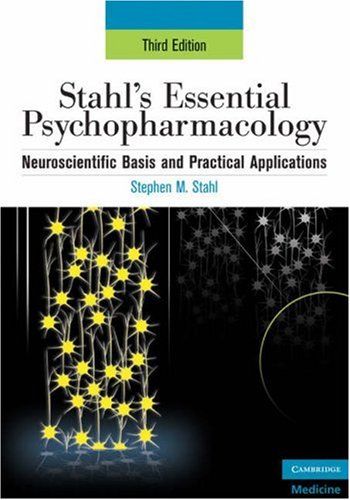
Stahl's Essential Psychopharmacology
Introduction
Nova: Imagine a textbook so influential that it's known simply by its author's last name. Like Harrison's for medicine or Guyton's for physiology. In the world of psychiatry, that name is Stahl. Stephen M. Stahl's Essential Psychopharmacology has, in just over two decades, transformed how an entire generation of clinicians understands the brain, mental illness, and the drugs used to treat them.
Nova: Far from it. This is the book that took one of the most intimidating subjects in medicine, how drugs act on the brain, and made it not only accessible but genuinely captivating. We're talking about a single-author work that spans over a thousand pages, filled with hundreds of hand-drawn illustrations, that has become the global gold standard for psychopharmacology education.
Nova: That's exactly what we're going to unpack today. The secret sauce of Stahl's Essential Psychopharmacology isn't just the science, it's the visual language, the storytelling, and an approach to teaching that turns complex neurotransmitter cascades into something you can almost see in your mind's eye. Whether you're a psychiatry resident, a practicing clinician, or just someone fascinated by how the brain works, this book has reshaped the conversation.
Who Is Stephen Stahl?
The Man Behind the Brand
Nova: So before we crack open the book itself, let's talk about the author. Stephen M. Stahl is not your typical academic. He holds both an MD and a PhD, he's board-certified in psychiatry, and he's held faculty positions at Stanford, UCLA, and the Institute of Psychiatry in London. But here's what really sets him apart: he spent several years as the Executive Director of Clinical Neurosciences at the Merck Neuroscience Research Center in the UK.
Nova: Exactly. And that dual perspective, academic clinician plus industry researcher, gives him a uniquely practical lens. He's also the chairman of the Neuroscience Education Institute, an organization he founded that has educated tens of thousands of clinicians worldwide. He's essentially built an educational empire around making psychopharmacology comprehensible.
Nova: That's a fair point, and one that's been debated in the field. His books tend to present the dominant scientific view rather than diving deep into controversies. But the sheer educational impact is undeniable. As one reviewer in the Indian Journal of Psychiatry put it, Stahl's has joined the ranks of classics like Harrison's and Guyton's. It's become a brand name in barely over a decade, which in medical publishing is lightning speed.
Nova: That's the fascinating part. Before Stahl came along, psychopharmacology textbooks were notoriously dense and impenetrable. They'd list receptor subtypes and second messenger cascades in ways that even many doctors found overwhelming. Stahl's insight was that if you could visualize these mechanisms, if you could literally draw what was happening at the synapse, the concepts would stick. And that's exactly what he did.
How Pictures Changed Psychiatry Education
The Visual Language Revolution
Nova: Here's the thing that makes Stahl's Essential Psychopharmacology genuinely revolutionary: the visual language. Every concept in the book, every neurotransmitter pathway, every drug mechanism, is illustrated with a consistent set of icons and diagrams. There's a little neuron with its receptors, there are neurotransmitter molecules shaped like specific symbols, and there are drugs depicted as distinct shapes that fit into or block those receptors.
Nova: Precisely. And the consistency is key. Once you learn that a particular icon means dopamine, or that a certain receptor shape is a D2 receptor, that visual vocabulary carries through all thirteen chapters. The fifth edition, published in 2022, includes over 500 new or refreshed figures, with an intuitive color scheme that helps you instantly recognize what you're looking at.
Nova: That's exactly what Stahl calls it: his unique visual language. And he didn't stop at the book. He created animated video versions, each 30 to 45 minutes long, where those same illustrations come to life. You can watch dopamine being released, reuptake pumps working, drugs blocking receptors, all in motion. It's remarkably powerful for learning.
Nova: He works with a medical illustrator, Nancy Muntner, who's been his collaborator for decades. But the conceptual design, the visual metaphors, those come from Stahl. He's said in interviews that he thinks visually and teaches visually, that this method came naturally to him as a way of explaining complex mechanisms to students who were struggling with the traditional text-heavy approach.
Nova: Overwhelmingly positive. One reviewer noted that you could flip through the book looking only at the tables and figures and still assimilate most of the core message. Addiction Biology called it concise, entertaining, and easily accessible. That's not language you typically hear applied to a thousand-page neuroscience textbook.
From Neurotransmission to Treatment
Inside the Book
Nova: Let's walk through the architecture of the book itself. The fifth edition has thirteen chapters, and they're organized in a really clever way. The first three chapters lay the foundation: chemical neurotransmission, then transporters and receptors and enzymes, then ion channels. This is the basic toolkit. Once you've got those building blocks, the remaining ten chapters each tackle a major psychiatric condition through the lens of specific neurotransmitter systems.
Nova: Exactly. And that's what distinguishes this from a prescriber's guide. Chapter four covers psychosis and schizophrenia through dopamine, serotonin, and glutamate networks. Chapter five then explains how antipsychotic drugs target those very same networks. Chapter six looks at mood disorders through norepinephrine and GABA. Chapter seven addresses antidepressants and mood stabilizers. And it keeps going: anxiety and trauma in chapter eight, chronic pain in chapter nine, sleep disorders through histamine and orexin in chapter ten, ADHD in chapter eleven, dementia and acetylcholine in chapter twelve, and finally impulsivity, compulsivity, and addiction in chapter thirteen.
Nova: That's a crucial distinction. Stahl himself is very clear: this is a book of theoretical psychopharmacology, not a how-to prescribing manual. It's about mechanisms, pharmacodynamics, the why behind drug action. If you want practical dosing and side effect management, he has a separate companion volume called The Prescriber's Guide, now in its sixth or seventh edition, covering over a hundred psychotropic drugs with specific guidance on therapeutics, side effects, special populations, and the art of switching between medications.
Nova: Precisely. And the fifth edition of the main book added eighteen brand new drugs and fourteen new uses for older drugs. It also expanded into areas like Parkinson's disease psychosis, behavioral symptoms of dementia, and mixed features in major depressive episodes. It's very much a living document that evolves with the field.
The Devil in the Details
Strengths, Criticisms, and Controversies
Nova: Now, no book this influential escapes scrutiny, and Stahl's has its share of thoughtful critics. The most substantive critique comes from academic reviewers who point out that the book presents the dominant view as settled fact, without always acknowledging the controversies or weaknesses in prevailing hypotheses.
Nova: Sure. The glutamate hypothesis of schizophrenia gets about thirty pages of coverage. Stahl presents two seemingly contradictory mechanisms: on one hand, acute psychosis as a state of glutamatergic excitotoxicity, and on the other, the NMDA receptor hypofunction hypothesis for negative and cognitive symptoms. Critics argue he doesn't fully reconcile these, and that the NMDA hypofunction hypothesis heavily depends on findings from PCP and ketamine, which some researchers argue may actually work through dopamine pathways rather than glutamate ones.
Nova: Exactly. And Stahl acknowledges in his preface that he intentionally simplifies at the expense of precision. His goal is clarity, not exhaustive debate. But the concern is that readers, especially trainees, might not know where the controversies lie.
Nova: That's a recurring discussion in the field. As someone who worked at Merck and continues to consult with pharmaceutical companies, there's an inherent tension. Some argue his presentations tend to favor newer, branded medications. However, the balance of opinion in the academic community seems to be that the educational value of the work far outweighs those concerns, especially when used alongside other resources.
Nova: That's exactly right. One reviewer from the National Institute of Mental Health and Neurosciences in India put it perfectly: this book is the springboard from which the advanced student can take off to a deeper exploration of the field. It's not the final word, but it's the best starting point.
Beyond the Textbook
The Stahl Ecosystem and Lasting Impact
Nova: What's really remarkable is that Stahl's Essential Psychopharmacology isn't just a book anymore. It's become an entire educational ecosystem. There's the Neuroscience Education Institute that runs major congresses every year. There are the video editions with animated lectures. There are illustrated spin-off books on specific topics like antidepressants, mood stabilizers, and anxiety. There's the Prescriber's Guide. There are case study companions. And there's even a deprescribing guide now.
Nova: Absolutely. The book has been translated into numerous languages and is used in training programs globally. It's the kind of text where, if you walk into a psychiatry department anywhere from Bangalore to Boston, you'll likely see that familiar cover on someone's desk.
Nova: I think it comes down to three things. First, the visual language: it genuinely makes the incomprehensible comprehensible. Second, the single-author voice: there's a consistency and personality across every chapter that multi-author textbooks simply can't match. And third, Stahl's ability to bridge the gap between basic neuroscience and clinical practice. He takes a psychiatrist who might be decades out of training and gives them a framework to understand why a new drug works the way it does.
Nova: He did. Before Stahl, psychopharmacology education was fragmented: basic science over here, clinical practice over there, with a vast canyon in between. He built a bridge across that canyon, brick by brick, illustration by illustration. And the fifth edition, published in 2022, shows that the bridge is still being reinforced and extended.
Conclusion
Nova: So let's bring it all together. Stahl's Essential Psychopharmacology is more than a textbook. It's a visual language, a teaching philosophy, and a global brand that has fundamentally changed how psychiatry understands the biological basis of mental illness and its treatment. From its origins as a chatty, accessible introduction, it has grown into a comprehensive reference spanning thirteen chapters and over a thousand pages, now in its fifth edition with over five hundred refreshed figures, eighteen new drugs, and expanded coverage of conditions from Parkinson's psychosis to dementia.
Nova: The criticisms about oversimplification and industry ties are worth keeping in mind, and the book is best used as a foundation to build on, not as the final authority. But for anyone looking to move beyond rote memorization and genuinely understand how psychiatric drugs interact with the most complex organ in the human body, there is simply no better starting point.
Nova: Whether you're a trainee, a seasoned clinician, or just someone who wants to understand the science behind the medications that millions of people take every day, Stahl's Essential Psychopharmacology opens a door that was previously locked tight. And once you walk through it, you'll never look at the brain the same way again.