The 5-Day Shortcut to Genius: Deconstructing the 'Sprint' Method
Golden Hook & Introduction
SECTION
Nova: yt, have you ever been in one of those endless brainstorming meetings? The kind with a whiteboard full of vague ideas, lots of loud voices, and by the end, you're not sure what was decided or if any of it was actually good?
yt: Oh, absolutely. It's a familiar pain. From an analytical standpoint, it's often a perfect storm of cognitive biases. You get groupthink, where everyone converges on one idea to avoid conflict. You get the 'loudest voice' phenomenon, where charisma trumps quality. The best idea rarely wins in that environment.
Nova: Exactly! It feels like it work, but it often doesn't. Well, what if I told you there's a proven method to go from a huge, fuzzy problem to a realistic, customer-tested solution in just five days? And the secret, ironically, is to ban brainstorming.
yt: That's a bold claim. I'm intrigued. Banning brainstorming sounds like heresy in some circles.
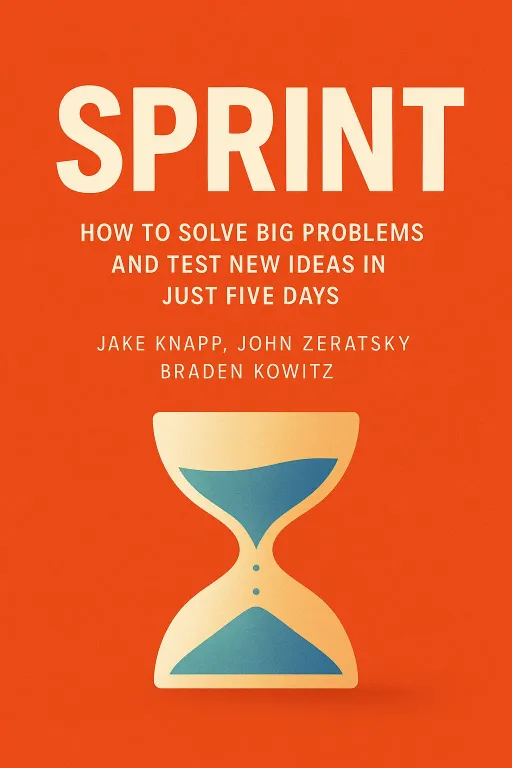
Nova: It is! And that's the core promise of the book 'Sprint: How to Solve Big Problems and Test New Ideas in Just Five Days' by Jake Knapp and his team from Google Ventures. They developed this incredible, structured process. So today, we're going to deconstruct this system from three angles.
yt: Okay, let's do it.
Nova: First, we'll challenge that myth of brainstorming and explore why working alone is often more powerful. Then, we'll uncover the magic of building a 'façade' to test big ideas in a single day. And finally, we'll look at the sprint's unique method for making high-stakes decisions without the usual drama.
yt: I love it. A system for innovation. This sounds right up my alley.
Deep Dive into Core Topic 1: The Anti-Brainstorm
SECTION
Nova: So let's start with that first, almost heretical idea: banning brainstorming. The author, Jake Knapp, was running these innovation workshops at Google. He was the master of the whiteboard and sticky notes. But one day, an engineer in the back of the room asked him a simple, devastating question: 'How do you know brainstorming works?'
yt: That's a fantastic question. The kind that makes you question everything you thought you knew. It's so easy to just assume a common practice is effective because... well, because it's common.
Nova: Precisely. And Knapp realized he didn't have a good answer. When he looked back at his projects, like the Priority Inbox for Gmail, he saw that the big breakthroughs didn't come from the group shout-a-thons. They came from individuals working quietly, then coming together to share and critique their fully-formed ideas. So, the sprint process is built on this principle of 'work alone, together.'
yt: That makes so much sense from a cognitive science perspective. You're separating the idea phase from the idea phase. Group brainstorming mashes them together, and people immediately start to self-censor or get attached to the first idea that's thrown out.
Nova: Yes! You're not fighting for airtime. In a sprint, Tuesday is for sketching solutions, and everyone does it individually. You have hours of quiet, focused time to think deeply and draw out your solution. It doesn't matter if you're a 'bad drawer'—the book says most solution sketches are just boxes and words. The goal is a concrete idea, not a work of art.
yt: So you're essentially getting parallel processing from every brain in the room, completely unfiltered. Each person is running their own simulation of a solution. You end up with a much more diverse and well-thought-out set of starting points than you would if everyone was just reacting to each other in real time.
Nova: That's the perfect way to put it: parallel processing. And to guide this, they use a simple but powerful tool for capturing problems during their expert interviews on Monday. Instead of just listing problems, they reframe everything as a question starting with 'How Might We...'.
yt: Ah, so instead of 'the checkout process is confusing,' it becomes 'How might we make the checkout process feel effortless?'
Nova: Exactly! It turns a complaint into a creative challenge. It's optimistic and open-ended. It’s a small change, but it completely shifts the team's mindset from problem-finding to opportunity-seeking. It's the fuel for all that individual sketching.
Deep Dive into Core Topic 2: The Art of the Façade
SECTION
Nova: And once you have all these individually generated ideas, the sprint's real magic kicks in on Thursday. It’s this philosophy of 'faking it.' The book describes it as building a time machine to see the future. And my favorite story of this is from a robotics company called Savioke.
yt: A time machine, I like that. Okay, tell me about the robots.
Nova: So, Savioke had built this amazing delivery robot, named Relay. It could navigate a hotel, ride the elevator, and bring a toothbrush or a snack to your room. The technology worked. But they had a huge, unanswered question: How would people about it? Would a robot showing up at your hotel door be cool, or would it be creepy and awkward?
yt: That's the human element. You can perfect the tech, but if the human-robot interaction is wrong, the whole thing fails. That's a classic risky assumption.
Nova: It was their biggest risk. So, they ran a sprint. They decided the most critical moment to test was the delivery itself—the interaction at the guest's door. On Thursday, they built a prototype. But they didn't write new code. They just took an iPad and strapped it to the robot to give it a face with simple, blinking eyes. They programmed it to play a few cute sounds. And, after the guest took their item, they programmed it to do a little 'happy dance'—just a little shimmy and a celebratory sound.
yt: So they were prototyping a personality.
Nova: They were prototyping a personality! On Friday, they set up in a real hotel and had the robot make deliveries to real, unsuspecting guests. The results were incredible. People weren't creeped out; they were delighted! They took videos, they high-fived the robot. One guest said, and this is a direct quote, "This is so cool. If they start using this robot, I’ll stay here every time."
yt: Wow. So they didn't test the robot's navigation or its battery life or its carrying capacity. They tested their single biggest, riskiest assumption: that people would accept a robot in a personal, hospitality setting. The 'façade' wasn't the robot itself, but the. That's a powerful distinction.
Nova: It is! It’s not about prototyping the entire product, it's about prototyping the. The book calls this 'Goldilocks quality'—the prototype has to be just real enough to get a genuine reaction from a customer. If it's too flimsy, people will give you polite feedback. If it's real enough, they'll give you their real, gut reaction. And that's what you need.
yt: That's the data. The goal isn't to build a thing, the goal is to get a clear signal on your most important question. That one-day prototype saved them months, maybe years, of building in the wrong direction. They learned that the robot's personality wasn't just a nice-to-have feature; it was the core of the customer experience.
Deep Dive into Core Topic 3: Decisions Without Debate
SECTION
Nova: But to even get to that amazing robot prototype, the team had to decide which idea to build. They had a wall full of sketches. And that's where sprints avoid another corporate trap: the endless decision meeting. They have a process they call the 'Sticky Decision.'
yt: I'm guessing it involves sticky notes?
Nova: Lots of them! It’s a five-step process that is, as the book says, 'unnatural but efficient.' First, they put all the anonymous sketches on the wall like an 'Art Museum.' Everyone reviews them in silence. Second, the 'Heat Map': everyone gets a sheet of little dot stickers and silently puts them next to parts of sketches they find interesting.
yt: So you're gathering data on what resonates before anyone even says a word. No one can 'sell' their idea.
Nova: No sales pitches allowed! Third is the 'Speed Critique.' The facilitator walks through each sketch, and the team has three minutes to discuss the highlights, especially where the heat map dots are clustered. The creator of the sketch stays silent until the very end, just to answer questions. Fourth is the 'Straw Poll,' where everyone gets one big dot sticker and silently votes for the solution they think is best.
yt: It's fascinating. The process is democratic in gathering input—everyone gets to put dots on the board, everyone gets a vote in the straw poll. But I have a feeling it doesn't end there.
Nova: You are right. The final step is the 'Supervote.' The Straw Poll is just advice. The final decision rests with one person: the 'Decider.' This is usually the project owner or a key executive. The Decider gets three special votes, and whatever they choose is what gets prototyped. No more debate.
yt: That's the key. It respects that accountability has to lie with one person. The 'Decider' role is the formal mechanism to prevent 'design by committee' and ensure the sprint's outcome actually has organizational backing.
Nova: And the book has a powerful cautionary tale about this. They call it 'SquidCo's Sprint Failure.' A team ran a fantastic sprint. They came up with a great solution, built a prototype, and it tested brilliantly with customers. But there was one problem: the Decider, their chief product officer, was traveling that week and wasn't involved.
yt: Oh no. I can see where this is going.
Nova: When he got back, he saw the results and said, 'This is great work, but you solved the wrong problem.' And he killed the project. The entire week of work was wasted because the person with the ultimate authority wasn't in the room to steer the ship and own the decision.
yt: A painful but perfect illustration of the principle. The sprint process isn't just about having good ideas; it's about making sure those ideas can survive and thrive in the real organization. The Decider's buy-in isn't a feature; it's a prerequisite.
Synthesis & Takeaways
SECTION
Nova: So when we pull it all together, we have this incredible system: generate better, more diverse ideas by working alone, test your riskiest assumptions by building a fast façade, and make firm decisions with structure, not endless debate.
yt: It's really a meta-skill, isn't it? It's a process for learning as fast as possible. The output of a sprint isn't necessarily a finished product. The most valuable output is validated learning. You either get a clear signal that you're on the right track, or you get a clear signal that you're not. You either succeed, or you learn why you failed, and both of those outcomes are incredibly valuable and save you a fortune in time and money.
Nova: A winner every time. That's what the book says. So for everyone listening, here's the question to ponder, inspired by 'Sprint': What's one big, risky question you're facing at work or in a personal project?
yt: And how could you build a simple, one-day 'façade'—a simple website, a brochure, even a scripted conversation—to get a real answer this week, instead of just guessing?
Nova: A perfect thought to end on. yt, thank you for deconstructing this with me.
yt: This was fun. It’s a process that really speaks to the power of structured thinking. Thanks, Nova.