

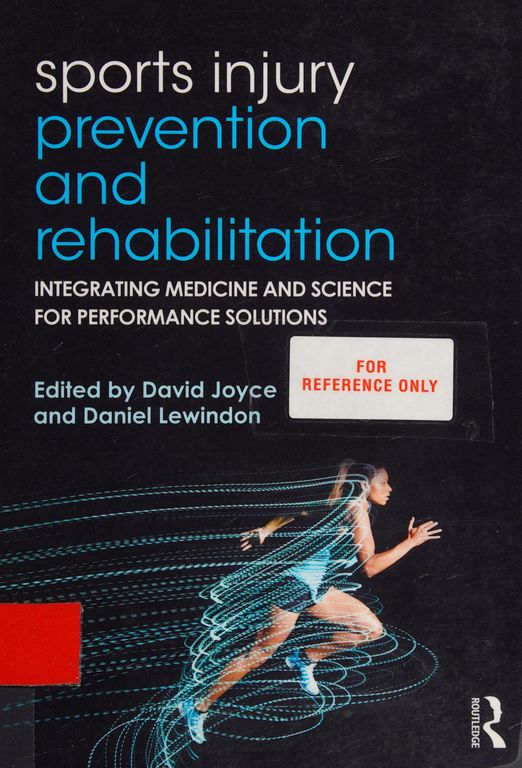
Sports Injury Prevention and Rehabilitation
Introduction
Nova: Imagine you are a world-class sprinter. You have spent four years training for a single ten-second window. The gun goes off, you explode out of the blocks, and then, halfway down the track, you feel that sickening pop in your hamstring. In an instant, your career, your dreams, and millions of dollars in endorsements are hanging by a thread. This is the nightmare every athlete lives with, and it is exactly what David Joyce and Daniel Lewindon set out to tackle in their seminal work, Sports Injury Prevention and Rehabilitation.
Nova: Exactly. It is often referred to as the bible of the field. David Joyce, who has worked with elite teams in the AFL, rugby, and soccer, teamed up with Daniel Lewindon to bridge a massive gap. You see, for a long time, sports medicine was siloed. You had the doctors who fixed the injury, the physios who did the rehab, and the strength coaches who handled the performance. This book argues that if those three groups are not speaking the same language, the athlete is the one who suffers.
Nova: There is, and it starts with a fundamental shift in how we view injury. It is not just a broken part; it is a system failure. Today, we are going to dive deep into Joyce's framework for not just returning to play, but returning to performance. We are going to look at why your stretching routine might be useless, why your brain is your biggest obstacle in rehab, and how data is finally replacing guesswork in the training room.
Key Insight 1
The Performance Gap
Nova: One of the most critical concepts Joyce introduces is something called the Performance Gap. This is the dangerous No Man's Land between being medically cleared and being actually ready to compete at an elite level.
Nova: Precisely. Joyce argues that medical clearance usually just means the tissue has healed. The bone is knit, or the ligament is stable. But the athlete's capacity to handle the specific demands of their sport has often withered away during that time off. If you jump straight from the treatment table to the starting lineup, you are essentially walking into a trap.
Nova: That is a perfect analogy. Joyce emphasizes that rehab should not be a separate phase that ends before training begins. Instead, rehab and performance training should be on a continuum. From day one of an injury, you are a performance athlete in a modified program. You are not just a patient.
Nova: It is about progressive loading. Joyce talks about the need to rebuild the athlete's engine while the specific injury is healing. If you have a broken wrist, there is no reason you cannot be working on your lower body power, your aerobic capacity, and even your cognitive reaction times. The goal is to minimize the drop-off in overall athleticism so that when the wrist is ready, the rest of the body is too.
Nova: Exactly. And Joyce points out that many re-injuries happen because the athlete is fatigued. If their fitness has dropped by twenty percent during rehab, they will hit their fatigue limit much earlier in a game. When you are tired, your mechanics break down, and that is when the next injury strikes. It is a vicious cycle that only a performance-integrated rehab can break.
Nova: They have to be. In the book, Joyce provides these integrated frameworks where the medical milestones and the performance milestones are tracked simultaneously. You do not move to the next level of performance until the medical markers are met, but you also do not stop the medical side until the performance markers are hit. It is a dual-track system.
Key Insight 2
Risk Profiling and the Biopsychosocial Model
Nova: Now, before we even get to the injury, Joyce spends a lot of time on prevention, or what he calls risk management. He is very clear: you cannot prevent all injuries. Sport is inherently chaotic. But you can profile the risk.
Nova: In a way, yes! But it is much more holistic than just looking at physical stats. Joyce advocates for the biopsychosocial model. This is a mouthful, but it basically means that an athlete's risk of injury is influenced by their biology, their psychology, and their social environment.
Nova: Believe it or not, yes. There is significant research cited in the book showing that high levels of life stress are a major predictor of injury. When you are stressed, your muscles are tighter, your peripheral vision narrows, and your recovery is slower. If a coach only looks at the physical load and ignores the fact that the athlete is going through a divorce or a move, they are missing half the picture.
Nova: Exactly. And the profiling goes even deeper. They look at things like injury history, which is the number one predictor of future injury. They look at biomechanics, like how an athlete lands from a jump. But they also look at things like sleep quality and nutrition. It is about creating a 360-degree view of the athlete's vulnerabilities.
Nova: That is a massive red flag. In Joyce's world, you would modify that athlete's training load immediately. You do not wait for the injury to happen. You manage the risk in real-time. This moves us away from the old-school idea of just doing the same warm-up for everyone.
Nova: Not at all. He argues that prevention programs must be individualized. If your risk profile shows you have weak glutes but great hamstring flexibility, why are you spending twenty minutes stretching your hamstrings? You should be spending that time on glute activation. It is about being surgical with your interventions.
Nova: Precisely. And that requires constant monitoring. It is not a profile you do once a year; it is a living document that changes based on how the athlete is feeling and performing every single day.
Key Insight 3
The Return to Play Continuum
Nova: Let's talk about the moment of truth: the Return to Play. Joyce describes this not as a single event, but as a continuum. It is a series of graduated steps that move the athlete from the clinic back to the heat of competition.
Nova: Yes, but Joyce adds a layer of objective data that takes the guesswork out of it. He is a huge proponent of using technology to measure things like force symmetry. For example, if you are coming back from a knee injury, he wants to see that your injured leg can produce at least ninety percent of the force of your healthy leg before you even think about sprinting.
Nova: Exactly. But here is the really interesting part: he also emphasizes psychological readiness. He uses a term called kinesiophobia, which is the fear of movement or re-injury. You can have a perfectly healed ligament and a strong leg, but if you are subconsciously afraid to plant that foot and cut, your brain will change your movement patterns, which actually increases your risk of getting hurt again.
Nova: Through graded exposure. You have to prove to the brain that the body is safe. This means creating drills that gradually increase the unpredictability and the intensity. You start with a drill where the athlete knows exactly where they are going. Then you move to a drill where they have to react to a whistle. Then a drill where they have to react to an opponent. You are training the nervous system to trust the repair.
Nova: That is a great way to put it. And the final stage of the continuum is what he calls Return to Performance. This is where the athlete is not just playing, but they are hitting their pre-injury benchmarks in speed, power, and agility. Joyce argues that if you stop at Return to Play, you have failed. You have to get them back to their competitive edge.
Nova: Exactly. And he uses specific exit criteria for each stage. You do not pass Go until you hit the numbers. It removes the pressure from the coach or the athlete to rush back because the data is the arbiter. It is hard to argue with a force plate that says your left leg is thirty percent weaker than your right.
Key Insight 4
Load Management and the Hamstring Deep Dive
Nova: We cannot talk about this book without mentioning load management. Joyce leans heavily on the work of researchers like Tim Gabbett to explain the Acute: Chronic Workload Ratio. This is a fancy way of saying: don't do too much, too soon.
Nova: It is vital. The research shows that if your workload in a given week—the acute load—is significantly higher than your average workload over the last month—the chronic load—your injury risk skyrockets. It is the spikes in training that kill you, not the total amount of training.
Nova: You are in the red zone. Joyce explains that the body is incredibly adaptable, but it needs time. If you stay within a certain ratio—usually between 0.8 and 1.3—you are actually building robustness. You are making the athlete harder to break. But go above 1.5, and you are playing Russian roulette with their tendons and muscles.
Nova: Hamstrings are the classic example of the Performance Gap. They often feel fine during low-speed activities, but they are under massive stress during high-speed sprinting. Joyce points out that many athletes re-tear their hamstrings because they do all their rehab at sub-maximal speeds. They never expose the muscle to the specific tension of a full-speed sprint until they are in a game.
Nova: Exactly. Joyce advocates for something called Nordic hamstring curls and high-speed running as a vaccine for hamstring injuries. You have to strengthen the muscle in its lengthened position and you have to sprint in training to be able to sprint in a game. It sounds counterintuitive—sprinting to prevent sprinting injuries—but it is about building that specific tissue capacity.
Nova: That is exactly right. And he applies this logic to everything from shoulders in swimmers to groins in soccer players. It is all about understanding the specific mechanical demands of the sport and ensuring the athlete's tissue capacity exceeds those demands. If the demand is ten and your capacity is eight, you are going to break. If your capacity is twelve, you are safe.
Conclusion
Nova: As we wrap up our look at David Joyce and Daniel Lewindon's Sports Injury Prevention and Rehabilitation, the biggest takeaway is that injury is not just a physical event; it is a complex, multi-dimensional challenge that requires a unified response. We have moved past the era of just icing a knee and hoping for the best.
Nova: Well said. Joyce's work reminds us that the goal of rehabilitation isn't just to get back to where you were; it is an opportunity to rebuild yourself into something even more robust. By integrating medicine, science, and performance, we can turn a setback into a launchpad.
Nova: It is a true masterclass in human resilience and scientific precision. If you want to dive deeper, the book is filled with specific protocols and case studies that are gold for anyone in the fitness or medical world.
Nova: This is Aibrary. Congratulations on your growth!