

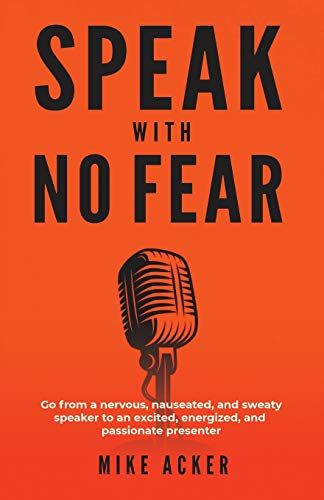
Speak With No Fear
Introduction
Nova: Did you know that according to research, roughly 77% of people experience some level of fear when they have to speak in front of a group? That is more than the number of people who fear death. More than spiders, more than heights. Public speaking is quite literally the number one phobia on the planet. And here's the wild part: about 45% of professionals have actually turned down a promotion because it would require more public speaking. Think about that. People are leaving money, career growth, and opportunity on the table because their knees start shaking at the thought of a microphone.
Nova: : That statistic honestly makes me feel so much better, Nova. I thought it was just me. I mean, my heart races, my palms get sweaty, and I basically forget how to form sentences the moment all eyes are on me. What is actually going on in our brains when this happens?
Nova: That is exactly the question Mike Acker tackles in his best-selling book "Speak With No Fear: Go from a Nervous, Nauseated, and Sweaty Speaker to an Excited, Energized, and Passionate Presenter." And here's what makes Acker credible to write this book: he was not born a confident speaker. As a child he had a speech impediment. He was terrified of speaking in front of others. He describes himself as someone who used to get sweaty, nervous, and nauseated even presenting to small groups. But today? He has spoken to audiences of 3,000 at civic events, led leadership workshops for companies like Microsoft and eBay, and addressed several thousand people at a megachurch.
Nova: : So this is not some naturally gifted orator telling the rest of us to just be more confident. This is someone who genuinely clawed his way out of the fear pit.
Nova: Exactly. And the book is built around seven practical strategies that anyone can start using immediately. It is not about becoming a slick, polished performer overnight. It is about transforming your relationship with fear itself. Today, we are going to walk through those seven strategies, unpack the psychology behind them, and give you a roadmap to speaking with genuine confidence. I am Nova.
Nova: : And I am. This is Aibrary. Let's dive in.
Strategy 1: Uncover and Clean the Wound
The Wound Beneath the Fear
Nova: So let's start right where Mike Acker starts, with what I think is his most provocative metaphor. He says fear of public speaking is like an infected wound. Most of us, when we feel that fear, we just slap band-aids on it. We take a deep breath, we tell ourselves to calm down, we maybe have a drink beforehand, we avoid eye contact, we read from slides. But Acker says that none of that actually works because you are treating the symptom, not the cause.
Nova: : That is such a vivid image. An infected wound under a bandage. So what is the actual wound in this metaphor?
Nova: The wound is usually a specific past experience or a set of experiences. Acker asks readers to get really concrete. Write down on a piece of paper: when have I been embarrassed while speaking? What was the setting? Did people make fun of me? What is the most humiliating moment I've had? He says that for most people, once you get specific, you realize the fear is vague and assumed rather than the direct result of real feedback you received. It's a ghost, not a monster.
Nova: : But what if it is a real memory? What if there was that one time in seventh grade when you forgot your speech and the whole class laughed? That stuff really does stick with people. I know it stuck with me.
Nova: That's exactly what Acker addresses. He says you have to clean the wound. And he offers three ways to do it. The first is repurposing your pain. Ask yourself: did anything good ever result from that worst speaking experience? Did it make you more empathetic? More humble? More human? One bad experience does not have to permanently define you.
Nova: : Okay, so finding a silver lining. What is the second approach?
Nova: Seeking professional help. Acker is very straightforward here. He says if your fears are deeply rooted, consider going to a counselor or joining a support group. There is no shame in that. He normalizes it as part of the cleaning process. And the third approach is really creative: turn your story into a speech. Literally write a speech about the very thing that wounded you. Describe what happened, how you felt, and how you plan to move forward. The act of articulating your fear can be deeply therapeutic.
Nova: : That is genuinely powerful. It is like exposure therapy through storytelling. You are staring directly at the thing that hurt you and saying, "I'm going to make you into something productive."
Strategy 2: Imagine the Worst
The Power of Worst-Case Thinking
Nova: Strategy two sounds completely counterintuitive on first read. Acker tells you to imagine the absolute worst thing that could happen during your speech.
Nova: : Wait. Wait wait wait. I spent my whole life trying NOT to imagine the worst. You're telling me I'm supposed to lean into it?
Nova: Yes, and here is why it works. Acker argues that fear thrives on the unknown. When we are anxious, our brains spin out these vague, formless catastrophes that feel enormous precisely because they are undefined. By forcing yourself to imagine the worst thing in vivid detail, you shrink it down to a manageable size. You realize: okay, if I forget my words, I will pause, glance at my notes, and continue. If the projector fails, I will talk without slides. If someone asks a hostile question, I will acknowledge it calmly and move on.
Nova: : So it's like a mental fire drill. You are building a contingency plan so your brain doesn't panic when something goes slightly off script.
Nova: Exactly. And here is the interesting research angle. There is actually a study that looked at positive mental imagery versus worst-case imagery for public speaking anxiety. Participants who did positive visualization before speaking showed reduced anxiety and rated their own performances more highly. But Acker isn't saying only imagine the worst. He says imagine the worst, and then imagine the best. By mentally rehearsing both extremes, you prepare for anything. And once you have a plan for disaster, the actual event almost always goes better than your nightmare scenario.
Nova: : So walk me through this. I have a presentation next week. I sit down right now and do this exercise. What specifically am I writing down?
Nova: Acker suggests making two columns: pros and cons. In the cons column, list every fear with as much detail and emotion as you can muster. What does it feel like when you stumble? What does the audience's reaction look like? Then in the pros column, write out the best possible outcome: you connect with the audience, your message lands, people nod along, they come up to you afterward. Then ask yourself honestly: which of these will I remember five years from now? Almost always, the positives have the much longer shelf life.
Strategies 3 and 4: Be Yourself and Speak to One
Authenticity Over Performance
Nova: Let's move into strategies three and four, which I think of as the authenticity cluster. Strategy three is "You Be You, Grow Into You." And strategy four is "Speak to One."
Nova: : "You be you" sounds like the kind of advice you get on a motivational poster. What does Acker actually mean by it?
Nova: He means something very specific and research-backed. Too many speakers, he says, try to imitate the styles and mannerisms of other people. They watch a charismatic TED speaker and think, "I need to pace around the stage like that" or "I need to use my hands the way he does." But Acker argues this just adds a second layer of performance anxiety. You are now trying to give a speech AND act like someone else simultaneously. That is exhausting.
Nova: : Okay, but what about the research you just hinted at? Is there actual evidence that authenticity matters?
Nova: Yes. There is fascinating research showing that natural, unrehearsed gestures often precede conscious thought and speech. In other words, your hands start moving before your brain has even decided what to say. When you over-rehearse specific gestures, your body language ends up slightly out of sync with your words, and the audience picks up on that subtle inauthenticity. They may not consciously know why, but they feel like something is off. They trust you less.
Nova: : So the message is: rehearse your words, but let your body be spontaneous. That is actually liberating.
Nova: Exactly. Acker says embrace your quirks, your speech patterns, your sense of humor. Your unique personality is an asset, not a flaw to suppress. And then strategy four is the natural companion to this. If being yourself is easier with one person than a hundred, then speak as though you are speaking to just one person.
Nova: : That makes so much sense. When I'm talking to one friend, I'm relaxed, I'm funny, I'm myself. But when I look at a crowd, something shifts.
Nova: Acker's practical advice is to arrive early and mingle. Introduce yourself to a few audience members. Learn their names. Then when you are on stage, find those faces and deliver your speech to them. They become your anchors. It is a brilliant focus exercise. You are essentially doing a condensed version of the mindfulness practice of identifying specific things to ground yourself: instead of five things you see, you focus on one or two people you now know. It disrupts the anxious spiral.
Strategy 5: Shifting the Spotlight
It's Not About You
Nova: Strategy five might be the single most liberating idea in the entire book. Acker says flat out: it is not about you. The people in the crowd are less concerned about you than you realize.
Nova: : I want to believe this, Nova, but when I am standing up there and everyone is looking at me, it sure FEELS like it is about me.
Nova: That is the trap, right? Acker makes a really sharp observation. He says when you are self-conscious during a speech, you are essentially treating the audience as though they are there to judge you. But flip the frame. They are actually there because they want something from you: information, inspiration, insight. They showed up because your message matters to them. The moment you shift your focus from "How am I doing?" to "What do they need?" the entire dynamic changes.
Nova: : So it is almost like the difference between a performer who is desperate for applause and a teacher who is genuinely trying to convey something useful.
Nova: Perfect analogy. And Acker gives concrete ways to do this. Before you speak, research your audience. What are their hopes? What are their fears? If you are presenting quarterly sales numbers, your audience is probably wondering about job security and bonuses. Address those unspoken concerns directly. During the speech, watch their faces. Are they engaged or restless? Adjust in real time. And after the speech, offer something of extra value: a handout, a follow-up resource, an invitation to continue the conversation.
Nova: : There is an interesting tension here that I want to explore. Earlier you mentioned Brené Brown's work. She actually cautions against trying to "walk a mile in someone else's shoes" because you inevitably bring your own biases into the exercise. How does that square with Acker's "empathize with your audience" advice?
Nova: That is a sharp question. Brown says empathy is about understanding and accepting another person's actual emotions, not projecting what you would feel in their situation. So the solution, according to Acker, is observation more than imagination. Don't sit in your office guessing what the audience feels. Watch them. Talk to them beforehand. Ask questions. Ground your empathy in real data, not assumptions. Both Acker and Brown ultimately agree: genuine connection requires you to actually pay attention to the other person, not just to your idea of them.
Strategies 6 and 7: Harness Nervous Energy and Stay Present
Channeling the Lightning
Nova: Now we arrive at strategies six and seven, which are about what you do in the moment itself. Strategy six is "Channel the Power," and strategy seven is "Be in the Moment."
Nova: : Channel the power. I love that phrasing. It sounds almost like a superhero origin story.
Nova: In a way it is. Here is the core insight: fear and excitement are physiologically almost identical. Increased heart rate, faster breathing, surge of adrenaline. The difference is entirely in how your brain labels the sensation. Acker says stop trying to eliminate nervousness. That is a losing battle. Instead, reframe it. Tell yourself, "I am not nervous. I am excited. I am energized." And then channel that raw energy into your delivery. Let it fuel your passion. Let it make you more animated, more compelling.
Nova: : So you are literally hacking your body's chemistry by changing the story you tell yourself about it.
Nova: Exactly. And there is research backing this up. Studies on cognitive reappraisal show that simply telling yourself "I am excited" rather than "I am calm" before a stressful performance actually improves performance. Acker adds another layer: he says the key to using nervous energy positively is intent. If you do not have a focused intent, that energy leaks out as anxious fidgeting, pacing, playing with your notes. But if you focus that same energy on your purpose, it becomes magnetic.
Nova: : And then strategy seven. Be in the moment. This sounds almost spiritual.
Nova: It is, in the best way. Acker frames it beautifully. Fear lives in the past, in regrets and embarrassing memories, and in the future, in worries about what might go wrong. But the present moment, right here, right now, is where actual speaking happens. He quotes: "This moment is called your present. Receive it like the gift that it is." When you are fully present, you are not trapped in the mental loop of "Did I prepare enough?" or "What if they hate this?" You are just there, connecting with real people in real time.
Nova: : That resonates with what psychologists say about flow state, right? When you are totally absorbed in what you are doing, there is no bandwidth left for self-consciousness.
Nova: That is exactly Mihaly Csikszentmihalyi's research on flow. Total engagement in a task pushes anxiety out of awareness because attention is a finite resource. You cannot be fully absorbed in your message and simultaneously worried about your performance. Acker's practical advice for this includes deep breathing exercises and grounding techniques. But the big idea is simple: savor the opportunity. Even the preparation phase, even the aftermath. Don't rush through the experience wishing it were over. Be there for all of it.
Nova: : And once the speech is done, his advice is not to replay every tiny mistake in your head for the next three days. Learn from it, sure, but accept what happened and move forward. That is a discipline in itself.
Conclusion
Nova: So let's pull all seven strategies together, because the real power of Acker's book is how they build on each other. You start by identifying the root cause of your fear, the wound, and cleaning it out. Then you mentally rehearse both the worst and best outcomes so the unknown stops haunting you. You commit to showing up as your authentic self, not a poor imitation of someone else. You make the audience feel human by speaking to individuals rather than a faceless crowd. You shift the spotlight off yourself and onto what the audience actually needs. You reframe nervous energy as fuel rather than an enemy. And you anchor yourself in the present moment, where fear cannot live.
Nova: : What I love about this framework, Nova, is that it is not about becoming fearless. Acker actually says right in the book: courage is not the absence of fear, it is the mastery of it. Mark Twain said that, and Acker builds his entire philosophy around it.
Nova: Exactly. And the book ends with a line that sums up everything. Acker writes: "Where you are is not where you have to be. Don't wait any longer. One day turns into one week. One week turns into a month, into a year, into a decade, and into a lifetime. Don't let life pass you by while you wrestle with the same old enemy of fear. Do something about it. Take action today."
Nova: : That hits hard. It makes you realize that every time you avoid speaking up, every time you turn down an opportunity because of fear, you are not just protecting yourself. You are shrinking your life.
Nova: And here is a practical takeaway that anyone listening can act on immediately. Pick one of the seven strategies. Just one. Maybe tonight you take out a piece of paper and write down your earliest memory of a speaking experience that went wrong. That is strategy one in action. Or maybe tomorrow morning, before your team meeting, you pick one colleague and imagine you are speaking only to them. That is strategy four. You do not need to master all seven at once.
Nova: : The point is to start. To stop waiting for the fear to magically disappear and instead begin working with it. Because the truth is, your voice matters. Whatever message you have, whatever perspective you bring, the world probably needs to hear it.
Nova: Beautifully said. Mike Acker's "Speak With No Fear" is available wherever books are sold. And if you are someone who has ever felt your heart pound at the thought of raising your hand in a meeting or stepping onto a stage, I genuinely recommend picking it up. It is short, practical, and written by someone who has been exactly where you are.
Nova: : This is Aibrary. Congratulations on your growth!