

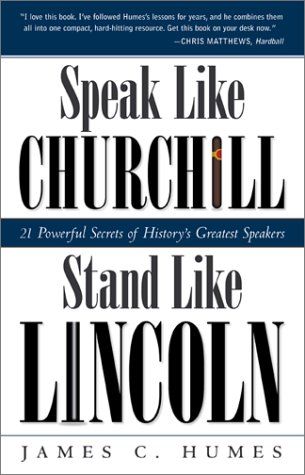
Speak like Churchill, stand like Lincoln
21 powerful secrets of history's greatest speakers
Introduction
Nova: Imagine standing before a room of thousands. The silence stretches for a full sixty seconds. You say nothing. You just stand there, making eye contact, letting the tension build. Most of us would panic. But Napoleon Bonaparte did exactly that — and his troops hung on every word that followed. That one technique is just the beginning of what we're diving into today.
Nova: : Sixty seconds of silence? That's almost painful to think about. What could possibly justify that kind of awkward pause?
Nova: That's exactly the question James C. Humes answers in his book "Speak like Churchill, Stand like Lincoln." And this is not some abstract theory from a self-help guru. Humes actually wrote speeches for five American presidents — Eisenhower, Nixon, Ford, Reagan, and George H. W. Bush. He spent decades studying what made history's greatest speakers truly magnetic.
Nova: : Five presidents? That's some serious credibility. So what did he figure out?
Nova: He distilled it into twenty-one practical techniques — what he calls the "Power Secrets" of history's greatest speakers. And the thread running through all of them: leadership is, at its core, selling. And selling is talking. Whether you're pitching a startup, giving a wedding toast, or leading a team meeting, the ability to command a room is not some mystical gift. It's a set of learnable skills.
Nova: : I love that reframe. But honestly, I've sat through so many dull presentations. What makes Churchill and Lincoln different from the average corporate speaker?
Nova: Here's a stat that blows my mind. Lincoln's Gettysburg Address — arguably the most famous speech in American history — is just 271 words. It took about two minutes to deliver. Meanwhile, the speaker before him spoke for two hours. Nobody remembers that guy's name. Churchill put it bluntly when he said, "There are too many public speeches and too little private thinking."
Nova: : Two minutes versus two hours. Point taken. So let's get into these secrets. Where does someone even begin?
Nova: Let's start with the first one — because it's the most counterintuitive.
The Power Pause and Power Opener
Before You Speak, Say Nothing
Nova: The very first technique Humes teaches is called the Power Pause. Before you utter a single word, you stand in silence. You make eye contact with your audience. You silently rehearse your opening line in your mind. Humes writes: "Stand, stare, and command your audience, and they will bend their ears to listen."
Nova: : Wait, just standing there silently? That sounds terrifying. Why does that work?
Nova: Think about it — when you walk on stage and immediately start speaking, you're chasing the audience's attention. But when you pause, the audience starts wondering what you're about to say. The silence creates anticipation. It's like a frame around a painting. Humes points to Napoleon, who despite being short and having a thick Corsican accent, would wait in absolute quiet before addressing his troops. Each second of silence made him seem larger.
Nova: : So the pause actually builds authority rather than draining it.
Nova: Exactly. And here's another surprising example — Benito Juarez, the Mexican president, was also short and had an accent that could have been a liability. But he would stand before crowds, silently rehearsing his opening words while maintaining eye contact. The silence created a magnetic tension. Humes even recommends using the pause when someone asks you a question — take a moment before answering. It makes you look thoughtful rather than reactive.
Nova: : That's incredibly practical. I can use that in a job interview tomorrow. What comes after the pause?
Nova: The Power Opener. Humes is adamant — never, ever start with "It's an honor to be here" or "Thank you for having me." Those first thirty seconds are when your audience is most attentive. Wasting it on pleasantries is like throwing away your best shot. Churchill specifically avoided opening with praise because he said it sounded like insincere flattery. Instead, he embedded compliments in the middle of his speeches — what he called "parenthetical praise."
Nova: : So what should you open with instead?
Nova: Humes says to craft a single, powerful opening sentence — a provocative statement, a surprising statistic, a vivid scenario. Something that makes the audience lean forward. He calls it the Power Opener, and he says you should prepare it obsessively and deliver it immediately after your Power Pause. The combination of silence followed by a knockout first line is devastatingly effective.
Nova: : Silence, then boom. I can see how that would work. But once you've got their attention, what do you do with it?
The Power Point, Power Brief, and Power Presence
Less Is Everything
Nova: Here's where most speakers go wrong — they don't know what they're actually trying to say. Humes tells a story about Harold Macmillan, who would later become Britain's prime minister. After his first speech in the House of Commons in 1925, he asked Churchill what he thought. Churchill's response was devastating: "Harold, when you rose you didn't know what you were going to say, when you were speaking you didn't know what you were saying, and when you finished you didn't know what you had said."
Nova: : Oh, that is brutal. But honestly, I've sat through meetings that felt exactly like that.
Nova: Right? Humes calls this the Power Point — and it's not about slides. It's your bottom-line message. Before you prepare anything else, you stop, think, and plan. Ask yourself: if the audience remembers only one thing, what should it be? Everything else in your talk is just reinforcement of that single core idea.
Nova: : One thing. That's it. That feels almost too simple.
Nova: It's deceptively hard, actually. It forces you to be disciplined. And once you have your Power Point, Humes says you need to deliver it as a Power Brief — which means shocking people with brevity. He tells the story of Calvin Coolidge, who hated wasting words. After attending church, a reporter asked him what the sermon was about. "Sin," Coolidge replied. "What did he say about it?" "He was against it."
Nova: : Two words? That's legendary.
Nova: And then there's Churchill. His most frequently recited speech is his 1941 address at Harrow School — where he'd been a mediocre student. The entire speech is less than a minute long. The most famous line: "Never give in. Never give in. Never, never, never, never — in nothing, great or small, large or petty — never give in except to convictions of honor and good sense." Humes says the audience braces for a twenty-minute oration — and when you give them five minutes instead, they remember it far more vividly.
Nova: : So it's the surprise of brevity. The audience is ready for a marathon and you give them a sprint. But what about how you look while doing all this?
Nova: That's Power Presence — and Humes is surprisingly specific about it. Churchill always wore a navy blue pinstriped suit with a gold watch chain, a blue polka dot bow tie, and a cigar. FDR had his cigarette holder. Stalin had his pipe. Humes calls this your "star suit" — a signature look that becomes part of your identity as a speaker. It's not about being flashy. It's about being recognizable and deliberate.
Nova: : So like Steve Jobs and his black turtleneck. People saw that and immediately knew who was about to speak.
Nova: Precisely. Humes says your clothes make a statement before you open your mouth. The selection shouldn't be casual or by chance. And it doesn't have to be a full outfit — it could be a distinctive accessory, a particular way you dress that people come to associate with you. Combined with erect posture and deliberate movements, it creates what he calls a commanding presence.
Power Quote, Power Stat, and Power Line
Words That Stick
Nova: Let's talk about the words themselves — because Humes has a whole toolkit for making your language memorable. First up: the Power Quote. His rule is simple: use exactly one quote per speech, and make it theatrical.
Nova: : One quote? That seems stingy.
Nova: Here's the reasoning. Humes once heard a Philadelphia city councilman quote an entire paragraph from Michael Jordan to a group of high school students. Even though it was their hero, the kids tuned out after the first minute. The quote was too long and delivered without any drama. Humes says a quote should be pithy and prominent. The source should be recognizable, and the delivery should be staged.
Nova: : Staged how?
Nova: He recommends pulling a card from your pocket, putting on a pair of glasses — even if they're just plain lenses — and reading the quote deliberately. Think about Theodore Roosevelt. In 1901, he paused mid-speech, pulled an envelope from his waistcoat, adjusted his pince-nez spectacles, and read: "There is an old African saying: 'Speak softly and carry a big stick.'" That line is still quoted over a century later because Roosevelt framed it like a piece of theater.
Nova: : That's brilliant. He turned a quote into a prop moment. What about statistics? I feel like numbers are where presentations go to die.
Nova: Humes has a solution for that too — the Power Stat. He says to follow the Three R's: Reduce, Round, and Relate. First, reduce the number of statistics to just one per talk. Second, round them — say "one out of five" instead of "21.2 percent." Third, relate the number to something people can visualize.
Nova: : Any good examples of that?
Nova: My favorite is Eisenhower. In 1958, the U. S. deficit hit a billion dollars for the first time. Eisenhower knew that a billion is just an abstraction. So he asked his speechwriter: if you laid a billion one-dollar bills end to end, would they reach the moon? The Commerce Department ran the numbers, and Eisenhower ended up saying: "To understand the billion-dollar deficit, imagine taking all the one-dollar bills in a billion and laying them out end to end. Why, it would more than go to the moon and back again!"
Nova: : Now that I'll remember. The moon and back. That's so much stickier than "a billion dollars."
Nova: Exactly. And then there's the Power Line — the most memorable phrase in your entire speech. Humes gives an acronym: C-R-E-A-M. Contrast, Rhyme, Echo, Alliteration, Metaphor. Kennedy's "Ask not what your country can do for you — ask what you can do for your country" uses contrast. Churchill's "blood, toil, tears, and sweat" uses alliteration and metaphor. Martin Luther King's "I have a dream" uses repetition — the echo effect.
Nova: : C-R-E-A-M. That's actually easy to remember.
Nova: Humes even provides a "Rhyming Nine" — nine sound patterns like AKE, AY, OW, and ITE that you can use to craft catchy lines. He says the 'B' and 'P' consonant sounds are the most powerful for alliteration. But his crucial warning: use only one Power Line per speech. If everything is highlighted, nothing is.
Power Reading, Power Button, and Power Closer
The Theater of Speech
Nova: Here's something that surprises a lot of people — Humes actually encourages reading your speech. But with a very specific technique.
Nova: : Wait, reading? Isn't that the cardinal sin of public speaking?
Nova: It is if you're staring down at your notes the whole time. But Humes teaches something called the See-Stop-Say technique. You look down and memorize a phrase — then you look up, pause, make eye contact, and deliver that phrase to the audience. Then you repeat. He's emphatic: "Never, never, never let words come out of your mouth when your eyes are looking down." Every word must be delivered to human faces, not to a piece of paper.
Nova: : So it's not that reading is bad — it's that disconnected reading is bad. This is essentially turning reading into a conversation.
Nova: Exactly. And this connects to another technique — the Power Button. You've crafted a brilliant Power Line, but how do you make sure people catch it? Humes says you need a signal phrase that acts like a highlighter pen. It tells the audience "Ready, set, listen."
Nova: : Give me an example.
Nova: Churchill's most famous line — "I have nothing to offer but blood, toil, tears, and sweat" — was preceded by the Power Button: "I would say to the House as I said to those who joined this government." Patrick Henry's "Give me liberty or give me death" was preceded by "I know not what others say, but as for me." Kennedy's "Ask not" was preceded by "And so my fellow Americans." Each Power Button creates a moment of suspense before the payoff.
Nova: : It's like a drum roll before the punchline. So you frame your best line with a signal. What about ending?
Nova: The Power Closer. Humes says, "Great is the art of beginning, but greater is the art of ending." Your final words are what people remember most vividly. He recommends ending with a story that moves people — something that ties back to your opening, creates an emotional arc, and leaves your audience with a clear call to action or a powerful image.
Nova: : And I assume there's no "thank you for your time" at the end either.
Nova: You're learning fast. Humes says the closer should feel like a natural culmination, not an abrupt stop. He even has a technique called Power Audacity — doing something unexpected, like Churchill's famous moment at the Other Club in London. New members had to give an impromptu talk on a random topic. Churchill drew the word "SEX" from the hat. He looked at the card and said in measured tones: "Sex... it gives me great pleasure." Then he sat down.
Nova: : That is audacious. And you'll never forget it. So what do we take away from all of this?
Conclusion
Nova: If there's one overarching theme in Humes' book, it's this: great speaking is not about being the smartest person in the room. It's about being the most prepared. Churchill didn't improvise his way to greatness — he labored over every word. He once said it took him six to eight hours to prepare a forty-minute speech. Lincoln wrote and rewrote the Gettysburg Address, which was only 271 words.
Nova: : So the secret is preparation, not natural talent.
Nova: Exactly. And Humes gives us a structure anyone can follow. Before you speak: pause and command the room. Open with impact, not pleasantries. Know your one bottom-line message. Keep it brief — surprise people with concision. Use one well-framed quote, one well-told statistic, one memorable Power Line. Signal your best lines with a Power Button. Read using See-Stop-Say so you never lose eye contact. And close with something that lingers.
Nova: : And show up dressed deliberately. Your presence is your first message.
Nova: Right. Humes says "leadership is selling, and selling is talking." Whether you're a CEO, a teacher, a parent, or someone who just wants to be heard more clearly in meetings, these techniques are not about manipulation. They're about respecting your audience enough to be clear, concise, and compelling.
Nova: : I love that framing. It's not about being slick. It's about being effective. So where do I start?
Nova: Humes would say: next time you have something to say, try the Power Pause. Just five seconds of silence before you speak. See how it changes the energy in the room. Then figure out your Power Point — the one thing you want people to remember. If you do just those two things, you're already ahead of ninety percent of speakers.
Nova: : Silence and clarity. Deceptively simple, incredibly powerful. Thank you, Nova. This has been a masterclass in what Humes calls "Powertalk."
Nova: And remember — as Churchill said, never give in. Never, never, never, never.
Nova: : This is Aibrary. Congratulations on your growth!