

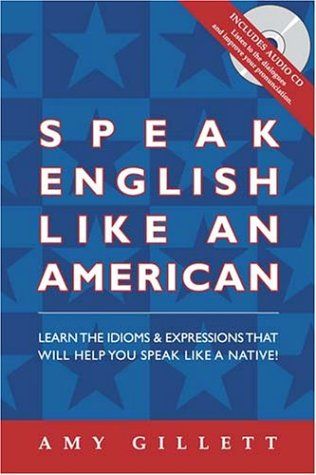
Speak English like an American =
Introduction
Nova: Welcome to Aibrary, where we crack open the books that actually change the way people learn. And today, we're diving into a book that has sold hundreds of thousands of copies worldwide, is used in ESL classrooms at Yale, UC Berkeley, Cornell, and Drexel University, and yet — here's the surprising part — it reads more like a family sitcom than a textbook. I'm talking about Speak English Like an American by Amy Gillett.
Nova: That's the genius of it. Instead of grammar drills and vocabulary lists, Gillett created a continuous story about a family — the Johnsons — and wove over 300 authentic American idioms directly into their conversations. Susan starts a cookie business. Bob deals with office politics. Ted navigates dating. Nicole handles high school drama. And as you follow their lives across 25 dialogues, you absorb the idioms the way a native speaker would — in context, in real situations.
Nova: Exactly. And the TESL-EJ journal, which is a peer-reviewed publication for ESL teachers, called the pragmatic usage notes in this book "particularly outstanding." The Wall Street Journal has featured Amy Gillett's work. This is not your average language book. So let's dig in — how does it work, why does it work, and what can it teach us about learning any language?
Key Insight 1
Meet the Johnsons: A Textbook That Tells a Story
Nova: So here's what makes this book structurally brilliant. You open it up, and the first thing you see is a cartoon drawing of the Johnson family: Bob the father, Susan the mother, Ted the teenage son, and Nicole the daughter. And from page one, their story begins.
Nova: A continuous one, yes. Susan, the mom, decides she wants to start her own cookie business. She pitches the idea to Bob at breakfast. Bob is initially skeptical but agrees to support her. Meanwhile, Ted is navigating high school and eventually gets a girlfriend. Nicole has her own school and friendship dramas. Bob deals with workplace challenges. It reads like episodes of a family TV show.
Nova: Right. Each of the 25 lessons is a dialogue between two or three characters. The target idioms appear in bold within the conversation, so you can't miss them. Then, after the dialogue, you get a mini-dictionary of every idiom used — with definitions, one or two example sentences, and often a critical pragmatic note about when the expression is appropriate or inappropriate.
Nova: A great one: the expression "shut up" appears in the book. Gillett includes a note that says, essentially, "Telling somebody to shut up is rude. It's better to say 'Be quiet!' or more politely, 'Please be quiet!'" That is the kind of real-world guidance that most textbooks skip entirely.
Nova: Precisely. And that's one reason the TESL-EJ reviewer highlighted this book: the pragmatic usage notes help learners use idioms appropriately in American culture, not just understand them abstractly. The book treats language as something alive and social.
Nova: Exactly. The cohesion of the overarching storyline gives learners a reason to keep turning pages. It's not "lesson 7, topic: weather." It's "what happens next with Ted's new girlfriend?" And by the way, Ted's dating life is where you learn expressions like "head over heels" — which means completely in love.
Nova: That's exactly it. And that's a learning principle that applies far beyond English.
Key Insight 2
Three Hundred Idioms, Zero Lists
Nova: Let's talk about the core content. The book teaches more than 300 common American English idioms and expressions. We're talking phrases like "keep your chin up" — stay positive during hard times. "Give it a shot" — try something. "Bright and early" — early in the morning. "Green with envy" — very jealous. "Live from hand to mouth" — barely having enough money to survive. "Look on the bright side" — find something positive in a bad situation.
Nova: That's the challenge with idioms. They rarely make literal sense. You can't decode them word by word. And that's why many learners hit a wall. They can master grammar and vocabulary, yet still feel lost in real American conversations because idioms are everywhere — in workplaces, on TV, in casual chats.
Nova: She embeds them in dialogue. Every idiom appears in bold during the scripted conversation. You see it used naturally by a character. Then, after the dialogue, you get a clear definition, two example sentences that show different contexts for the same idiom, and — as we mentioned — pragmatic notes when needed. Only then do you practice.
Nova: Yes. There are three main types of practice. The first is fill-in-the-blank — you choose the best idiom from four options. The second is "choose the best substitute" — you pick which definition matches the idiom. But the third type is the standout: pragmatic response exercises. The book gives you a character's statement containing an idiom — say, Bob says something using "give it a shot" — and then asks you to select the most culturally appropriate reply from Susan.
Nova: Exactly. That's a much higher level of language mastery. And after every five lessons, there's a review section that includes crossword puzzles, which is a clever way to make review feel less like a test and more like a game.
Nova: Because learners can quickly look up any idiom they encounter in real life — maybe they heard it on a podcast or a colleague said it in a meeting — and find the exact page where it's taught in context. It transforms the book from a linear course into a reference tool learners can return to for years.
Key Insight 3
The Audio Advantage: Why the CD Changes Everything
Nova: Now here's something that separates this book from a lot of language resources: it comes with high-quality audio recordings of every single dialogue. Twenty-five tracks, all read by native American English speakers at a normal conversational pace.
Nova: Not slowed down. And that's intentional. Gillett wants learners to train their ears on real speech rhythm, the actual speed Americans use. The idea is that if you only ever practice with slow, overly enunciated English, you'll be caught off guard in real conversations.
Nova: It might at first, and that's okay. The recommended approach is to listen multiple times. First, just listen without reading to see what you catch. Then listen while reading the dialogue. Then use the shadowing technique — play the audio, pause after each sentence, and repeat what you hear, mimicking the pronunciation and intonation as closely as possible.
Nova: Exactly. And Gillett's book makes it accessible to everyday learners. The recordings give you a model for everything — not just individual words, but connected speech, the rhythm of American English, the way sounds blend together. The TESL-EJ review specifically noted that the CD is "very helpful for beginners who wish to listen to American English pronunciation," even though the book itself targets intermediate learners.
Nova: Yes. And for advanced learners, the audio offers intensive listening practice — the chance to zoom in on discrete language items like idioms through repeated listening. The reviewer pointed out that EFL students outside the US, who may rarely hear authentic American English, especially benefit from having these dialogues they can replay endlessly.
Nova: They do. So if you're a Japanese speaker, you get the same Johnson family story and the same audio, but the idiom definitions and notes are in Japanese. Amy Gillett clearly understood that sometimes, for full comprehension of nuanced expressions, you need a bridge in your first language. But for those who want full immersion, the all-English edition is there too.
Nova: That flexibility is probably part of why the book has stayed in print through multiple editions since 2004 and spawned an entire series — More Speak English Like an American, Speak Business English Like an American, and Speak English Around Town.
Key Insight 4
Who This Book Is For — and Who It's Not
Nova: Let's talk honestly about who this book serves best — and where it might fall short. Gillett targets intermediate to upper-intermediate learners, roughly B1 to B2 on the European framework. The definitions and practice exercises use language at that level, so a true beginner would struggle.
Nova: Not at all. But if you already have a foundation in grammar and basic vocabulary and you've hit that frustrating plateau where you understand textbook English but get lost in real conversations — this book is designed exactly for that moment.
Nova: Precisely. The book also skews toward adult learners. Some idioms — like "shut up" — require social awareness to use appropriately, and adults generally have more of that sensitivity. Plus the content themes — starting a business, workplace dynamics, dating — are adult-relevant.
Nova: Good catch. The book doesn't teach pronunciation in a technical sense. There's no International Phonetic Alphabet, no diagrams of tongue placement. If you want deep pronunciation work, you'll need a different resource. The audio helps with listening and imitation, but it doesn't explain how to physically make the sounds.
Nova: Exactly. This won't help you write a research paper or give a formal presentation. It's conversational American English. And some of the cultural references are deeply American — the Thanksgiving mini-lesson, for example — which means non-US learners might need extra context to fully grasp certain scenarios.
Nova: That's the sweet spot. And the book is remarkably self-study friendly. You don't need a teacher. You can work through it on your own schedule — the prepedu review recommends two to three lessons per week, with regular revision sessions. The answer key is in the back. The audio is self-contained. It's a complete package.
Nova: It says the core need hasn't changed. Learners want to understand real people speaking real English. Fancy technology can help, but at the end of the day, you still need exposure to authentic language in meaningful contexts — and a story about a family starting a cookie business turns out to be a surprisingly timeless way to deliver that.
Conclusion
Nova: So let's step back and look at the big picture. What does Speak English Like an American actually teach us — not just about English, but about learning itself?
Nova: Absolutely. Story is the original memory technology. Long before we had spaced repetition algorithms, we had narratives. Gillett's book is essentially a reminder that language lives in human situations, not in vocabulary lists.
Nova: And the third thing: the audio component can't be an afterthought. This book works because you can hear the idioms spoken at natural speed. Reading "give it a shot" on a page is not the same as hearing it in a real conversation, with the rhythm and intonation of American English.
Nova: If you're an intermediate English learner who can handle basic conversations but feels lost when Americans use casual expressions, and you're motivated to do self-study for maybe 15 to 30 minutes a day — get it. It's $21.95 from the publisher's website. That's less than a single tutoring session, and you'll come away with over 300 idioms you can actually use. But if you're a complete beginner, build your foundation first, then come back to this.
Nova: At the end of the day, the title says it all. You already speak English — now speak it even better. That's the promise, and for hundreds of thousands of learners around the world, this book has delivered.
Nova: This is Aibrary. Congratulations on your growth!