

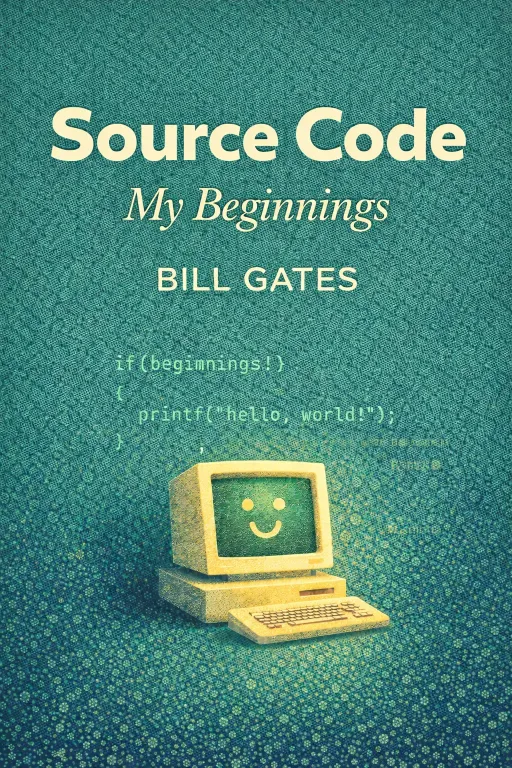
Decoding Bill Gates
Content
Content
Narrator: Introduction
Imagine a teenager, cold and miserable, trudging through miles of deep snow on a remote mountain trail. His hiking group is exhausted, one member is injured, and the mood is grim. But inside this young man’s mind, he isn’t thinking about the cold or the danger. He’s thinking about code. He is mentally writing and rewriting a program, optimizing it, making it leaner and more elegant with every step. The rhythmic crunch of his boots in the snow becomes the metronome for a silent, intense act of creation. That teenager was Bill Gates, and that moment of profound focus, where physical hardship fueled intellectual breakthrough, was not an anomaly. It was a glimpse into the unique operating system of his mind. In his memoir, "Source Code: My Beginnings," Gates unpacks the formative experiences that shaped this mindset, revealing how a love for card games, a rebellious intellect, and a mother’s grand vision became the foundational code for one of the most influential figures of the modern era.
Key Insights
Key Insight 1: The World Can Be Understood
Long before he ever touched a computer, Bill Gates’s intellectual training began at a card table. The book reveals the profound influence of his maternal grandmother, Adelle Thompson, whom he called Gami. She was a legendary card player in the family, and from the age of five, Gates was her devoted, and consistently losing, opponent. For years, he was fascinated and frustrated by her ability to win seemingly every game, from gin rummy to bridge. He couldn't decipher her method.
The breakthrough came during a game of Pounce when he was about eight years old. Gami finally coached him, revealing her secret: she wasn’t just lucky; she was tracking every card played. She was running a mental algorithm, calculating probabilities and anticipating every move. For Gates, this was a revelation. He realized that the mysterious and complex world of a card game was not random. It was a system with rules that could be learned, analyzed, and ultimately, mastered. He understood that Gami had trained her brain, and he could too. This single lesson became a core tenet of his worldview. As he later reflected, card playing taught him that no matter how complex something seems, it can be figured out. The world, in essence, can be understood. This belief in decipherable systems would become the bedrock of his approach to software and problem-solving.
Key Insight 2: The Architect of Ambition
While Gami instilled a love for intellectual puzzles, it was his mother, Mary Maxwell Gates, who designed the social and ethical framework of his upbringing. The book paints a vivid picture of a woman with a "grand vision" for her family. Success, in her view, was not defined by wealth, but by reputation, civic duty, and what she called "good stewardship"—the careful and responsible management of everything entrusted to one’s care.
This philosophy was not just spoken; it was engineered into the family’s life. A powerful example comes from the family’s annual summer vacation at a place called Cheerio Lodge. Ten families, mostly his parents' college friends, would rent cottages together. To ensure her shy son socialized, Mary devised a dinner rotation scheme where the children would draw names and eat with a different family each night. Gates explains that his mother’s goal was to expose her children to role models—ambitious, educated, and civically engaged adults who worked in law, finance, and public service. These forced dinners, though initially uncomfortable for a young, introverted Gates, were a masterclass in social navigation and an immersion in the world of adult responsibility. His mother was not just raising children; she was cultivating future leaders, instilling in them a sense of duty that would later manifest in the Gates family’s immense philanthropic work.
Key Insight 3: The Logic of Rebellion
As Gates’s confidence in his own intellect grew, it inevitably led to conflict with the established rules of the world around him. The book details a "rebellious phase" that began not in adolescence, but around the age of nine. This wasn't a rebellion of delinquency, but one of logic. He began to question the rationality of adult authority and social conventions he found illogical.
A perfect illustration of this was his philosophy on school grades. His fourth-grade teacher, Mrs. Carlson, gave grades for both achievement and effort. Gates found this absurd. He argued that an "A3"—an A for achievement and a 3 (the lowest score) for effort—should be the most celebrated grade of all. To him, achieving a top result with minimal effort was the ultimate sign of intelligence and efficiency. He was practicing "ratio optimization." Mrs. Carlson, understandably, thought he was joking. This wasn't just a child being difficult; it was an early sign of a mind that prioritized logical efficiency over social conformity. This same impulse drew him to the school library, where he found deep satisfaction not just in reading, but in mastering the Dewey Decimal system. The library wasn't a random collection of books; it was a logical system, an order dictated by numbers. By learning that system, he could become an expert, capable of navigating any library in the world.
Key Insight 4: The Crucible of Code
The memoir opens and closes with the story that perfectly fuses Gates’s physical endurance and intellectual obsession. In 1971, during that grueling hike in the Olympic Mountains, he retreated from the physical misery into a mental puzzle. His school had just acquired a new PDP-8 computer, a desktop-sized machine with a mere six kilobytes of memory. Gates had taken on the challenge of writing a BASIC language interpreter for it. As he walked for miles through the snow, he mentally coded a crucial component: the formula evaluator.
The constraints of the machine’s limited memory forced him to be ruthlessly efficient. He had to write short, simple, elegant code. The physical rhythm of walking, he recalls, helped him think. He barely spoke all day, completely immersed in his coding puzzle. By the end of the hike, he had mentally crafted what he considered the best code he had ever written. Though the school’s computer was reclaimed before he could finish the project, that formula evaluator code remained etched in his memory. Three and a half years later, as a sophomore in college, his friend Paul Allen showed him an article about a new, groundbreaking microcomputer. Gates immediately recalled the code he had perfected on that miserable hike. He sat down and typed it into a new machine, and with that, he writes, he "planted the seed of what would become one of the world’s largest companies and the beginning of a new industry."
Conclusion
The most powerful takeaway from "Source Code" is that the revolutionary success of Bill Gates was not born in a single moment of inspiration. It was the result of a specific mindset meticulously assembled over a lifetime of small, formative experiences. His journey reveals that a person’s ultimate impact is a product of their foundational programming: the belief that problems are solvable, the values that guide ambition, and an unshakeable confidence in the power of focused, rational thought.
The book serves as a profound reminder that the "source code" of our own lives is written not in grand gestures, but in the quiet moments of learning, questioning, and persevering. In a final act of "good stewardship," a value his mother championed, all profits from the book are being donated to United Way, an organization she once led. It leaves us to consider the code being written in our own lives—the lessons we internalize and the values we choose to execute—and how that code will ultimately shape the world we build.