

The Roots of Reason: From Ancient Greece to Modern Thought
Golden Hook & Introduction
SECTION
Nova: Atlas, I want to play a game. I’ll say a historical philosopher, and you give me the title of their self-help book for the modern age. Ready?
Atlas: Oh, I love a good challenge, Nova! Lay it on me.
Nova: Alright, first up: Socrates.
Atlas: Hmm, Socrates… "Know Thyself: And Why You're Probably Doing It Wrong."
Nova: Perfect! Okay, next: René Descartes.
Atlas: Easy. "I Think, Therefore I Am… But Seriously, How Do I Stop Overthinking Everything?"
Nova: Nailed it! And our last one, the guy who probably started it all: Plato.
Atlas: Plato… "The Cave: A Guide to Escaping Your Echo Chamber and Seeing Actual Sunlight."
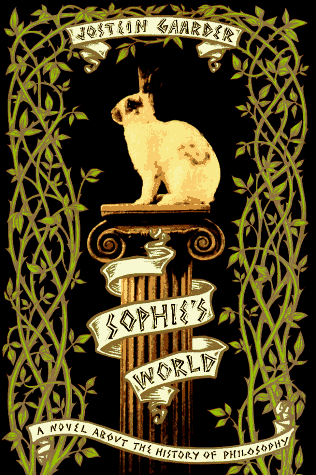
Nova: Fantastic! That last one actually hits pretty close to home for what we're diving into today. Because we’re not just talking about philosophy; we're talking about how to escape our own intellectual caves and see the world with new eyes, thanks to a truly unique book: Jostein Gaarder’s.
Atlas: Oh, I know that one! It's the book that makes philosophy feel less like a dusty tome and more like a thrilling mystery. I remember hearing about its massive global success, how it became this unexpected literary phenomenon, captivating millions, which is pretty wild for a philosophy book.
Nova: Absolutely! It's one of those rare books that manages to be both a critical darling and a commercial smash hit, translated into over sixty languages. Gaarder, a Norwegian philosophy teacher, had this brilliant idea to create a narrative that would make these profound, often intimidating, concepts accessible to young people, and adults too. He basically created a Trojan horse for philosophy, smuggling deep thought into a captivating story.
Atlas: That’s a great way to put it. For anyone who's ever felt like philosophy was behind a paywall of academic jargon, is like finding a secret back door. It really speaks to the "context seeker" in all of us, doesn't it? Trying to understand how these big ideas evolved.
The Narrative Gateway to Philosophy
SECTION
Nova: Exactly. And that's our first core idea today: as a narrative gateway. Gaarder’s genius wasn't just he taught, but he taught it. Instead of a dry textbook, he gives us Sophie, a 14-year-old girl who starts receiving mysterious letters from an anonymous philosopher. These letters take her on a whistle-stop tour through Western philosophy, from the pre-Socratics all the way to existentialism.
Atlas: So, it's like a philosophical "Choose Your Own Adventure" for the intellectually curious. But how does that narrative structure actually make complex ideas more digestible? Are we talking about simplified explanations, or something deeper?
Nova: It's deeper. Gaarder masterfully weaves the philosophical lessons Sophie's unfolding personal mystery. For instance, when Sophie is learning about Plato's Theory of Forms, it's not just an abstract lecture. She's presented with a question about what makes all horses "horse-like," or she's given a red scarf that keeps reappearing in different contexts, making her question the nature of reality and perception. The philosophical question becomes part of her lived experience in the story.
Atlas: That’s fascinating. It sounds like he’s not just explaining philosophy, he’s the philosophical process. For someone who thrives on understanding the evolution of thought, that must be incredibly powerful. It's like you're not just being told the cave, you're experiencing what it's like to walk out of it.
Nova: Precisely. And the way he introduces the philosophers, it's not just names and dates. You get a sense of their personality, their historical context, and the pressing questions they were trying to answer in their own time. Take the Socratic method, for example. Instead of just defining it, the teacher, Alberto Knox, often engages Sophie in Socratic-like dialogues, guiding her to discover the answers herself.
Atlas: That’s a game-changer. So many people, myself included sometimes, can find philosophical texts intimidating because they feel like you need a secret decoder ring to understand them. But by placing these ideas in a relatable narrative, it lowers the barrier to entry significantly. It’s like Gaarder understood that our brains are hardwired for stories, not just bullet points.
Nova: Absolutely. It's the ultimate "accessible explanation." He recognized that the human mind grasps concepts better when they're embedded in a relatable context. It’s the difference between a lecture on the theory of gravity and watching an apple fall from a tree. One is abstract, the other is immediate and experiential.
Atlas: What’s interesting, too, is how this approach directly addresses the "deep thinker" and "context seeker" within us. It doesn’t just give you the answers; it shows you the journey of discovery, the intellectual struggle that led to those ideas. It connects the dots across centuries.
Nova: And that's critical because philosophy wasn't born in a vacuum. Each philosopher was often responding to, building upon, or rebelling against the ideas that came before them. illustrates this intellectual lineage, showing how one era's questions shaped the next.
Building Your Philosophical Toolkit
SECTION
Nova: Which brings us to our second core idea: as a philosophical toolkit builder. It's not just a history lesson; it's an invitation to engage with the big questions yourself. Gaarder essentially hands you the tools to critically examine your own assumptions and make sense of the world.
Atlas: That’s where it gets really interesting for me. It’s one thing to learn about Plato, but it’s another to see how his ideas might help you grapple with a modern ethical dilemma. How does the book encourage that kind of active application?
Nova: Well, the narrative itself often presents Sophie with dilemmas or observations that mirror the philosophical concepts she's learning. For instance, after discussing existentialism, Sophie might face a situation where she has to make a choice that defines her own meaning, rather than simply accepting pre-ordained roles. The book constantly nudges the reader to ask: "How does this apply to life?"
Atlas: So, it's not just about understanding ancient Greek thought, but about understanding how those ancient questions—about justice, reality, purpose—continue to manifest in our modern debates about science, society, and even artificial intelligence.
Nova: Precisely. Take the concept of free will versus determinism. That's a debate that spans millennia, from ancient Stoics to modern neuroscience. Gaarder introduces these ideas in a historical context, but the implications for personal responsibility, legal systems, and even our understanding of addiction are profound and timeless. The book doesn't give you easy answers, but it equips you with the frameworks to ask better questions.
Atlas: And that's key for someone who values understanding the evolution of thought and making sense of the world. It’s not about memorizing facts; it’s about developing a new lens through which to view reality. It sounds like it cultivates that mindset of embracing the discomfort of challenging your own assumptions.
Nova: It absolutely does. One of the powerful lessons is that many of the "new" ideas we grapple with today have deep roots in philosophical history. When we debate the ethics of AI, for example, we're essentially revisiting questions about consciousness, agency, and the nature of intelligence that philosophers have pondered for centuries.
Atlas: That gives me chills, honestly. It’s like realizing that the conversations we're having right now are just new verses in an ancient song. And gives you the sheet music to understand the whole symphony. It sounds like a fantastic way to synthesize ideas from different fields, too—connecting philosophy to science, to ethics, to psychology.
Nova: It is. It teaches you that philosophy isn't a niche academic pursuit; it's the foundational operating system for every other field of human inquiry. It shows you how to look for the connections, for the underlying principles that govern seemingly disparate areas of knowledge.
Synthesis & Takeaways
SECTION
Nova: So, what ultimately offers us isn't just a grand tour of philosophical evolution, but a profound invitation to build our own philosophical toolkit. It’s a vivid demonstration that the most complex ideas can be made accessible and that understanding the past is essential for navigating the present.
Atlas: Yeah, I think what really resonates is that it’s not about becoming a philosopher, but about becoming a more thoughtful, critically engaged human being. It's about recognizing those ancient questions that still echo in our daily lives and having the tools to grapple with them.
Nova: And that’s the true power of it. It cultivates intellectual curiosity, sharpens our analytical approach, and ultimately helps us make more sense of the world around us. It reminds us that the quest for clarity is a timeless, and deeply rewarding, journey.
Atlas: It's an essential read for anyone who wants to move beyond surface-level understanding and really dig into the profound meanings that shape our existence. It’s a gift to the "context seeker" in all of us.
Nova: And it gives us permission to ask those big, uncomfortable questions without feeling intimidated. It’s a book that truly transforms how you think.
Atlas: This is Aibrary. Congratulations on your growth!