

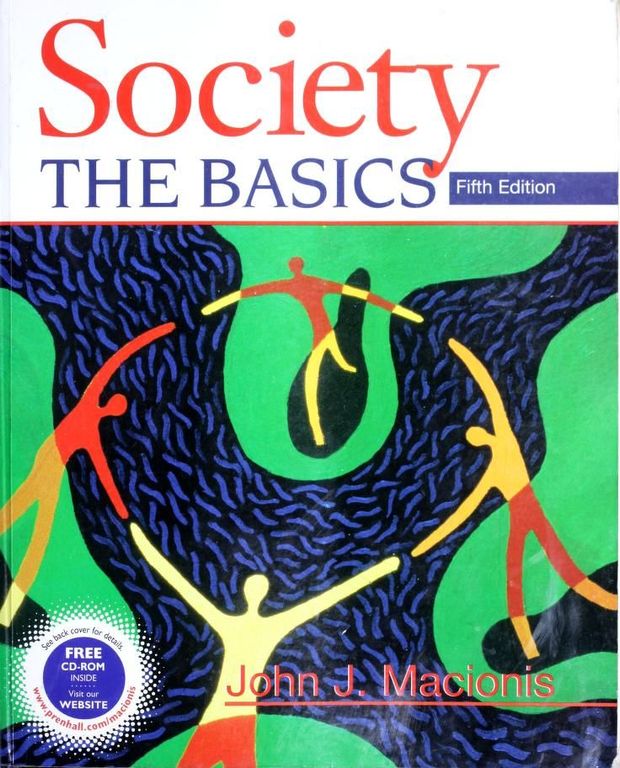
Society
The Basics
Introduction
Nova: Have you ever stopped to wonder why you chose the clothes you are wearing today? Or why you decided to go to college, or even why you feel the need to check your phone every five minutes?
Nova: That is exactly what John J. Macionis wants to challenge in his book, Society: The Basics. He argues that what we think of as purely personal decisions are actually shaped by massive, invisible social forces. It is like that moment in The Matrix where you realize there is a whole system running in the background that you never noticed.
Nova: In a way, yes! Macionis invites us to look at the world through a sociological lens, which means seeing the general in the particular. It is about realizing that our individual lives are part of a much larger story. Today, we are diving deep into his work to see how society builds us, how it divides us, and where we are all heading in this digital age.
Key Insight 1
The Sociological Lens
Nova: The core of Macionis's work starts with the sociological perspective. He uses two really famous phrases to describe it: seeing the general in the particular and seeing the strange in the familiar.
Nova: Think about something as personal as marriage. We think we fall in love and get married because of a unique, magical connection. But if you look at the data, people tend to marry others of the same social class, race, and age. The general pattern of society is actually guiding your particular choice of a partner.
Nova: More like a very strict choreographer! And then there is seeing the strange in the familiar. This is about looking at things we do every day and realizing how weird they actually are. Like, why do we spend thousands of dollars on a diamond ring? Or why do we sit in rows in a classroom? Macionis wants us to realize that society is not just natural or inevitable; it is constructed.
Nova: Exactly. And he introduces three main ways sociologists explain these patterns. First, there is the structural-functional approach. This views society as a complex system where every part works together to promote solidarity and stability. Think of it like a human body where the heart, lungs, and brain all have a job to keep the person alive.
Nova: Right. But then you have the social-conflict approach. This one is the opposite. It sees society as an arena of inequality that generates conflict and change. It asks: who benefits from the way things are? It is not about balance; it is about power struggles between different groups, like the rich versus the poor or different racial groups.
Nova: And the third one is the symbolic-interaction approach. This is more micro-level. It looks at how people interact in their daily lives through symbols, like words, gestures, and even the clothes we wear. It is about how we create our own reality through these small interactions.
Key Insight 2
The Fabric of Culture
Nova: Once you have the lens, Macionis takes you into the concept of culture. He defines it as the ways of thinking, the ways of acting, and the material objects that together form a people's way of life. It is basically the software that runs the human hardware.
Nova: It really is. He breaks it down into material culture, like your smartphone or your car, and non-material culture, which are the ideas, values, and norms of a society. One of the most interesting things he discusses is how technology drives cultural change.
Nova: Macionis points out that as technology advances, it creates what he calls cultural lag. This is when some parts of a culture change faster than others, which can cause conflict. Think about medical technology that can keep people alive indefinitely, but our legal and ethical systems are still debating whether that is right. The tech is ahead of the rules.
Nova: He also talks about the difference between high culture and popular culture. High culture is often associated with the elite, like opera or classical literature, while popular culture is what the masses consume. But he notes that these lines are blurring. What was once considered low-brow can become high art over time.
Nova: Precisely. And he emphasizes that we live in a global village now. Because of globalization, cultures are mixing more than ever. You can find a Starbucks in almost every major city on Earth. But this also leads to the fear of cultural imperialism, where one culture, usually Western, starts to dominate and erase local traditions.
Nova: Macionis also dives into values, which are the standards people use to decide what is desirable or good. In the United States, he points out values like individualism, achievement, and efficiency. But he also notes that these values often contradict each other. We value equality, but we also value competition, which inherently creates winners and losers.
Key Insight 3
The Ladder of Inequality
Nova: This brings us to one of the most powerful sections of the book: social stratification. This is how society ranks categories of people in a hierarchy.
Nova: Exactly. And Macionis uses a haunting example to illustrate this: the sinking of the Titanic. Did you know that your chance of survival that night had almost everything to do with your social class?
Nova: It was incredible. More than sixty percent of the first-class passengers survived, but only about twenty-five percent of the third-class passengers did. Even though the men in first class were supposed to let women and children go first, a first-class man was actually more likely to survive than a third-class child. That is the power of social stratification in a life-or-death situation.
Nova: Macionis explains that stratification is a trait of society, not just a reflection of individual differences. It persists over generations, and it is universal but variable. Every society has it, but how it looks changes. He compares caste systems, where your position is determined at birth, to class systems, which allow for more social mobility.
Nova: That is a major point he makes. He discusses the difference between the ideal of meritocracy, where you get ahead based solely on your talent and effort, and the reality of social inheritance. Your starting point on the ladder matters immensely. He also looks at this on a global scale, comparing high-income, middle-income, and low-income nations.
Nova: That is a perfect analogy. He points out that the richest twenty percent of the world's population receives about eighty percent of the world's total income. Meanwhile, the poorest twenty percent survives on less than one percent. This global inequality affects everything from life expectancy to literacy rates.
Nova: And he does not stop at class. He looks at how race, ethnicity, and gender create their own layers of stratification. He discusses the concept of the minority majority, noting that in the coming decades, the United States will transition to a society where non-Hispanic whites are no longer the majority. This shift is already changing our politics, our schools, and our culture.
Key Insight 4
The Digital Frontier
Nova: In the most recent editions of Society: The Basics, Macionis spends a lot of time on something that is reshaping everything we have talked about so far: social media and digital technology.
Nova: We really are. Macionis explores how social media is changing the way we construct our identity. We are constantly performing for an audience, curating a version of ourselves that might not match reality. This leads to what he calls the presentation of self in a digital age.
Nova: And he connects this to rising rates of anxiety and depression, especially among young people. The constant comparison and the need for validation through likes and shares are creating new social pressures that did not exist twenty years ago. But it is not just personal; it is political.
Nova: Exactly. He discusses how algorithms can isolate us into groups of people who only think like we do, which makes it harder to have a functional, unified society. He also touches on the rapid development of artificial intelligence. AI is not just a tool; it is a social force that could redefine work, education, and even what it means to be human.
Nova: It has to, because these things are the new fabric of our society. Macionis also looks at how technology is changing social institutions like the family. We are seeing more diverse family structures, more people living alone, and technology playing a huge role in how people meet and maintain relationships.
Nova: And even religion and education are moving online. He asks us to consider what we lose when these face-to-face social institutions become digital. Do we lose the social glue that holds us together? It is a big question with no easy answer.
Conclusion
Nova: We have covered a lot of ground today, from the basic sociological lens to the complex world of global inequality and the digital frontier. If there is one takeaway from John J. Macionis and Society: The Basics, it is that we are never truly alone in our decisions. We are always part of a larger social web.
Nova: That is the ultimate goal of sociology. By understanding the forces that shape us, we gain the power to shape them back. Whether it is fighting for social justice, navigating the challenges of social media, or just understanding your neighbor a little better, the sociological perspective is a tool for a better life.
Nova: That is the first step toward a sociological imagination. Thank you for joining us on this journey through the foundations of our social world.
Nova: This is Aibrary. Congratulations on your growth!