Understanding Political Ideologies
Golden Hook & Introduction
SECTION
Nova: Your weekly team alignment meeting is boring because of a structural conflict designed in the nineteenth century.
Atlas: Oh, I knew my calendar was haunted. I knew it. That explains so much.
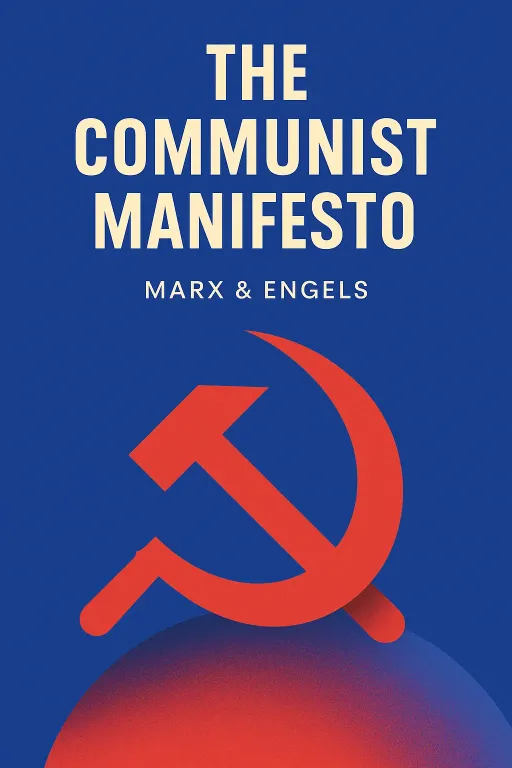
Nova: It actually does. Today we are looking at how the deep, tectonic shifts of history still shape our daily grinds, our office politics, and the way we lead. We are diving into two massive texts that unpack these forces. First, the foundational and highly influential text, The Communist Manifesto, written by Karl Marx and Friedrich Engels in 1848. Second, we are exploring Michael Newman's widely acclaimed book, Socialism, which traces how these radical ideas adapted, split, and transformed across different eras.
Atlas: That is a heavy-hitting lineup. When people hear Marx or socialism, they usually think of massive geopolitical standoffs, cold war history, or intense political debates. But you are saying these texts have something direct to say about my Monday morning stand-up meeting?
Nova: Absolutely. Marx and Engels were writing during a period of dizzying technological and social change, very much like our own digital revolution. They were trying to understand why, as society became incredibly productive, the people doing the actual work felt increasingly powerless and exhausted. Newman takes that thread and shows how different groups tried to redesign the system to be more collaborative.
Atlas: That sounds like the ultimate systemic review. If we want to build healthier, more resilient organizations today, we have to understand the invisible architecture we inherited. Where do we even start to unpack this?
Nova: We start with the core engine that Marx and Engels identified as the driver of human history. The idea that society is fundamentally structured by economic relationships, and that these relationships naturally create friction.
The Structural Engine of the Modern Workplace
SECTION
Nova: In The Communist Manifesto, Marx and Engels lay out a breathtakingly simple and provocative premise. The history of all hitherto existing society is the history of class struggles. They argue that every era is defined by who owns the tools of production and who has to sell their labor to survive.
Atlas: Okay, let me check if I got that right. In the industrial era, the bourgeoisie owned the factories and the steam engines, while the proletariat owned nothing but their time and their physical ability to work.
Nova: Exactly. And because the factory owners wanted to maximize profit, they had a structural incentive to pay the workers as little as possible and make them work as hard as possible. Meanwhile, the workers had the opposite incentive. This created an inherent, inescapable tension. Marx and Engels argued that this tension is the actual engine that drives societal evolution forward.
Atlas: That sounds incredibly intense, but I can definitely see how that tension translates to the modern corporate world. We might not be working in coal mines, but anyone who has ever stared at a digital dashboard tracking their keystrokes knows what it feels like to have their labor optimized by someone else.
Nova: You have hit on a crucial concept. Marx called this the alienation of labor. Before the industrial revolution, a craftsman, say a shoemaker, owned his tools, bought his leather, designed the shoe, and sold the finished product. He had a direct, personal relationship with his work. But once he was brought into a factory, he was put on an assembly line. His job was reduced to hammering the same peg into a heel, ten thousand times a day. He became, as Marx wrote, an appendage of the machine.
Atlas: Wow, that is a powerful way to put it. It is the difference between building a whole house and just turning a single screw over and over. In the modern knowledge economy, we see this when work gets hyper-specialized. You are not designing a product; you are just managing one specific column on a spreadsheet, or writing one tiny feature for an app you do not own. You lose sight of the bigger picture.
Nova: The structural friction remains the same. The conflict is built into the blueprint of the organization. When we experience burnout, or when teams feel completely disconnected from their mission, we often blame individual managers or personal motivation. The reality is that the friction stems from the design of the system itself. The system is prioritizing efficiency and output over human connection and agency.
Atlas: That makes so much sense. It takes the pressure off individual blame and forces us to look at the architecture. If a system is designed to treat people as units of labor, then we should not be surprised when those people feel disengaged. But how did we get here? How did the factory model become the default setting for the modern office?
Nova: It happened through a process of systematic standardization. In the early twentieth century, a theorist named Frederick Winslow Taylor introduced scientific management, which was basically the ultimate realization of Marx's fears. Taylor would stand over workers with a stopwatch, measuring every single movement to eliminate wasted time. He wanted to turn humans into perfect, predictable machines.
Atlas: That sounds like a nightmare. It is the ultimate expression of control.
Nova: It was incredibly efficient for mass production, but it completely stripped away worker autonomy. And that legacy is deeply embedded in our modern professional environments. Think about open-plan offices designed for constant surveillance, or software that tracks how long you are active on your computer, or the relentless pressure to optimize every single minute of your day. We are still using nineteenth-century factory logic to manage twenty-first-century creative minds.
Atlas: Right, like we are trying to run cutting-edge software on ancient, dusty hardware. If a leader wants to build a truly collaborative, empathetic team, they are essentially fighting against a century of deeply ingrained structural habits.
Nova: That is the strategic challenge. To lead effectively today, you cannot just offer free snacks or put a ping-pong table in the break room. You have to actively interrogate the power structures and workflows of your organization. You have to ask who owns the decisions, who benefits from the surplus value of the work, and how much agency your team members actually have over their daily lives.
Atlas: This makes me wonder about the alternative. If the industrial, top-down model is the source of this systemic friction, what does the alternative actually look like in practice? How do we transition from a system of control to a system of genuine collaboration?
Nova: That is where Michael Newman's exploration of socialism becomes so valuable. He shows that people have been experimenting with answers to that exact question for over two hundred years.
From Monoliths to Modern Collaboration
SECTION
Nova: When we look at Michael Newman's Socialism, we discover that the movement was never a single, rigid doctrine. It was a sprawling, diverse ecosystem of thinkers, activists, and experiments, all trying to solve the problem of industrial exploitation. One of the most fascinating early pioneers was a Welsh textile manufacturer named Robert Owen.
Atlas: Wait, a factory owner was trying to pioneer socialist ideas? That sounds like a massive contradiction.
Nova: It was highly unusual for his time. In the early 1800s, Owen took over the New Lanark cotton mills in Scotland. The industrial revolution was at its most brutal. Children as young as ten were working fourteen-hour days in dangerous, filthy conditions. But Owen believed that character is formed by the environment. If you create a humane, supportive environment, you will produce better, happier, and ultimately more productive human beings.
Atlas: That is an incredibly modern sentiment. It sounds exactly like what we call corporate culture today. What did he actually do at New Lanark?
Nova: He transformed the entire community. He reduced the workday to ten and a half hours, which was revolutionary at the time. He completely banned child labor under the age of ten. He built the world's first infant school, provided free healthcare, set up a cooperative store where workers could buy goods at fair prices, and built decent housing.
Atlas: That sounds like an oasis in the middle of a grim, industrial desert. But did it actually work, or did he go bankrupt?
Nova: It was a massive commercial success. New Lanark became highly profitable and attracted visitors from all over the world who wanted to see this miracle. Owen proved that treating workers with dignity, investing in their well-being, and creating a collaborative community was not just morally right, it was incredibly effective.
Atlas: Oh, I love that. It completely busts the myth that you have to exploit people to build a successful enterprise. But if it was so successful, why didn't every other factory owner immediately copy him?
Nova: Because the dominant economic system still rewarded short-term exploitation. Owen's peers were focused on immediate profit margins, and they viewed his ideas as dangerous and utopian. Newman's book shows that this tension between reform and revolution, between working within the system and overthrowing it, has always been at the heart of socialist philosophy.
Atlas: I can see how that tension plays out today. In the corporate world, you have leaders who want to make incremental changes, like offering mental health days or introducing agile workflows, while others feel the entire corporate structure needs a complete overhaul.
Nova: The key takeaway from Newman's work is that the search for democratic, collaborative alternatives is an ongoing process. One of the most powerful offshoots of this history is the cooperative movement. In a cooperative, the workers themselves own the enterprise. They share the profits, and they vote on major decisions. It is a direct challenge to the traditional hierarchy where a small group of shareholders holds all the power.
Atlas: That sounds amazing, but is it actually scalable? Can you run a complex, modern business that way?
Nova: Look at the Mondragon Corporation in Spain. It started in the 1950s as a small cooperative with a handful of workers. Today, it is a massive federation of worker cooperatives employing over eighty thousand people, operating across finance, industry, and retail. They have survived global economic crises, maintained high employment stability, and kept their pay ratios incredibly equitable. The highest-paid executives rarely make more than six times what the lowest-paid worker makes. Compare that to the average American CEO, who makes hundreds of times more than their average employee.
Atlas: Wow, that is a stunning contrast. It proves that democratic workplaces can survive and thrive in the real world. For a leader who might not be able to turn their entire company into a cooperative, what are the practical, daily lessons we can draw from this?
Nova: It is about distributing power and building psychological safety. If you want a collaborative team, you have to actively dismantle the fear that comes from traditional hierarchies. You have to create channels where team members have a genuine say in how work is done, how projects are managed, and how success is defined.
Atlas: So, instead of being the master architect who hands down the blueprint from on high, a strategic leader should act more like a facilitator, helping the team co-create the blueprint together.
Nova: Exactly. It is about moving from control to stewardship. When you understand that historical structures are designed to centralize control, you can make the conscious choice to decentralize it. You can build a team where people are not just appendages of a digital machine, but active, respected contributors to a shared mission.
Synthesis & Takeaways
SECTION
Atlas: This has been a fascinating journey. We started with the fiery rhetoric of Marx and Engels in 1848, moved through the diverse practical experiments of socialism in Michael Newman's work, and ended up right back in our modern offices. It makes me realize how much of our daily work stress is not actually personal. It is historical.
Nova: That is the profound shift in perspective. When we understand these historical structures, we gain a superpower. We stop blaming ourselves or our colleagues for the friction we feel. We start seeing the invisible lines of force that shape our behavior.
Atlas: Right, like realizing the draft in your room is not your imagination; there is a structural gap in the window frame. Once you see the gap, you can actually fix it.
Nova: That is the path to resilience and strategic leadership. As an aspiring leader or an analytical thinker, your job is to look at the architecture of your team. Are you reinforcing a system of alienation, or are you building a community of collaboration? Are you treating your team members as resources to be optimized, or as partners in a shared endeavor?
Atlas: For anyone listening who wants to take action on this today, what is the one concrete step they can take in their next meeting?
Nova: Start by changing the flow of information and decision-making. In your next project alignment, do not just assign tasks. Invite your team to co-design the workflow. Ask them what obstacles are draining their energy and how the structure of the work can be redesigned to give them more autonomy. Give them a stake in the process.
Atlas: That is a powerful, practical way to bring a little bit of Robert Owen's New Lanark into the digital age. It is about building a foundation of empathy and collaboration, one structural adjustment at a time.
Nova: It is the ultimate form of strategic leadership. By understanding the past, we gain the tools to architect a better, more resilient future.
Atlas: This is Aibrary. Congratulations on your growth!