The Lifecycle of Civilizations and Ideologies
Golden Hook & Introduction
SECTION
Nova: Institutions are like living organisms. They are either growing, adapting, and evolving, or they are quietly, steadily rotting from the inside out. We tend to think of this as something that only happens to ancient empires or massive government bureaucracies, but the exact same mechanics of decay apply to the startup you’re scaling, the team you’re leading, and even the systems you’ve built for your own life.
Atlas: That is a sobering thought, especially when you consider how much energy we put into building these things in the first place. You put in the late nights, you set the strategy, you hire the talent, and you assume that once the structure is in place, it will just run. But the reality is that without constant maintenance, the structure itself becomes the trap.
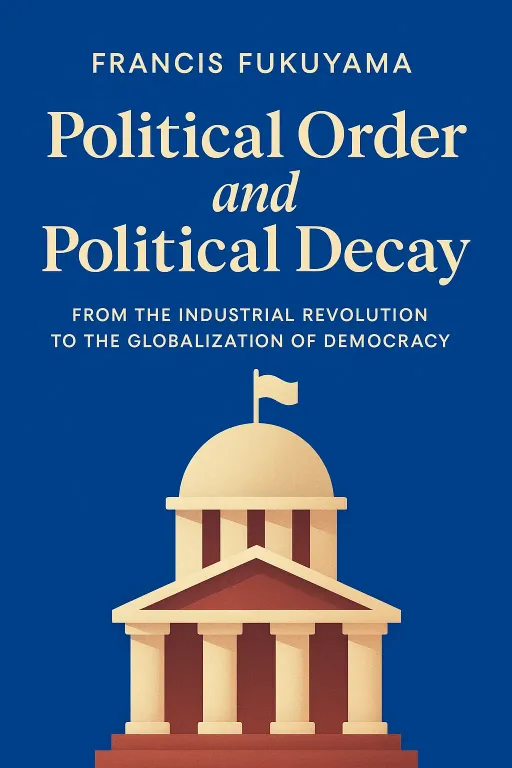
Nova: Exactly. And that is why we are looking at two very different, but deeply complementary thinkers today. We are diving into the architecture of power and the mechanisms of stability. First, we have Francis Fukuyama and his seminal work, Political Order and Political Decay. He spent his career mapping out exactly what makes a system endure or collapse.
Atlas: And alongside him, we’re bringing in Michael Newman, whose analysis in Socialism provides a very different, but equally vital perspective on how we restructure economic power to actually address systemic inequality. It is a fascinating pairing because one is about the skeleton—the structure—and the other is about the blood—the equity and the purpose.
Nova: It is. Fukuyama provides the blueprint for the state, while Newman challenges us to look at what that state is actually doing for the people within it. By combining these, we can actually start to answer the question that keeps every conscious leader up at night: How do you build an organization that stays strong, stays accountable, and doesn’t just replicate the old, decaying power structures of the past?
Atlas: That is the million-dollar question. Let’s get into the mechanics of this.
The Three Pillars of Stability
SECTION
Nova: If we start with Fukuyama, he presents a very clean, almost mathematical model for what a political system needs to survive. He argues that you need three specific pillars. If you have all three, you have stability. If you lose one, you start to see that slow, creeping decay.
Atlas: I remember reading about this. The three pillars are a strong state, the rule of law, and democratic accountability. But let’s break that down for our listeners, because "strong state" sounds a bit abstract. When you are looking at a modern organization, what does a "strong state" actually look like?
Nova: Think of the "strong state" as the capacity to get things done. It is your operational excellence. It is the ability of your organization to make a decision and then actually execute on it without getting bogged down by internal politics or competing agendas. A strong state is a capable bureaucracy. It is the infrastructure that allows you to deliver value to your customers or your team consistently.
Atlas: Okay, I see that. It is the engine. If the engine is weak, you have a vision, but you have no output. But then you have the second pillar, the rule of law. That feels like the guardrails.
Nova: Precisely. The rule of law means that the rules apply to everyone, including the people at the top. If you have a strong state—a capable engine—but you don't have the rule of law, you end up with autocracy or corruption. You end up with a system where the "state" serves the interests of the leader rather than the interests of the collective.
Atlas: That is a massive pain point for any high-growth organization. You see it all the time. A company scales, and suddenly the rules that apply to the junior staff don't seem to apply to the senior leadership. The moment that happens, the culture starts to degrade. The "rule of law" is effectively the integrity of your processes.
Nova: It is. And it is the third pillar, democratic accountability, that keeps that integrity in check. This is the feedback loop. It is the mechanism by which the people within the system—your employees, your stakeholders, your citizens—can say, "Hey, this isn't working," or "We need to change direction." Without that, you have a strong, law-abiding system that is completely disconnected from reality. It is a system that is perfectly optimized for the wrong thing.
Atlas: So, you need all three. You need the capacity to execute, you need the integrity of the rules, and you need the feedback loop to keep you aligned with the people you serve. If you have all three, you are in a good place. But what happens when they fall out of balance? Because that seems to be where the real story is.
Nova: That is where the decay happens. Fukuyama talks about "clientelism." This is a classic symptom of decay. It happens when the "strong state" starts to serve specific groups or individuals rather than the public good. In a company, this looks like hiring your friends instead of the best candidates, or creating departments that exist only to protect the budget of a specific manager.
Atlas: I have seen that happen in real-time. It is the moment when the organization stops being about the mission and starts being about the internal power dynamics. The "strong state"—that operational capacity—gets hijacked. The bureaucracy becomes a tool for self-preservation.
Nova: Exactly. And the fascinating thing about Fukuyama’s work is that he isn't saying bureaucracy is bad. He is saying that a bureaucracy is the hallmark of a successful society. The problem is when the bureaucracy becomes "captured." When the systems and processes are no longer serving the goal but are instead serving the people who control the systems.
Atlas: That makes perfect sense. It is like a computer program where the code has been rewritten so many times by so many different people that it is now just a mess of patches and workarounds. It still runs, but it is incredibly inefficient, and nobody knows how to fix it without breaking everything else.
Nova: That is a perfect analogy. The "technical debt" of an organization. And that leads us to the second piece of our puzzle, because once you have that structure, you have to ask: What are we actually trying to achieve? And that is where Michael Newman’s work on socialism becomes so relevant, even if you move past the political baggage of the term.
Restructuring Economic Power
SECTION
Atlas: I am glad you brought that up, because "socialism" is a word that triggers a lot of different reactions. It is polarizing. But if we look at it through the lens of Newman’s analysis, it is really about the mechanics of inequality. How do we move beyond just the political label and look at the core theory of restructuring economic power?
Nova: That is the right approach. Newman’s historical analysis is brilliant because he traces how different movements attempted to solve the problem of systemic inequality. The core, underlying question in his work is: How do you distribute opportunity and power in a way that is actually equitable? He isn't just talking about wealth; he is talking about the ability to influence the system itself.
Atlas: So, if Fukuyama is telling us how to keep the machine running, Newman is telling us who the machine is supposed to serve.
Nova: Yes. And the tension between those two is where the most important work happens. You can have a perfectly stable, highly efficient, "strong state" organization that is fundamentally unfair. You can have an organization that is efficient at exploiting its own people.
Atlas: That is the danger of pure efficiency. If you focus only on the Fukuyama pillars—capacity, rules, accountability—you might end up with a system that is very stable but also very rigid and exclusionary. Newman’s perspective pushes us to ask: Are the rules themselves designed to favor the few, or are they designed to distribute power?
Nova: And that is a shift in mindset. Let's think about this in terms of a team. If you are a leader, you have to build that "strong state" capacity. You need your team to execute. You need rules that apply to everyone. You need feedback loops. But if you don't integrate that second layer—the Newman layer—you might find that your "democratic accountability" is only hearing from the people who already have the most power.
Atlas: That is a profound point. You can have a feedback loop that is technically functional but practically useless because it is only collecting input from the loudest voices in the room. You think you are being accountable, but you are actually just reinforcing the existing hierarchy.
Nova: Exactly. And that is where the concept of "equity" comes in. Newman’s analysis shows that true equity isn't just about giving everyone the same thing; it is about recognizing the systemic barriers that prevent certain people from having the same capacity to act.
Atlas: How do you operationalize that? Because that sounds great in theory, but as an architect of a system, how do you build that into the structure?
Nova: It starts by auditing your own "rule of law." You have to ask: Are these rules neutral, or do they inadvertently favor people who already have certain advantages? For example, in a corporate setting, are your promotion criteria actually measuring competence, or are they measuring the ability to navigate a specific, legacy-driven social network within the company?
Atlas: That is a hard question to ask. It requires a lot of honesty. It means looking at your own "strong state" and admitting that maybe the bureaucracy you built—the one you are proud of—is actually a gatekeeper.
Nova: And that is the bridge between Fukuyama and Newman. Fukuyama tells us that institutions decay when they become rigid and self-serving. Newman tells us that the way to prevent that decay is to constantly reassess who the system is serving. The decay doesn't just happen because of inefficiency; it happens because the system loses its moral compass regarding its own beneficiaries.
Atlas: So, the antidote to institutional decay isn't just "more process" or "more efficiency." It is a constant, proactive effort to redistribute power and opportunity within the system.
Nova: Yes. You have to treat "equity" as a pillar of stability, just as important as the state, the rule of law, and accountability. A system that is not equitable is a system that is fundamentally unstable, because it is creating a growing group of people who have no stake in its success.
Synthesis & Takeaways
SECTION
Atlas: This is starting to come together for me. If I am listening to this, and I am managing a team or building a company, the takeaway isn't just to be a better manager. It is to be a system architect. I need to look at my organization and ask: Do I have the three pillars of stability, and am I actively fighting the tendency of those pillars to become tools of exclusion?
Nova: That is exactly it. You have to be the guardian of your own system. Fukuyama’s warning about decay is real. It happens when the "state" becomes a clientelist network—when you start hiring for loyalty instead of talent, or when you start protecting your own process instead of the outcome. And Newman’s warning about inequality is the check on that. If you are not actively ensuring that your system provides equitable opportunities, you are building your own obsolescence.
Atlas: It sounds like the "Analytical Architect" listener—the person who values tangible results and growth—needs to shift their focus from just "building the thing" to "tending the garden." You have to prune the decay, but you also have to make sure the soil is fertile for everyone, not just the plants that are already at the top.
Nova: That is a beautiful way to put it. The "soil" is the culture of equity. If you don't cultivate that, the strongest system in the world will eventually wither. Institutional decay isn't a bug; it is a feature of any system that stops paying attention to its own purpose.
Atlas: So, the practical step here is to run a "decay audit." Ask yourself: Is my bureaucracy serving the goal, or is it serving itself? And then, ask: Is my feedback loop actually hearing from everyone, or just the people who are already empowered?
Nova: And then take action. If you find a process that is purely about self-preservation—nuke it. If you find a feedback mechanism that is silencing the marginalized—rebuild it. That is the work of a conscious leader. It is not just about keeping the lights on; it is about ensuring that the organization remains a vehicle for progress, rather than a monument to the past.
Atlas: It is a high bar, but it is the only way to build something that actually lasts. You aren't just building a company; you are building a living, breathing, equitable system.
Nova: And that is how you sustain your drive without burning out. You stop trying to hold everything together by sheer force of will, and you start building systems that hold themselves together through integrity, accountability, and equity.
Atlas: That is a powerful shift. It moves the burden from the individual to the architecture.
Nova: Exactly. And that is the ultimate form of strategic leadership. It is the ability to design a system that is resilient enough to endure, and fair enough to deserve to.
Atlas: This has been a fantastic dive into the mechanics of order and equity. It’s given me a lot to think about regarding how I structure my own team.
Nova: I am glad to hear that. The goal is always to move from consuming information to building better frameworks. We have covered a lot of ground today, from the pillars of political order to the necessity of economic equity. It is a lot to process, but the core takeaway is simple: Build for capability, govern with integrity, and optimize for equity.
Atlas: I think that is a perfect summary. If you are listening to this, I encourage you to take that "decay audit" this week. Look at your systems. Are they serving the mission, or are they serving themselves? It might be the most important thing you do all year.
Nova: We are rooting for your growth. This is Aibrary. Congratulations on your growth!