Post Capitalism and the Automation of Wealth
Golden Hook & Introduction
SECTION
Nova: We have been sold a lie that working harder is the only way to climb the ladder of success. But what if the ladder itself is being dismantled, not by a crisis, but by the very technology we are building to make our lives easier?
Atlas: That is the uncomfortable truth that most people are ignoring. We look at artificial intelligence and see productivity hacks or cool image generators, but we are missing the structural collapse of the old labor-for-income trade. It is like watching a building being renovated from the inside out while we are still sitting at our desks on the top floor.
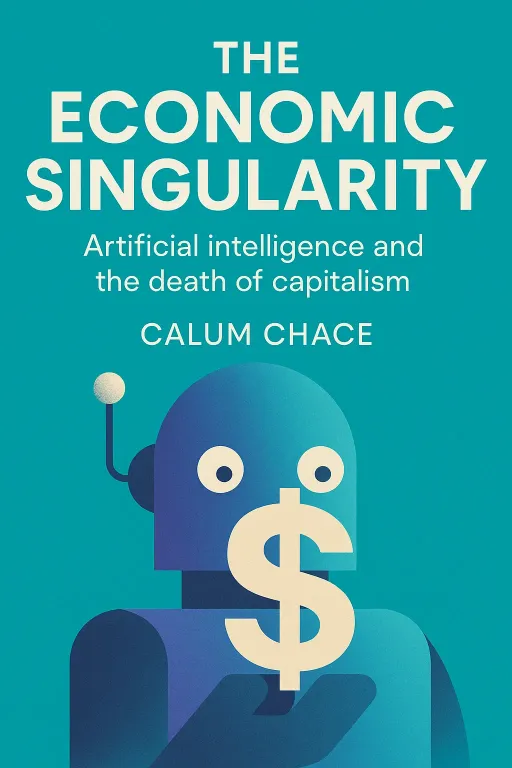
Nova: Exactly. And that is why today we are looking at two fundamental pillars of our future. We are diving into The Economic Singularity by Calum Chace, which lays out the technological reality of automation, and we are pairing that with Socialism by Michael Newman, which gives us the historical framework for how we might distribute the wealth that results.
Atlas: It is a fascinating, if slightly terrifying, pairing. Chace was an early thinker on the implications of AI, and his work is often cited as a wake-up call for how rapidly the job market is going to shift. And Newman? He provides the necessary intellectual history to understand that these questions about distribution are not new; they have just taken on a completely different scale.
Nova: Right. And for our listeners, specifically those who view themselves as analytical architects of their own careers, this is not just academic theory. This is the blueprint for the next thirty years of your professional life. We are talking about moving from being a laborer in a system to becoming an architect of a new kind of wealth.
Atlas: I love that framing. Let us get into the engine room first. Let us talk about the Singularity.
The Technological Engine: The Singularity
SECTION
Nova: When Calum Chace writes about the Economic Singularity, he is not talking about some sci-fi scenario where robots take over the world with lasers. He is talking about the point where artificial intelligence becomes capable of performing almost all human labor more efficiently and cheaply than we can. It is a fundamental shift in the economics of production.
Atlas: Wait, let me stop you there. I hear people say this all the time, and the immediate reaction is always, well, technology has always created more jobs than it destroyed. The printing press didn't end writing; it exploded the demand for it. Why is this time different? Why is Chace so convinced that this is a one-way street toward the automation of labor?
Nova: That is the central question. And the difference, as Chace argues, is the nature of the machine. In the past, machines replaced our muscles. They took away the need for physical labor, which meant we moved into cognitive, information-based roles. But AI is not a machine that replaces muscle; it is a machine that replaces cognition. It is replacing the very thing that made humans indispensable in the last century.
Atlas: So, we are not talking about a tractor replacing a plowman. We are talking about an algorithm replacing the analyst, the paralegal, the coder, and the middle manager.
Nova: Precisely. And when you remove the need for human cognition in the production process, you break the link between labor and income. For the last few hundred years, if you wanted to eat, you had to produce something of value, usually by selling your time or your mental energy. If the marginal cost of human labor trends toward zero because an AI can do it for pennies, what happens to the price of labor?
Atlas: It crashes. It has to. If an AI can write a better legal brief, diagnose a disease with more accuracy, or optimize a supply chain with zero fatigue, why would any rational organization pay a human a salary, health benefits, and a pension? The economics just do not support it.
Nova: And that is the crux of the Singularity. Chace is pointing out that we are approaching a world where the cost of goods and services could plummet because the labor cost component vanishes. We could live in a world of unprecedented abundance. But the mechanism to get that abundance into the hands of people—who no longer have jobs—is currently broken.
Atlas: This is where my brain starts to itch. If the cost of goods drops, that is great. But if I have no income because my cognitive labor is obsolete, the price of goods is irrelevant. I still cannot afford them. This is the disconnect that most tech optimists gloss over. They talk about the abundance, but they ignore the distribution.
Nova: That is exactly where the friction lies. You have the engine of growth, which is accelerating, and then you have the rails of society, which were built for a coal-burning, human-labor-intensive economy. You cannot run a high-speed electric train on tracks meant for a steam engine.
Atlas: So, if Chace is the one telling us the train is coming, we need to look at who is going to lay the new tracks. And that brings us to the second part of our conversation, the distribution question.
The Societal Rails: Rethinking Distribution
SECTION
Nova: This is where Michael Newman’s work on the history and theory of collective distribution models becomes essential. When people hear the word socialism today, they often think of specific political regimes or Cold War baggage. But if we strip that away and look at it as a structural analysis of resource management, Newman provides a framework for how societies have historically tried to solve the problem of inequality and distribution.
Atlas: I appreciate that distinction. It is easy to get bogged down in partisan labels. Let us put the labels aside. If we are entering a post-labor economy, we are essentially talking about how to distribute the bounty produced by machines. We are talking about decoupling survival from work.
Nova: Exactly. And historically, we have seen various models for this. Newman’s analysis helps us see that these are not just utopian fantasies; they are attempts to answer the question: how do we ensure the stability of a society when the market can no longer provide work for everyone?
Atlas: But here is the pushback I hear from the analytical crowd. If you decouple survival from work, do you not kill the incentive to innovate? If I can live comfortably without working, why would I bother to build, to create, or to solve hard problems? Doesn't the whole system stagnate?
Nova: That is the classic counter-argument. But consider the current reality. We have millions of people working jobs they hate, burning out, and wasting their potential on tasks that are essentially just keeping the gears turning for someone else’s profit. Is that really the peak of human innovation?
Atlas: You have a point. A lot of modern work is just bureaucracy.
Nova: Imagine if the goal of society shifted from full employment—which is an outdated metric—to full flourishing. If the basic needs of life are covered by the automated output of the machines, the incentive to work shifts from survival to curiosity, mastery, and contribution.
Atlas: That sounds great in a philosophy class, but let us get real about the transition. We are talking about a massive shift in power. If the people who own the AI—the owners of the capital—are the ones reaping the rewards, they are not just going to hand out the wealth because it is the moral thing to do. History shows that distribution models are usually the result of intense pressure, negotiation, and sometimes, social upheaval.
Nova: You are absolutely right. And that is what Newman’s historical analysis underscores. These systems are rarely gifts from the top down. They are responses to the changing structure of the economy. When the Industrial Revolution hit, it created the labor movement because the factory conditions were unsustainable. Now, we are in the middle of a Digital Revolution. The "factory conditions" of our time are not physical; they are economic. It is the precariousness of gig work, the obsolescence of professional skills, and the concentration of wealth in tech monopolies.
Atlas: So, the "distribution model" isn't just about charity; it's about system stability. If you have an economy where the machines produce everything but 90 percent of the population has no money to buy it, the economy collapses. The owners of the capital need consumers.
Nova: That is the most pragmatic argument for a new distribution model. It is not just about fairness; it is about the survival of the market itself. If the masses cannot participate in the economy, the economy has no purpose.
Atlas: This brings us back to the user profile we are talking to today. The Analytical Architect. The person who wants to build a future-proof life. If we accept that these two forces—the technological engine and the societal rails—are moving toward a collision, how does an individual navigate this?
Wealth Architecture in a Post-Labor World
SECTION
Nova: This is the critical takeaway. If you are an analytical architect, you have to stop thinking about your career as a linear path where you trade hours for dollars. That model is being disrupted. Instead, you need to think about wealth architecture.
Atlas: Give me a concrete example. What does a "wealth architect" do differently than a traditional professional?
Nova: A traditional professional asks, "What degree should I get to be employable for the next forty years?" A wealth architect asks, "What assets can I own or create that the machines cannot easily replicate, or that benefit from the machine's productivity?"
Atlas: Okay, so we are talking about leverage. If the machines are doing the commodity work, the human value shifts to things like strategy, high-level creative synthesis, human connection, and, importantly, ownership of the tools themselves.
Nova: Exactly. Think about the difference between being the person who codes the app and the person who owns the platform. The coder is being automated. The platform owner is the one benefiting from the automation.
Atlas: That sounds like a shift from being a "worker" to being an "investor" or "owner." But what about the person who isn't a billionaire tech founder? What is the move for the regular high-skilled professional?
Nova: It is about diversification of value. You need to cultivate what I call "human-centric capital." Skills that rely on empathy, nuance, complex ethical judgment, and physical dexterity in unpredictable environments. AI is great at pattern recognition, but it is terrible at navigating the messy, ambiguous, high-stakes political and emotional landscapes of real-world decision-making.
Atlas: So, double down on the things that make us human. I like that. It’s not about competing with the machine; it’s about being the pilot, the curator, and the architect of the machine’s output.
Nova: And it’s about understanding the systemic changes. As Newman points out in his work on socialism, the political and economic systems are not static. They change. If you are an architect, you need to be paying attention to the policy debates around AI, universal basic income, and corporate taxation. These are not just news headlines; they are the structural changes to the playing field you are operating on.
Atlas: That is a great point. I think a lot of people tune out the policy stuff because it feels boring or too political. But if you are an analytical thinker, you should see that policy is basically the "rules of the game." If the rules are going to change, you need to understand the direction of that change to position yourself effectively.
Nova: Precisely. If you are a builder, you do not just look at the materials; you look at the building codes. The distribution models we are moving toward are the building codes of the future economy.
Synthesis & Takeaways
SECTION
Atlas: This has been a fascinating pivot. We started with the idea that AI is going to automate labor, and we ended with the idea that we need to redesign our entire relationship with work and wealth.
Nova: And that is the synthesis. We cannot just be passive consumers of technology or passive victims of economic trends. We have to be active architects.
Atlas: So, for the listener who is sitting there thinking, "Okay, this is heavy. What do I do tomorrow morning?" What is the high-impact framework?
Nova: The framework is simple but demanding. First, audit your current skill set. Ask yourself: is what I do primarily cognitive pattern recognition? If the answer is yes, you are in the blast zone. You need to start moving toward roles that require human-centric judgment, empathy, and complex strategy.
Atlas: And second?
Nova: Second, start building your own "wealth architecture." Look for ways to own assets rather than just selling your time. It could be intellectual property, equity, or community-based networks. Move toward ownership.
Atlas: And third, stay informed on the systemic level. Don't just follow the tech news; follow the economic and social policy debates. Understand that the "rails" of our society are going to be rebuilt. You want to be on the side of the track that is being built, not the side that is being torn up.
Nova: It is a profound shift in mindset. We are moving from a world where "hard work" was the currency, to a world where "adaptability and ownership" will be the currency.
Atlas: It is a bit daunting, but it is also incredibly empowering. It means the future isn't something that happens to us; it is something we can anticipate and prepare for.
Nova: That is the goal of all this analysis. We are not just predicting the future; we are preparing to build our place within it. And honestly, that is the most analytical, strategic thing anyone can do.
Atlas: Well said. This has been a fantastic dive into the intersection of technology and society. It is the kind of big-picture thinking that keeps us ahead of the curve.
Nova: Indeed. And for our listeners, keep digging into these frameworks. The more you understand the engine and the rails, the better you can navigate the journey.
Atlas: This is Aibrary. Congratulations on your growth!