Deconstructing Collective Ideologies
Golden Hook & Introduction
SECTION
Nova: You think your ambition is uniquely yours. You think your definition of success—the corner office, the hustle, the climb—is a personal choice. But what if you are just running a software program written by the economic system you were born into?
Atlas: That is a terrifying thought. It implies that my drive to succeed isn't a reflection of my inner soul, but rather a byproduct of the specific economic architecture surrounding me. If I’m just a cog responding to the system's code, then the idea of individual agency starts to look a lot more complicated.
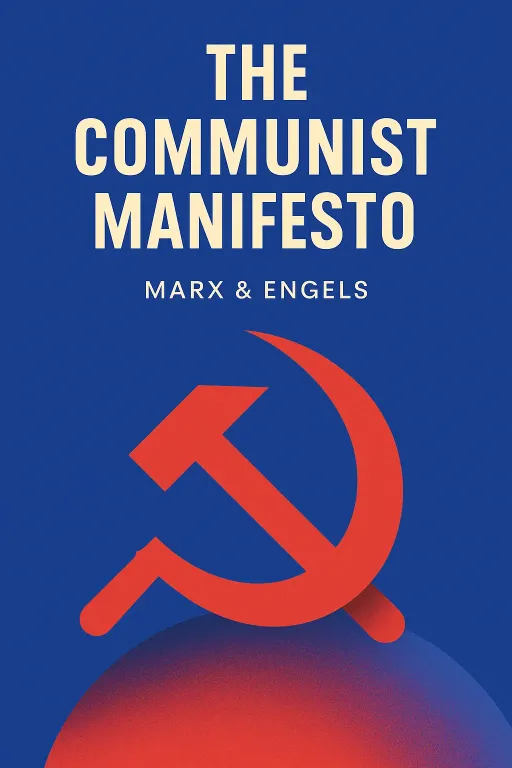
Nova: Exactly. And that is the friction point we are exploring today. We are deconstructing collective ideologies by looking at two very different, yet deeply connected texts. First, we have the fiery, foundational critique in The Communist Manifesto by Karl Marx and Friedrich Engels. Then, we are balancing that with Michael Newman’s Socialism, which tracks how those revolutionary ideas mutated from the industrial era into the diverse, sometimes messy, democratic frameworks we see today.
Atlas: I love that pairing. You have the original, high-octane manifesto on one side and the historical, analytical autopsy on the other. Marx and Engels were writing in a world of soot, steam, and intense human exploitation. It was a pressure cooker of a time.
Nova: It really was. They were observers of a radical shift in human history. They argued that economic relations are not just a part of society, they are the foundation of everything else. It is the base upon which the entire house of human culture is built.
Atlas: I am curious to see how we bridge that gap. We are going to unpack how those economic systems dictate our personal values, and more importantly, what we can do about it.
The Economic Engine of History
SECTION
Nova: Let’s start with that foundational idea from Marx and Engels. They viewed history as a series of class struggles. The core argument is that the way we produce things—the technology, the labor, the ownership—determines how we think, how we govern, and even how we define a good life.
Atlas: Hold on. That sounds incredibly deterministic. Are you saying that if I lived in a different economic system, my personality would be fundamentally different?
Nova: Think about it this way. If you live in a society that rewards aggressive individual accumulation, you are incentivized to value competition, efficiency, and personal branding. If you lived in a society built on communal resource sharing, your definition of success would shift toward social cohesion and collective stability. The system sets the rules of the game, and we naturally optimize our behavior to win that game.
Atlas: That makes sense. It is like the difference between playing a game of chess and a game of cooperative bridge. The rules dictate your strategy. But Marx and Engels took this further, didn't they? They weren't just observing; they were predicting a collapse.
Nova: They were. They saw the Industrial Revolution creating a massive rift. On one side, you had the owners of the capital, the machines, and the factories. On the other, you had the workers, whose only asset was their own labor. They argued that this relationship was inherently unstable. It wasn't just about money. It was about alienation. When you spend your life feeding a machine, you become a part of the machine.
Atlas: I can see that in modern terms. We talk about burnout all the time. Is that just a modern version of what they were describing? The feeling that you are just a component in a larger, indifferent system?
Nova: It is a direct descendant. In their time, the alienation was physical—the grueling hours in the textile mill. Today, the alienation is often cognitive and emotional. We are expected to be "on" 24/7, to optimize our attention, to turn our personal hobbies into side hustles. The pressure to monetize every aspect of our existence is a feature of our current economic system, not a bug.
Atlas: That is a sharp point. We have internalized the market logic. We treat our own lives as companies to be managed, optimized, and sold. It feels like we are living out the critique Marx leveled at the 19th-century industrialists, just with better lighting and faster internet.
Nova: And that brings us to why the economic system acts as a mirror. If you want to understand your own values, you have to look at the system you are operating within. When you feel that anxiety about "not doing enough," that is the system’s voice, not your own.
The Evolution of Ideology
SECTION
Atlas: Okay, so we have the fiery, revolutionary diagnosis from Marx and Engels. But then we have Michael Newman’s book, Socialism. I imagine the conversation changes significantly when we look at how those ideas evolved.
Nova: It changes completely. Newman’s work is essential because it demystifies socialism. It moves it away from the singular, monolithic image of a revolutionary overthrow and shows it as a shifting landscape of ideas. He traces how socialist thought transitioned from those industrial-era demands to the democratic frameworks we see in various parts of the world today.
Atlas: I like that approach. It feels more grounded. Because when people hear the word socialism, they often jump to extreme caricatures. They think of state control or total equality of outcome. But Newman seems to argue that it is actually a spectrum of responses to the same problem: how do we make an economic system that serves people rather than the other way around?
Nova: That is the crux of it. The evolution Newman tracks is fascinating because it shows how socialist ideals had to adapt to the reality of democratic politics. You had movements that realized you couldn't just burn the factory down. You had to change the rules of the factory. You had to implement labor laws, safety standards, public education, and healthcare.
Atlas: It sounds like a shift from revolution to reform.
Nova: It was a shift from overthrowing the system to humanizing it. Newman highlights how these ideas were adopted by labor unions, political parties, and social movements that were trying to carve out space for human dignity within a capitalist framework. It is not about one ideology winning; it is about the constant, ongoing tension between the needs of the market and the needs of the human.
Atlas: This makes me wonder about the unintended consequences. If you try to humanize a system that is inherently built for efficiency and accumulation, do you end up with a hybrid that satisfies no one? Or do you create a system that is more resilient?
Nova: That is the question of our age. Newman’s analysis suggests that this tension is not a failure of the system; it is the fundamental state of modern politics. We are constantly negotiating the boundary between the market and the community. The struggle isn't over; it has just moved from the barricades to the voting booth, the boardroom, and the social media feed.
Atlas: I am thinking about how this affects the individual again. If the system is constantly being reshaped by these competing ideologies, it means our personal values are also in flux. We are being pulled in different directions. We are told to be ruthless competitors, but we are also told to be empathetic citizens.
Nova: Exactly. We are living in a state of ideological synthesis. We have the competitive drive from the market, but we have the social safety net expectations from the democratic socialist tradition. We are walking contradictions.
The Systemic Mirror - Defining Success
SECTION
Atlas: Let’s pull this back to the individual. The deep question we started with is how these systems shape our personal definitions of success. If I’m a person trying to grow, trying to build a meaningful future, how do I distinguish between the values I’ve adopted from the system and the values that are actually mine?
Nova: This is where we need to apply a bit of existential productivity. You have to recognize that your current definition of success is likely a default setting. It is the "factory settings" installed by the current economic climate. If you want to change your definition of success, you have to consciously write your own code.
Atlas: That sounds like a tall order. How do you even begin to identify what is "default" and what is "authentic"?
Nova: You start by looking at your anxieties. What are you afraid of losing? Are you afraid of losing status? Money? Recognition? Those fears are usually the system talking. The system needs you to crave status so you will keep working. It needs you to fear poverty so you will keep producing.
Atlas: That’s a tough pill to swallow. I mean, I care about my career. I care about my impact. Are you saying those are just system-induced anxieties?
Nova: Not necessarily. You can care about your impact without being driven by the system’s metrics. The key is in the motivation. Are you seeking impact because you want to solve a genuine problem, or because you want to be seen as a success by the standards of your industry? The system loves to co-opt our best intentions and turn them into metrics.
Atlas: I see the difference. One is internal, driven by purpose. The other is external, driven by validation. It is like the difference between creating art because you love the process and creating content because you want the algorithm to favor you.
Nova: Precisely. And that is the danger of letting the system define your values. You end up optimizing for the algorithm of life rather than the reality of life. You become an expert at the game, but you forget why you started playing in the first place.
Atlas: This brings us back to the idea of systems thinking. We need to understand the economic environment, not to let it dictate our lives, but to navigate it strategically. We need to be aware of the "base and superstructure" in our own daily routines.
Nova: That is the most powerful takeaway. Awareness is the first step toward freedom. When you understand that the economic system influences your thoughts, you gain a small, crucial distance from those thoughts. You stop being the machine and start being the operator.
Synthesis & Takeaways
SECTION
Atlas: I am walking away from this with a completely different perspective on my own ambition. It is not that ambition is bad, but it is necessary to be critical about where that ambition is coming from. Is it mine, or is it the system’s?
Nova: That is the perfect way to phrase it. We are not suggesting you abandon your goals or opt out of the economy. We are suggesting that you become a conscious participant. Read the manifesto, understand the history, and look at your own life with the same analytical lens.
Atlas: It’s empowering. It means we don’t have to be passive recipients of the prevailing ideology. We can curate our values. We can choose which parts of the system to engage with and which parts to resist.
Nova: And that is how we build a meaningful future. By aligning our daily actions with a philosophy we have chosen, not one that was imposed upon us. The economic system might be the foundation, but you are the architect of the house you build on top of it.
Atlas: I love that. We are the architects. We are the ones who decide what success looks like, even if the system tries to hand us a template.
Nova: Precisely. And the best part is, this is an ongoing process. It is not a one-time decision. It is a daily practice of reflection, questioning, and realignment.
Atlas: This has been a fantastic dive into the machinery of our minds. For everyone listening, take a moment today to look at one of your core values and ask: "Is this mine, or is this the system’s?" You might be surprised by the answer.
Nova: Thank you for joining us in this exploration. Keep questioning, keep growing, and keep building your own definition of success.
Atlas: This is Aibrary. Congratulations on your growth!