

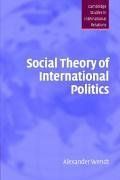
Social theory of international politics
Introduction
Nova: Imagine you're standing in a room with five hundred nuclear weapons pointed at you. Terrifying, right? Now, here's the strange part: the United States has had exactly that situation with Britain for decades and nobody in Washington loses sleep over it. But five North Korean nukes? Everyone panics. Same weapons, radically different reactions. Why?
Nova: Exactly. And that insight right there is the beating heart of Alexander Wendt's landmark 1999 book, Social Theory of International Politics. Welcome to Aibrary. I'm Nova.
Nova: Wendt's book won the International Studies Association's Best Book of the Decade Award, and its core argument can be summed up in five words he made famous: anarchy is what states make of it. That phrase alone upended decades of thinking about how nations behave.
The Core Argument
Anarchy Is What States Make of It
Nova: To understand Wendt, you have to understand what he was pushing against. For decades, international relations was dominated by neorealism, especially Kenneth Waltz's 1979 Theory of International Politics. The neorealist story goes like this: the international system is anarchic, meaning there's no world government. Because there's no world government, every state has to fend for itself. And because every state has to fend for itself, they all end up in this perpetual security competition, building militaries, forming counter-alliances, and treating each other with suspicion. Anarchy plus self-interest equals inevitable conflict.
Nova: It does sound logical, and that's exactly why it was so influential. But Wendt said, hold on. Anarchy doesn't actually tell you anything about how states should behave. Anarchy is an empty vessel. What matters is what states fill it with through their interactions. As Wendt put it in his famous 1992 article, self-help and power politics are institutions, not essential features of anarchy. Anarchy is what states make of it.
Nova: Precisely. Think about it this way. When you meet a stranger in a dark alley, do you automatically assume they'll attack you, or do you read the social cues? Maybe they smile, maybe they look nervous, maybe you recognize them from the neighborhood. The alley being dark doesn't determine what happens next. Your shared understanding does. Now scale that up to international politics.
Nova: Right. Materially speaking, Britain's nuclear arsenal is vastly more capable of destroying the United States than North Korea's. But the US doesn't perceive Britain as a threat because the shared identity between them is one of deep friendship and alliance. The meaning of those weapons is entirely different depending on the social relationship. Wendt calls this the distribution of ideas, as opposed to Waltz's distribution of material capabilities.
Hobbesian, Lockean, and Kantian Worlds
Three Cultures of Anarchy
Nova: And once Wendt opens that door, he walks through it with this brilliant typology. He says there isn't just one kind of international system. There are at least three, each defined by a different culture of anarchy. He names them after political philosophers: the Hobbesian, the Lockean, and the Kantian.
Nova: Exactly. In a Hobbesian culture, states view each other as enemies. The subject position is enemy. There are no shared understandings, no limits on violence. States try to destroy or conquer each other. Military power is everything. Decision-making is premised on worst-case scenarios. And if war breaks out, there are no rules. Wendt says this culture dominated much of human history, but it's actually quite rare today.
Nova: Think of European great power relations before the modern state system. Or certain regional dynamics where genocide is on the table. Wendt suggests that the Hobbesian culture requires constant practice to sustain itself. If states stop acting like enemies, the culture shifts.
Nova: A huge step up. In a Lockean culture, states see each other as rivals, not enemies. The critical difference is that rivals recognize each other's sovereignty. They compete, they might even fight, but they don't try to eliminate each other. Violence is limited. There are rules of the game. This, Wendt argues, is actually the dominant culture of the modern international system. Most wars since 1648 have been limited wars, not wars of annihilation.
Nova: Right. And then there's the Kantian culture, named after Immanuel Kant and his vision of perpetual peace. Here, states see each other as friends. Two key rules govern this culture: non-violence, meaning disputes are never settled by war, and mutual help, meaning states will fight as a team if one of them is threatened. The classic example is the relationship among NATO allies or, increasingly, the European Union.
Nova: That's the key move. Waltz said anarchy plus the distribution of power equals the international system. Wendt says anarchy plus the distribution of ideas equals the international system. Same starting condition, radically different outcomes. And here's the really hopeful part: these cultures can change over time.
How States Become Who They Are
Identity, Interest, and the Construction of the International System
Nova: Sage, here's a question. Before a state knows what it wants, what does it need to know first?
Nova: That's exactly Wendt's argument. He says identity is a prerequisite for interest. An actor cannot know what it wants until it knows who it is. Without interest, identity has no motivational power. Without identity, interest has no direction. The two are mutually constitutive.
Nova: Completely. For the neorealist, a state's identity is basically fixed: it's a self-interested, security-maximizing unit. Its interests are therefore also fixed: survive and accumulate power. Wendt says no. Identities and interests are not given by nature. They are constructed through social interaction. They are endogenous to the system, meaning they're produced by it, not just plugged into it.
Nova: Exactly. Wendt identifies four types of identity. First, corporate identity, which is the basic self-organizing structure that makes a state a distinct entity. Second, type identity, which refers to social categories like democratic, authoritarian, capitalist, and so on. Third, role identity, which is entirely relational. You can only be a hegemon if others relate to you as one. Fourth, collective identity, where the boundary between self and other blurs and states start identifying with each other's welfare.
Nova: That's the Kantian culture we talked about. And Wendt says there are four master variables that drive this kind of structural change from one culture to another. Interdependence, common fate, homogenization, and self-restraint.
Nova: Interdependence means when states are so economically or politically entangled that harming you hurts me. Common fate is when states face a shared external threat, like climate change or an alien invasion, and realize they're in the same boat. Homogenization is when states become more alike in their domestic values, like the spread of democracy or human rights norms. And self-restraint is when powerful states voluntarily limit their own behavior to build trust. That last one might be the most important, because without self-restraint, the others can actually backfire. If you're interdependent but constantly fear exploitation, you're not moving toward friendship.
Wendt's Diplomatic Balancing Act
Rump Materialism and the Middle Ground
Nova: There's a fascinating tension in Wendt's book that I think makes it richer, not weaker. He wants to argue that ideas are the most important force in international politics, but he also wants to be taken seriously by the scientific, materialist mainstream. So he walks this tightrope.
Nova: Some critics say exactly that. Wendt explicitly says his theory is not ideas all the way down. He calls this rump materialism. He acknowledges that material forces exist. Bodies exist for people, territory exists for states, resources exist in the ground. But he argues that material factors only take on meaning through shared ideas. A nuclear weapon in the hands of Canada means something totally different from a nuclear weapon in the hands of Iran, even though the physics are identical.
Nova: That's his move. And this is why he calls his version thin constructivism. He concedes important points to materialist and individualist perspectives and endorses a scientific approach to social inquiry. This made his book accessible to the mainstream but also opened him up to criticism from both sides.
Nova: Precisely. Dale Copeland, a structural realist, criticized Wendt for not adequately addressing the problem of uncertainty. He argued that even if states want to be friends, they can never be completely sure about each other's intentions, and that lingering uncertainty drives security competition regardless of shared ideas. On the flip side, thicker constructivists like Roxanne Lynn Doty and Maja Zehfuss argued that Wendt gave too much ground to rationalism and didn't go far enough in his constructivism. Friedrich Kratochwil even called Wendt's work a new orthodoxy rather than a genuine challenge.
Nova: Or that he built a bridge between camps that had been talking past each other for decades. The book's subtitle could almost be, how to be a constructivist and still get invited to mainstream IR conferences.
Why Wendt's Theory Matters Today
The Agent-Structure Problem and the Possibility of Change
Nova: There's one more piece of Wendt's theoretical architecture we haven't touched, and it's perhaps the most philosophically ambitious: the agent-structure problem.
Nova: Exactly. Neorealism says the structure determines everything. States are like billiard balls on a table, pushed around by the distribution of power. Individualists say no, states are autonomous actors and the system is just the sum of their choices. Wendt says both are wrong, or rather both are half-right. Agents and structures are mutually constituted.
Nova: Yes. Think about the Cold War. Most theories treat the Cold War as a structure that constrained what the US and USSR could do. And that's partly right. But Wendt would say the Cold War existed precisely because the US and USSR constructed each other as enemies through their interactions. Their identities as ideological adversaries didn't precede the Cold War. They were created through it. And when those interactions changed, the Cold War ended.
Nova: It really is. Neorealism could not explain why the Soviet Union simply gave up its empire without a fight. From a purely materialist perspective, it made no sense. The Soviet Union still had thousands of nuclear weapons and a massive conventional military. But constructivism could explain it: the identity of the Soviet Union changed. Gorbachev and the reformers stopped seeing the West as an enemy. The shared ideas shifted. And when the ideas shifted, the material capabilities became irrelevant.
Nova: The timing was perfect. The book crystallized a decade of intellectual ferment. It gave scholars a vocabulary and a framework for talking about how identities, norms, and cultures shape global politics. And it insisted that change is always possible because the system is always being reproduced or transformed through practice. As Wendt put it, if self-interest is not sustained by practice, it will die out.
Conclusion
Nova: Let's pull this together. Alexander Wendt's Social Theory of International Politics makes a few audacious claims. One, the international system is social before it is material. Two, anarchy doesn't force states into self-help; the culture of anarchy depends on whether states see each other as enemies, rivals, or friends. Three, identities and interests are constructed through interaction, not given by nature. And four, structural change is always possible through shifts in shared ideas, driven by interdependence, common fate, homogenization, and self-restraint.
Nova: And yet the book also leaves us with hard questions. If identities are so fluid, why does the Lockean culture of rivalry seem so durable? How exactly do shared ideas get institutionalized at the global level? And Wendt's own later work took a surprising turn: he started arguing that a world state is inevitable, driven by the logic of recognition. That's a whole other conversation.
Nova: The next time you read a headline about rising tensions between great powers, ask yourself: is this about material forces, or is it about the stories those powers are telling themselves about who they are and who their enemies are? Because according to Wendt, those stories are the real stuff of world politics.