

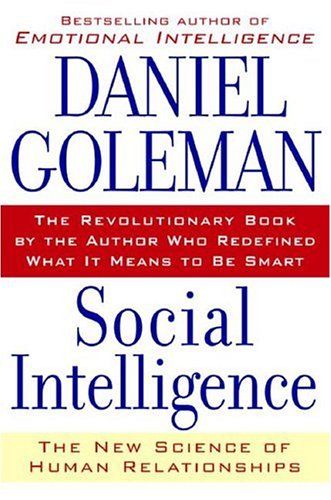
Social Intelligence
Introduction
Nova: Have you ever walked into a room where two people were clearly in the middle of a heated argument, even though they were completely silent? You just felt the tension in the air, right?
Nova: That feeling is not just your imagination. It is actually your social brain at work. Today we are diving into Daniel Goleman's landmark book, Social Intelligence: The New Science of Human Relationships. Goleman, who famously brought emotional intelligence into the mainstream, shifted his focus here from how we manage ourselves to how we connect with others.
Nova: It is more like an expansion pack. If Emotional Intelligence is about the internal one-person psychology, Social Intelligence is about the two-person psychology. Goleman argues that we are literally wired to connect. Our brains are designed to be in a constant dialogue with the brains of the people around us.
Nova: That is exactly the analogy Goleman uses. He suggests that our social interactions are not just transactions of words and information, but a bridge where our nervous systems actually link up. This has massive implications for our health, our leadership, and even our basic happiness. Today, we are going to unpack the biological hardware that makes this possible and how we can get better at using it.
The Science of Connection
The Biological Wi-Fi
Nova: To understand social intelligence, we have to look at the hardware. Goleman talks about something called mirror neurons. These were discovered in Italy by researchers studying monkeys, but it turns out humans are packed with them too.
Nova: In a way, yes. When you see someone smile, your mirror neurons for smiling fire as if you were the one smiling. If you see someone in pain, your brain mimics that pain. It is the biological basis for empathy. It allows us to feel what another person is feeling instantaneously, without even thinking about it.
Nova: Exactly. And it goes deeper. Goleman introduces us to oscillators. These are neurons that coordinate our movements with other people. If you are having a great conversation, you might notice you and the other person are sitting in the same posture, or you are nodding at the same rhythm. That is your oscillators syncing up your physical presence.
Nova: Precisely. But there is another player in this game: spindle cells. These are these incredibly long neurons, about four times longer than others, and they act like a high-speed transit system for social information. They allow us to make snap judgments about whether someone is trustworthy or dangerous in a fraction of a second.
Nova: Right. It is our social radar. This leads to what Goleman calls emotional contagion. Emotions are literally contagious. If a leader walks into a meeting feeling anxious, that anxiety spreads through the room via these mirror neurons and oscillators like a virus. But the same is true for enthusiasm or calm.
Nova: It really is. Goleman points out that we are constantly sculpting each other's brains and biological states through our interactions. A stressful interaction does not just ruin your mood; it can actually trigger a cascade of stress hormones that affect your immune system. Social connection is a biological necessity, not just a luxury.
Two Ways of Processing
High Road and Low Road
Nova: Now, Goleman divides our social processing into two main paths: the high road and the low road. The low road is that lightning-fast, automatic system we just talked about. It operates beneath our conscious awareness.
Nova: Very much so. It is driven by the amygdala and it is all about raw emotion and survival. It is the part of you that feels a flash of irritation when someone cuts you off in traffic before you even realize what happened. It is fast, but it is also messy and often wrong because it relies on stereotypes and past trauma.
Nova: Right. The high road runs through the prefrontal cortex. It is slower, it is conscious, and it allows us to think before we act. It is what lets you realize, oh, that person who cut me off might be in a rush to the hospital, so I should probably let it go. It gives us agency over our social responses.
Nova: Because the low road is a survival mechanism. If you are in a truly dangerous social situation, you do not want to wait for the high road to finish its analysis. You need that gut feeling to tell you to leave now. The problem is when the low road takes over in situations that do not require a survival response, like a disagreement with your spouse.
Nova: Exactly. Goleman emphasizes that the low road is where primal empathy lives. You feel the other person's pain instantly. But the high road is where you decide what to do about it. Without the high road, we are just reactive. Without the low road, we are cold and disconnected.
Nova: That is a great way to put it. True social intelligence requires both. You need the sensitivity of the low road to pick up the signals, and the wisdom of the high road to navigate them effectively.
Awareness and Facility
The Ingredients of Social Intelligence
Nova: Goleman breaks social intelligence down into two broad categories: Social Awareness and Social Facility. Social awareness is what we sense about others, and social facility is how we act on that awareness.
Nova: Within Social Awareness, he lists things like primal empathy, which is that low-road feeling of others' emotions. Then there is attunement, which is listening with full receptivity. It is not just hearing words; it is being fully present with the person.
Nova: You hit the nail on the head. Then there is empathic accuracy, which is the high-road ability to actually understand what the other person is thinking and feeling. And finally, social cognition, which is knowing how the social world works, like understanding the unwritten rules of a workplace or a culture.
Nova: Social Facility starts with synchrony. That is the ability to interact smoothly at a nonverbal level. Then there is self-presentation, which is how we present ourselves to others. Not in a fake way, but in a way that is appropriate for the context.
Nova: Exactly. But it also includes influence, which is the ability to shape the outcome of social interactions, and concern, which is acting on the needs of others. Concern is the most important piece here. Goleman argues that empathy without concern is just a psychological trick. Social intelligence at its best leads to altruism.
Nova: Right. He distinguishes between the social chameleon who just blends in to get what they want, and someone with genuine social intelligence who uses their skills to foster better connections and help others. Without the element of concern, social intelligence can actually be quite predatory.
Nova: Exactly. It is about the quality of the connection. Goleman talks about I-You versus I-It relationships. An I-It relationship is when you treat the other person as an object to be used or an obstacle to be overcome. An I-You relationship is when you recognize the full humanity of the other person. Social intelligence is the tool that helps us move toward I-You interactions.
From Isolation to Altruism
The Dark Side and the Healing Power
Nova: We have talked about the good stuff, but Goleman also looks at what happens when social intelligence is missing or when we fall into the us versus them trap.
Nova: He explains that our brains are naturally wired to categorize people into in-groups and out-groups. When we see someone as part of our group, we use our mirror neurons to empathize with them. But when we see someone as an outsider, those neural circuits actually dampen down. We literally do not feel their pain as much.
Nova: In a sense, yes. We dehumanize the out-group by turning off the social brain. Goleman suggests that the way to fix this is through meaningful personal contact. When we actually interact with someone from the other group, the high road can override the low road's biases, and we start to see them as a You instead of an It.
Nova: This is one of the most striking parts of the book. Goleman cites research showing that social isolation is as big a risk factor for mortality as smoking or high blood pressure. On the flip side, strong social connections can actually speed up healing and bolster the immune system.
Nova: Literally. There is a study he mentions where people with strong social ties were much less likely to catch a cold when exposed to a virus than those who were isolated. Our bodies need social connection to regulate our stress hormones. We are not designed to carry the burden of life alone.
Nova: Exactly. And Goleman ends on a hopeful note. He argues that social intelligence is not a fixed trait. Because the brain is plastic, we can actually train ourselves to be more socially intelligent. We can learn to listen better, to be more aware of our impact on others, and to broaden our circle of empathy.
Conclusion
Nova: As we wrap up our look at Daniel Goleman's Social Intelligence, the big takeaway is that we are not islands. Our brains are deeply interconnected, and every interaction we have is a chance to influence the well-being of someone else, as well as our own.
Nova: Exactly. Goleman's work reminds us that kindness and empathy are not just nice ideas; they are biological imperatives. By developing our social awareness and our social facility, we can create more nourishing relationships and a more compassionate world.
Nova: We all should. The more we understand the science of how we connect, the better we can navigate the complexities of being human together. If you want to dive deeper, I highly recommend picking up the book. It is filled with fascinating studies that we could not even scratch the surface of today.
Nova: My pleasure. This is Aibrary. Congratulations on your growth!