

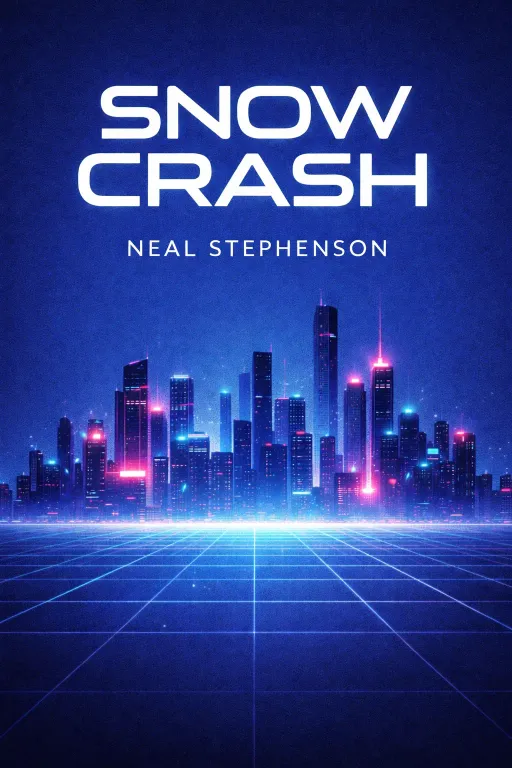
The Ultimate Brain Hack
Introduction
Narrator: Imagine a computer virus so potent it doesn’t just crash your hard drive—it crashes your brain. A master hacker named Da5id, a founding father of the virtual world, stares into a flickering bitmap offered by a mysterious stranger. His avatar dissolves into a blizzard of digital snow, and in the real world, he collapses, his mind wiped clean, leaving him speaking only in a babbling, incomprehensible tongue. This isn't just a system failure; it's a neurological catastrophe. What if a string of code could infect human consciousness itself? This is the central, terrifying question at the heart of Neal Stephenson’s seminal cyberpunk novel, Snow Crash. It plunges us into a world where the line between information and biology has not just blurred, but completely erased.
A Fractured World of Corporate States and Virtual Escape
Key Insight 1
Narrator: Snow Crash presents a near-future America that has collapsed under its own weight, fragmenting into a patchwork of corporate-owned, sovereign city-states called "Burbclaves." National infrastructure is a relic; highways, security, and even pizza delivery are privatized and run with ruthless, monopolistic efficiency. This world is introduced through the eyes of Hiro Protagonist, a man who embodies its contradictions. In reality, he’s a "Deliverator" for CosaNostra Pizza, an elite, high-stakes profession where failing a 30-minute delivery has severe, Mafia-enforced consequences. He lives in a cramped 20-by-30-foot storage unit.
But in the "Metaverse," a persistent, globe-spanning virtual reality, Hiro is a legend. He’s a master hacker and a co-creator of The Black Sun, an exclusive virtual nightclub. He owns a sprawling, elegant mansion on the Metaverse’s main thoroughfare, The Street. This digital world is where millions flock to escape the grimness of reality, interacting through their custom "avatars." The Metaverse isn't just a game; it’s a parallel society with its own economy, real estate, and social hierarchy, a place where virtual status offers a powerful antidote to real-world insignificance.
The Kourier and the Brutal Logic of the Streets
Key Insight 2
Narrator: If Hiro represents the digital frontier, the character Y.T. embodies mastery of the physical one. A fifteen-year-old Kourier, she navigates the dangerous, privatized freeways on a technologically advanced skateboard. Her board’s "Smartwheels" use radar and sonar to adapt to any terrain, and she propels herself by firing a magnetic harpoon, or "poon," onto passing vehicles.
Her skill is put on display in a dramatic chase. While on a delivery, she poons a minivan driven by an aggressive suburban teenager. The teen, fueled by what the novel calls "horse testosterone," tries to smash her into a designer fire hydrant. But Y.T., with a keen understanding of both physics and psychology, anticipates his every move. She gives her poon line slack as he initiates a handbrake turn, then reels it in hard, using his momentum to slingshot herself forward at incredible speed, leaving him to crash into a massive marble street sign. Her journey also reveals the absurdity of privatized law, as she is apprehended by "MetaCops" and taken to "The Clink," a franchised jail cell located in the basement of a 24-hour convenience store. Y.T.’s story illustrates that survival in this world depends on a combination of high-tech gear, sharp instincts, and a profound defiance of the broken systems of control.
The Metavirus of Language
Key Insight 3
Narrator: The mystery of "Snow Crash" deepens as Hiro investigates. With the help of a sentient AI program called the Librarian, he discovers that the phenomenon is not just a computer virus or a drug, but both—and also a religion. The Librarian reveals that Snow Crash is a modern manifestation of an ancient Sumerian "nam-shub," a neurolinguistic virus that can infect the human brain through both sight and sound.
The theory presented is that language itself is a form of software for the brain's "hardware." In ancient Sumer, a single, powerful "mother tongue" allowed for direct programming of the human brainstem, creating a society of passive, obedient workers. An ancient hacker-god named Enki created a counter-virus, the "nam-shub of Enki," which fragmented this mother tongue into thousands of different languages. This event, mythologized as the Tower of Babel, was actually a protective measure. It forced humanity to develop consciousness and rational thought by erecting "walls of mutual incomprehension" that prevented the easy spread of mind-controlling viruses. Snow Crash is the re-emergence of that original, infectious mother tongue.
L. Bob Rife's Grand Design for Control
Key Insight 4
Narrator: The orchestrator of this "infocalypse" is L. Bob Rife, a megalomaniacal media and telecommunications tycoon. Having monopolized the world's fiber-optic networks, Rife uncovered this ancient neurolinguistic knowledge and devised a plan to weaponize it for global control. His strategy is twofold.
First, he targets the world's disenfranchised populations. Through his network of Pentecostal franchises, "Reverend Wayne's Pearly Gates," he spreads a biological version of the virus. This virus, transmitted via infected blood serum, makes people susceptible to glossolalia, or "speaking in tongues"—the audible output of the ancient mother tongue. These infected followers are gathered on "The Raft," a massive flotilla of ships tethered to Rife's personal aircraft carrier. With radio receivers grafted into their skulls, they become a programmable army, awaiting Rife's broadcasted commands.
Second, Rife targets the "technological priesthood"—the hackers. Because their minds are wired to understand binary code, the "machine language" of computers, they are immune to Rife's religious programming. To neutralize them, he uses the digital version of Snow Crash, a "logic bomb" of pure binary information that directly attacks the hacker's brain, causing a catastrophic mental crash.
The Unpredictable Force of Raven
Key Insight 5
Narrator: Serving as Rife's primary enforcer is Raven, a terrifying Aleut harpooneer of immense physical power and chilling charisma. Raven is more than just a henchman; he is a force of nature driven by a deep-seated desire for revenge against America for the historical injustices done to his people. His weapon of choice is a set of molecule-thin glass knives that are undetectable by security systems.
More terrifyingly, the sidecar of his motorcycle contains a nuclear warhead salvaged from a Soviet submarine, with the trigger wired directly to his brain. If Raven dies, the bomb detonates. This makes him a walking nuclear deterrent, a "sovereign" whom even the most powerful corporate entities dare not cross. He operates with brutal efficiency, hijacking a Mafia operation to capture Russian officials and taking Y.T. under his dangerous protection, all while pursuing his own enigmatic agenda.
The Violent Convergence of Two Worlds
Key Insight 6
Narrator: The novel’s climax is a frantic, parallel battle in both reality and the Metaverse. In the virtual world, Hiro confronts Raven on the stage of a massive hacker concert. Raven is about to unleash the digital Snow Crash logic bomb on the crowd. In a spectacular sword fight, Hiro manages to "decapitate" Raven's avatar, temporarily disabling him in the Metaverse. Hiro then deploys the "nam-shub of Enki," the ancient counter-virus, inoculating the hackers just as the logic bomb detonates.
Simultaneously, in the real world, a massive confrontation unfolds at LAX. Y.T. escapes Rife's helicopter with the help of the entire Kourier network, who swarm the aircraft with their poons. On the tarmac, the Mafia, led by Uncle Enzo, confronts Rife. The conflict culminates when Fido, a cybernetically enhanced "Rat Thing" fiercely loyal to Y.T., sacrifices itself by leaping into the engine of Rife's escaping jet. The resulting explosion incinerates Rife and his biological virus, bringing his immediate threat to a fiery end.
Conclusion
Narrator: The single most important takeaway from Snow Crash is that in a world saturated by information, the lines separating code, language, belief, and biology become dangerously thin. The human mind itself is the ultimate programmable—and hackable—device. Neal Stephenson masterfully weaves ancient mythology, linguistics, and computer science into a prophetic vision of the future.
Decades after its publication, the novel’s fictional creations of the "Metaverse" and "avatars" have become cornerstones of our real-world digital landscape. Snow Crash remains a powerful and relevant warning. It challenges us to look at the information we consume—the memes, the ideologies, the narratives—and ask a critical question: are we in control of the code, or is the code in control of us?