

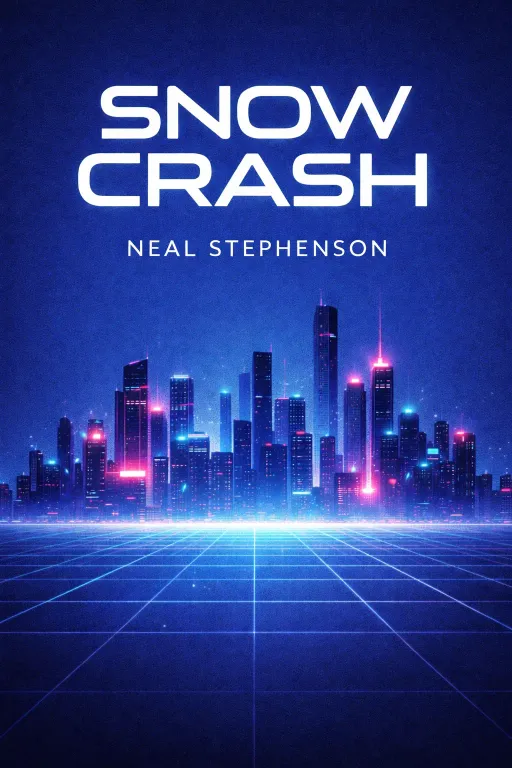
The Code in Our Brainstems: Hacking the Human Operating System
Golden Hook & Introduction
SECTION
Dr. Celeste Vega: Imagine waking up to find that a string of binary code flashed across your computer screen didn't just crash your operating system—it physically rewired your brain, leaving you in a state of permanent, babbling cognitive collapse. This isn't just a sci-fi nightmare; it's the central premise of Neal Stephenson's cyberpunk classic,. Welcome to the show. I'm Dr. Celeste Vega, and today we are stepping into a world where high-speed pizza delivery is a matter of life and death, and where the line between a computer virus and a biological infection completely dissolves. Joining me today is Samuel, a software engineer specializing in AI automation. Samuel, it is wonderful to have you here.
samuel: Thanks, Celeste. It's great to be here. You know, as someone who spends their days writing code to automate tasks and build systems, reading is an incredibly trippy experience. Stephenson was writing in 1992, but the way he conceptualizes code, system architecture, and human-machine interfaces feels incredibly prescient. It makes you look at your own codebase and wonder... what are we actually programming here?
Dr. Celeste Vega: Exactly! It forces us to ask some really deep questions. Today, we're going to tackle this groundbreaking book from two different angles. First, we'll explore the technical architecture of the Metaverse—looking at how its protocols, rendering constraints, and latency mirror real-world software engineering. And second, we'll plunge into the mind-bending concept of neurolinguistic hacking—exploring how ancient Sumerian incantations and modern digital viruses exploit the universal "hardware" of the human brainstem.
samuel: It's a wild ride, Celeste. From virtual real estate to cognitive firmware, there's so much to unpack. I can't wait to dive in.
Deep Dive into Core Topic 1
SECTION
Dr. Celeste Vega: Let's start with the setting that made this book famous: the Metaverse. Long before tech giants started changing their names to capture this concept, Stephenson laid out a incredibly detailed, highly structured virtual world. In the book, the Metaverse is accessed through specialized goggles and earphones that project laser light directly onto the user's retinas. And at the center of it all is "The Street"—a massive, 65,536-kilometer-long virtual boulevard that wraps around a black sphere. Samuel, as a software engineer, what stands out to you about the way this virtual world is constructed?
samuel: Oh, the technical details are absolutely beautiful. That number you just mentioned—65,536 kilometers—that's not just a random number Stephenson pulled out of a hat. That is exactly two to the sixteenth power. For anyone who works in computer science, that's a fundamental binary boundary. It's the maximum value of a 16-bit unsigned integer. By grounding the very dimensions of the Metaverse in the mathematical constraints of computer hardware, Stephenson makes the virtual space feel incredibly real and logical. It's a system governed by protocols, not magic.
Dr. Celeste Vega: That is such a brilliant observation, Samuel. It really shows how Stephenson's background in technology informed his world-building. And within this protocol-driven world, we see a stark contrast between virtual wealth and physical reality. Take our protagonist, Hiro Protagonist. In the Metaverse, he is a "prince"—a elite hacker who co-founded the famous club, The Black Sun, and owns a massive, beautifully rendered virtual mansion. But in Reality? He lives in a cramped, 20-by-30-foot U-Stor-It storage unit in a bleak, hyper-corporate Los Angeles, sharing the space with a roommate and struggling to pay his bills.
samuel: It's a powerful critique of where our priorities can shift when virtual spaces become highly immersive. Hiro's virtual assets don't translate to real-world financial security. He has to take on freelance stringer work for the Central Intelligence Corporation—which is this wild, privatized merger of the CIA and the Library of Congress—just to buy groceries. It's like having a million-dollar digital avatar but not being able to afford rent. As an engineer, it makes me think about user experience and the psychological escape hatch that technology provides. If reality is bleak and fragmented into these privatized "Burbclaves" run by corporate franchises, of course you're going to invest your identity and resources into the high-fidelity, protocol-regulated Metaverse.
Dr. Celeste Vega: Yes, the Metaverse offers a sense of order and status that the physical world completely lacks. But even in this highly regulated digital space, the physical constraints of the real world still creep in. I'm thinking specifically about how connection quality dictates social status. If you access the Metaverse through a high-speed fiber-optic cable, your avatar is solid, realistic, and moves smoothly. But if you're jacking in via a cheap cellular link—like Hiro has to do sometimes while driving his van—your avatar becomes a low-resolution, black-and-white wireframe. You're literally looked down upon by other users because your bandwidth is low.
samuel: Talk about digital stratification! It's a perfect metaphor for the digital divide. And what's fascinating is how Stephenson uses these technical constraints as active plot devices. There's this incredible scene where Hiro needs to infiltrate L. Bob Rife's central network, represented as a massive black cube with no doors, guarded by military-grade security daemons. Hiro can't just fight his way in because, in the Metaverse, avatars are programmed to be equally strong unless you hack them. So, what does he do? He exploits satellite latency.
Dr. Celeste Vega: Oh, that "latency hack" is one of the coolest parts of the book! Can you break down how that actually works in terms of system architecture?
samuel: Absolutely. So, Hiro is connecting to the Metaverse via a satellite uplink from a boat, which introduces a tiny, fraction-of-a-second delay in data transmission between his computer and the central servers. When he swings his virtual katana at the solid wall of Rife's cube, his local computer renders the sword passing the wall before the server has time to receive the data, process the collision, and send back the message saying "No, you can't do that." Hiro exploits that tiny window of lag. He literally slips his avatar through the wall on the tail end of his sword's data packet before the server registers the boundary violation. It's a brilliant, realistic depiction of how network latency can be weaponized. It's not magic; it's just understanding the physics of data transmission.
Dr. Celeste Vega: It's absolutely mind-blowing. It shows that even in a virtual world, the underlying code and the physical infrastructure of servers and satellites dictate the rules of engagement. But as we see later in the book, this deep connection between the user's mind and the digital code can have devastating, physical consequences. And that brings us to the core mystery of the story: the Snow Crash virus.
Deep Dive into Core Topic 2
SECTION
samuel: This is where the book shifts from a cool tech-adventure into some seriously deep, philosophical territory. The transition from the technical architecture of the Metaverse to the biological architecture of the human brain is just masterclass writing.
Dr. Celeste Vega: It really is. The mystery begins when Hiro is in The Black Sun and is approached by a mysterious, low-resolution avatar offering him a "hypercard" containing a drug called "Snow Crash." Now, in computer lingo, a "snow crash" is a system bug at such a fundamental level that it frags the part of the computer controlling the electron beam in the monitor, turning the screen into a static, gyrating blizzard of black-and-white pixels. Hiro is wary, but his friend and fellow hacker, Da5id, accepts the hypercard. When Da5id opens it, his computer screen "snow-crashes," and he is exposed to a wall of digital static. Immediately, Da5id suffers a massive, real-world neurological collapse. He falls out of his chair, convulsing, and is left in a vegetative state, babbling incoherently.
samuel: As a programmer, this scene is terrifying. Because what Stephenson is suggesting is that a hacker's brain is fundamentally different from a non-programmer's brain. If you spend your life writing and analyzing binary code, your brain actually self-modifies. Your neural pathways—your "bioware"—physically adapt to process binary information. So, when Da5id stares into that wall of digital static, his optic nerve carries that raw binary code directly into his brainstem. His brain tries to compile and execute the static as if it were code, and it completely "snow-crashes" his biological operating system. It's a buffer overflow attack on the human mind!
Dr. Celeste Vega: Yes! A software problem that poisons the hardware. And to understand how this is possible, Hiro has to team up with an AI daemon called the Librarian to research ancient history. They discover that this modern digital virus is actually a resurrection of an ancient, neurolinguistic virus. The Librarian explains that in ancient Sumer, there was no independent concept of "evil"—only disease and ill health. And the Sumerian society was run by "me"—which were verbal rules or programs for tasks like bread-baking, farming, or diplomacy. These "me" were stored in temples and administered by priest-kings. The people were essentially passive receivers of information—as Hiro puts it, "ears with bodies attached."
samuel: This is where my mind started blowing fuses, Celeste. Stephenson is basically describing ancient Sumerian culture as a giant, automated system. The "me" are literally software instruction sets for running a society, and the citizens are the processors executing the code without conscious thought. It's the ultimate form of social automation. But because everyone spoke the same "mother tongue"—a primal language that accessed the deep, universal structures of the human brainstem—the entire population was vulnerable to a single, virulent mind-control program. If a hacker got hold of the "mother tongue," they could write a "nam-shub"—a speech with magical force—that could completely reprogram or infect the entire population.
Dr. Celeste Vega: Exactly. And that is where the historical figure of Enki comes in. Enki was a "neurolinguistic hacker" who realized that this passive, automated state was keeping humanity stagnant. To save the human race from being permanently controlled by these viral "me," Enki created a counter-program: the "nam-shub of Enki." This counter-virus targeted the deep linguistic structures of the brain, scrambling the universal language and causing the differentiation of human tongues. This is the scientific explanation for the biblical Tower of Babel! By splitting human language into thousands of mutually incomprehensible dialects, Enki created a natural firewall. The old viral "me" could no longer spread, forcing humanity to start thinking independently, which gave birth to modern human consciousness and rational thought.
samuel: That is an incredibly profound concept. Linguistic diversity as a security protocol! It's like how in modern software development, we avoid monocultures. If every server in the world runs the exact same operating system and the exact same software stack, a single exploit can take down the entire global infrastructure. By introducing diversity—different operating systems, different programming languages—you limit the blast radius of any given virus. Enki did the exact same thing for the human race. He fragmented our operating systems so we couldn't all be hacked at once.
Dr. Celeste Vega: It's a beautiful analogy, Samuel. But the villain of our book, the global monopolist L. Bob Rife, wants to undo Enki's firewall. Rife has realized that in our modern, media-saturated world, a huge portion of the population has become "aliterate"—they rely on TV and oral traditions, making them susceptible to a new, centralized "mother tongue" distributed through his global fiber-optic network and a fundamentalist glossolalia cult. Rife is using the biological version of the Snow Crash virus—spread through blood serum and vaccines—to infect the "biomass" of refugees on his floating city, the Raft. He grafts radio receivers directly into their skulls so he can broadcast "me" directly into their brainstems, creating a massive, programmable, automated army.
samuel: It's the ultimate, terrifying synthesis of biological, digital, and social engineering. Rife is trying to turn humanity back into "ears with bodies attached," using technology to bypass our conscious firewalls. And the only way Hiro can stop him is by finding the original "nam-shub of Enki"—the ancient counter-program—and broadcasting it through the Metaverse to jam Rife's mother-tongue signals. It's a literal battle of code vs. code, played out across virtual and physical realities.
Synthesis & Takeaways
SECTION
Dr. Celeste Vega: As we reach the climax of the book, we see this battle play out in spectacular fashion. Hiro defeats Rife's enforcer, Raven, in a digital sword fight, and with Juanita's help, they successfully broadcast the "nam-shub of Enki" throughout the Metaverse, protecting the hacker community and disabling Rife's neurolinguistic virus. It's a triumphant moment, but it leaves us with some incredibly heavy things to ponder. Samuel, as we wrap up our discussion today, what are your main takeaways from, especially looking through the lens of your work in AI and software engineering?
samuel: You know, Celeste, the biggest takeaway for me is the concept of "informational hygiene." In the book, the Deuteronomists created a strict, book-based religion with precise copying protocols as a way to inoculate people against the "Asherah virus." Today, we are flooded with automated information, deepfakes, and AI-generated content designed to capture our attention and influence our behavior. We are constantly being bombarded with digital "me"—algorithms trying to program our preferences and our thoughts.
Dr. Celeste Vega: That is so true. The algorithms of social media are, in a way, modern "nam-shubs" designed to bypass our rational defenses and trigger primal emotional responses.
samuel: Exactly. They target our cognitive vulnerabilities just like the Snow Crash virus targeted the deep structures of the brainstem. So, my actionable advice for our listeners—and something I'm taking to heart as an engineer—is to actively practice informational hygiene. Don't just passively consume the data streams fed to you by automated systems. Question the inputs. Diversify your information sources. Build your own mental firewalls. In a world that is constantly trying to automate our thinking, maintaining our capacity for independent, critical thought is the ultimate act of rebellion.
Dr. Celeste Vega: Beautifully said, Samuel. Linguistic diversity and critical thinking are indeed our greatest security protocols. Thank you so much for sharing your incredible insights with us today. This has been an absolutely fascinating conversation.
samuel: Thank you, Celeste. It was an absolute blast.
Dr. Celeste Vega: And to our listeners, we leave you with this question to ponder: In a world increasingly run by algorithms and automated systems, how are you protecting your own cognitive operating system? Until next time, keep your firewalls up and your minds open.