

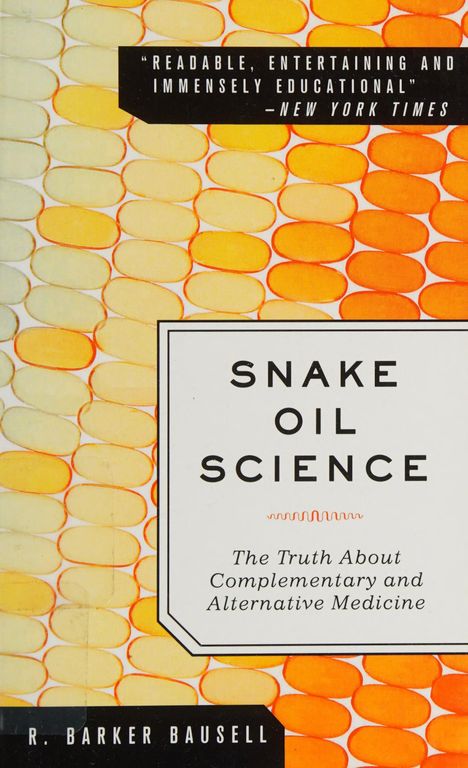
Snake oil science
the truth about complementary and alternative medicine
Introduction
Nova: Welcome to Aibrary. I'm Nova, and today we're diving into a book that asks a question millions of people would rather not hear the answer to. What if I told you that acupuncture, chiropractic, herbal remedies — the entire multibillion-dollar alternative medicine industry — works beautifully for one reason and one reason only: the placebo effect?
Nova: : That is a bold opening, Nova. And I have to say, I know people — smart people — who swear by their acupuncturist or their naturopath. Are you really telling me they're all just fooling themselves?
Nova: I'm not telling you that. R. Barker Bausell is. He's the author of "Snake Oil Science: The Truth About Complementary and Alternative Medicine," published by Oxford University Press in 2007. And Bausell is no armchair critic — he's a biostatistician, a professor of research methodology at the University of Maryland, and someone who spent his career knee-deep in clinical trial data.
Nova: : Okay, so he has credentials. But the title alone — "Snake Oil Science" — sounds pretty combative. Is this just a takedown piece?
Nova: Surprisingly, no. That's what makes this book fascinating. Bausell doesn't dismiss CAM out of hand. He acknowledges something crucial upfront: CAM therapies do work. People do feel better after using them. The question he asks is sharper and more uncomfortable — do any of these therapies work better than a placebo? And after examining the highest-quality evidence available, his answer is a definitive no.
Nova: : So the entire book is essentially about separating real therapeutic effects from the power of belief. That sounds like it matters for way more than just alternative medicine.
Nova: Exactly. And that's why the New York Times called it "entertaining and immensely educational." Bausell is fundamentally teaching us how to think about scientific evidence — what makes a study trustworthy, what biases sneak into research, and why our own brains are so spectacularly good at fooling us. Stick with us, because by the end of this episode, you might never look at a health claim the same way again.
What Counts as Alternative Medicine
The Landscape of CAM
Nova: Let's start with what we're actually talking about. Bausell opens the book by mapping the sprawling terrain of complementary and alternative medicine, or CAM. In 2002, a U. S. government survey found that 36 percent of Americans had used some form of CAM therapy in the previous twelve months. We're talking tens of millions of people.
Nova: : Thirty-six percent? That is way higher than I would have guessed. What exactly falls under the CAM umbrella?
Nova: Bausell organizes it into five categories. First, indigenous medical systems — things like Traditional Chinese Medicine and Ayurveda from India. These are entire worldviews about health that evolved over centuries in specific cultures. Second, nonindigenous medical systems that developed more recently — osteopathy, naturopathy, homeopathy, chiropractic. Third, spiritual or energetic healing — think therapeutic touch, Reiki, distant healing. Fourth, relaxation-oriented therapies like meditation and yoga practiced for health purposes. And fifth, what he calls extensions of conventional science — chelation therapy, biofeedback, so-called natural drugs.
Nova: : That covers a lot of ground. And I can already hear someone saying, "Wait, yoga and meditation? Those definitely help me."
Nova: Right, and Bausell would probably agree they help you relax and feel better. The question is whether they do anything beyond that — whether they actually alter disease processes in ways that a placebo cannot. And that brings us to the heart of the book. He makes a pointed observation: most CAM practitioners simply do not value, and in his experience do not understand, the scientific process. Meanwhile, dissatisfaction with conventional medicine — especially for chronic conditions like back pain, arthritis, and fatigue — created an enormous demand that CAM was perfectly positioned to fill.
Nova: : So it's a market response to a gap in what conventional medicine can offer?
Nova: That's exactly how Bausell frames it. Conventional medicine is brilliant at acute problems — infections, broken bones, surgical emergencies — but struggles with chronic, nagging conditions. People hurt, they're frustrated, and along comes a practitioner who spends an hour listening to them, offers a holistic explanation for their suffering, and provides a treatment that feels meaningful. The stage is set for the placebo effect to work its magic.
How Belief Becomes Biochemistry
The Power and Biology of Placebo
Nova: Bausell dedicates substantial chapters to the history and science of the placebo effect, and this is where the book really shines. The term "placebo" first appeared in a medical dictionary in 1785, meaning a treatment given to amuse rather than benefit a patient. For centuries, it was just a trick doctors played.
Nova: : And then someone decided to actually study it?
Nova: That someone was Dr. Henry K. Beecher. In 1955, he published a landmark paper called "The Powerful Placebo." He re-analyzed results from fifteen clinical trials and found that roughly 35 percent of patients responded positively to placebos. Let that sink in — one in three people got better from a sugar pill. Beecher's paper became an instant classic and fundamentally changed how we evaluate medical treatments. It led directly to the requirement for double-blinding, where neither the patient nor the doctor knows who's getting the real treatment.
Nova: : So the question becomes: if one in three people improve from nothing but belief, how do you ever know if a therapy actually works?
Nova: Precisely. And Bausell goes deeper. He identifies three factors that drive the placebo analgesic effect. First, classical conditioning — like Pavlov's dogs, we can be trained to respond physiologically. In a striking experiment, healthy women were given nitroglycerin in distinctively flavored tablets for weeks. Then researchers swapped in identical-tasting tablets with no active drug — and the women's heart rates still changed, just as if they'd received nitroglycerin. The body had learned the response.
Nova: : That's wild. So your body literally learns to produce a drug-like response just from the ritual of taking a pill?
Nova: Exactly. The second factor is desire — your motivation to feel better. Studies have shown that patients who conscientiously take their placebo pills improve more than those who skip them, even though there is absolutely no medical reason why compliance with a sugar pill should matter. And the third factor is expectation — the level of belief that the treatment will work.
Nova: : But here's what I really want to know — is there an actual biological mechanism, or is placebo just "in your head"?
Nova: This is one of Bausell's most important principles. The placebo effect has a plausible biochemical mechanism: the body's endogenous opioid system. Studies using naloxone, a drug that blocks opioid receptors, have shown that placebo pain relief can be partially or completely reversed when those natural opioid pathways are blocked. Your brain literally releases its own painkillers when you believe you're being treated. The belief becomes biochemistry.
Nova: : So the placebo effect isn't fake medicine — it's real medicine your body manufactures itself. That reframes the entire conversation.
Nova: It does. And Bausell is very clear: the placebo effect is real, it can temporarily reduce pain, and it occurs only when the patient believes the intervention is capable of working. That belief can be instilled through conditioning or through the suggestion of a trusted, respected practitioner. This is exactly why a caring CAM therapist who spends forty-five minutes with you can produce results that a rushed five-minute conventional doctor visit cannot.
When Sham Needles Work Just as Well
The Acupuncture Case Study
Nova: Let's get concrete. Bausell walks us through what he considers some of the best CAM research ever conducted, and it revolves around acupuncture for dental pain. Dr. Lixing Lao at the University of Maryland ran a rigorous, double-blinded, randomized, placebo-controlled trial. Patients had dental surgery, then received either real acupuncture, or one of two types of sham acupuncture.
Nova: : Wait — how do you fake acupuncture? If someone sticks a needle in you, you know it.
Nova: That's exactly the challenge Bausell highlights. Evaluating a procedure-based therapy is much harder than testing a pill. Lao used clever placebo controls — one involved needles inserted at non-acupuncture points, another used a device that looked and felt like acupuncture but didn't actually penetrate the skin. And here's the crucial detail: Lao also asked patients afterward which treatment they thought they received.
Nova: : And what did he find?
Nova: The results were definitive. There was no statistically significant difference in pain relief between real acupuncture and either placebo group. None. But — and this is the jaw-dropper — there was a huge difference between patients who believed they got real acupuncture and those who believed they got the sham. People who thought they were in the real treatment group reported significantly less pain, regardless of which group they were actually in.
Nova: : So the belief, not the needle, was doing all the work.
Nova: Bausell summarizes it brilliantly: if you believe in CAM therapies, they will most likely work for you. If they don't work, you'll find a reason for the failure and continue believing — thereby prohibiting reality from conflicting with your beliefs. That's the cognitive trap at the heart of the entire CAM phenomenon.
Nova: : That's both fascinating and a little disturbing. Our minds are so powerful at constructing narratives that we literally can't see through them.
Nova: And Bausell identifies the psychological mechanisms at play: cognitive dissonance — the reluctance to admit we were wrong — and what psychologists call an internal locus of control, the optimistic belief that we can influence our own health outcomes. These are not character flaws. They're basic human psychology. But they make us sitting ducks for ineffective treatments.
Ninety-Eight Reviews and a Five Percent Problem
The Evidence, Systematically Examined
Nova: So far we've talked about individual studies. But Bausell goes much further. He surveys nearly one hundred Cochrane Collaboration systematic reviews — the gold standard for summarizing medical evidence — covering various CAM therapies. He classifies each review as positive or negative and then digs into the quality of the evidence.
Nova: : And what did he find?
Nova: Out of ninety-eight high-quality systematic reviews, Bausell initially identified about twenty-one that appeared to show positive results for CAM. But then he applied scrutiny. He looked at whether the positive effects disappeared in higher-quality trials, whether later and better studies reversed earlier positive findings, and whether publication bias might explain the results. After stripping away the noise, he ended up with roughly five percent of reviews showing genuinely positive findings.
Nova: : Five percent. That's...
Nova: That's exactly what you would expect by chance alone. Ronald Fisher, the father of modern statistics, established the 0.05 significance level — meaning that even if a therapy does absolutely nothing, about one in twenty studies will show a positive result purely due to random variation. Bausell's finding of five percent positive results aligns perfectly with what you would expect if CAM therapies were completely ineffective beyond placebo.
Nova: : So the entire body of evidence for CAM is indistinguishable from random noise?
Nova: That's Bausell's third principle, stated starkly: "There is no compelling, credible scientific evidence to suggest that any CAM therapy benefits any medical condition or reduces any medical symptom — pain or otherwise — better than a placebo." And his second principle is equally damning: "No CAM therapy has a scientifically plausible biochemical mechanism of action over and above those proposed for the placebo effect."
Nova: : Speaking of mechanisms — homeopathy has to be the easiest target, right? Treatments so diluted that not a single molecule of the original substance remains?
Nova: Bausell certainly addresses homeopathy, but he's remarkably evenhanded. He points out that some CAM therapies have perfectly plausible mechanisms — chiropractic manipulation, for instance, could theoretically affect musculoskeletal pain through physical means. The problem is that when tested against credible placebo controls, the effects evaporate. And then there's a finding I find absolutely staggering: Andrew Vickers and colleagues examined acupuncture trials by country of origin and discovered that 98 percent of trials from China, Japan, Hong Kong, and Taiwan reported positive results. Russian trials: 97 percent positive. Compare that to about 30 percent from Canada, Australia, and New Zealand, or 53 percent from the United States.
Nova: : That is an enormous red flag. Either acupuncture works dramatically better when performed near the Great Wall, or there's something seriously wrong with research standards in those countries.
Nova: Bausell's conclusion is clear — nationality of the investigator must be considered when interpreting CAM research, because the cultural belief in these therapies is so strong that it systematically biases how studies are designed, conducted, and interpreted. And even beyond nationality bias, there's publication bias — journals are far more likely to publish positive results than negative ones. The combined effect creates an illusion of evidence where none actually exists.
The Psychology and Sociology of Believing
Why We Fall for It
Nova: Bausell devotes serious attention to why smart, educated people — including scientists and celebrities like Prince Charles and Oprah Winfrey — champion CAM therapies. He identifies what he calls the "natural impediments to making valid inferences."
Nova: : I love that phrase — it sounds like something a biostatistician would say. Break it down for me.
Nova: There are several layers. For patients, the biggest trap is the natural history of ailments. Most conditions — back pain, headaches, fatigue — fluctuate on their own. You feel terrible, you try something, you feel better, and you naturally attribute the improvement to the treatment. But you might have felt better anyway. Regression to the mean is a merciless statistical phenomenon: extreme measurements tend to be followed by less extreme ones, simply because that's how averages work.
Nova: : So if I go to a chiropractor at the peak of my back pain, odds are I'll feel somewhat better afterward no matter what they do.
Nova: Exactly. For practitioners, there's a selection bias built right into their business model. Patients who don't improve stop coming. The therapist only sees the satisfied customers who return, creating a distorted picture of success rates. And then there's the Hawthorne effect — people behave differently when they know they're being observed or treated. Just the act of participating in a study or seeing a caring practitioner can produce improvements.
Nova: : What about the scientists conducting the research?
Nova: Unconscious experimenter bias is pervasive. If you've dedicated your career to studying acupuncture, you want it to work. You might subtly communicate expectations to patients, choose outcome measures that favor positive results, or interpret ambiguous data in the most favorable light. This isn't fraud — it's human nature. Bausell notes that he himself once conducted acupuncture research and was genuinely curious whether it worked. The data convinced him it didn't, but he understands firsthand the pull of wanting to find something.
Nova: : And then there's the media.
Nova: The media amplifies everything. A single small, flawed study suggesting that an herb fights cancer becomes headline news. The larger, better study showing no effect? That's not a story. Bausell argues that this creates a profoundly distorted public understanding of what the evidence actually says. Add in the fact that CAM is a massive industry — billions of dollars annually — and you have powerful economic incentives to maintain the illusion of efficacy.
Nova: : So we're up against our own psychology, biased research, publication practices, media sensationalism, and market forces. It's almost a miracle anyone can think clearly about health claims.
Nova: That's precisely why Bausell wrote the book. He's not just debunking CAM — he's teaching scientific literacy. He wants readers to understand what makes a study credible: randomization, double-blinding, adequate sample size, low attrition, publication in high-quality peer-reviewed journals. These are tools anyone can learn to apply.
Conclusion
Nova: So where does Bausell leave us? Remarkably, he doesn't end by telling readers to avoid CAM altogether. His final chapter offers practical tips for choosing a CAM treatment and therapist — essentially, how to maximize the placebo effect if you're going to use these therapies anyway.
Nova: : That is a surprising ending. After nearly three hundred pages of debunking, he actually gives advice on how to use CAM?
Nova: He does, and it's pragmatic. His advice: choose a therapist who inspires genuine confidence, someone you believe in. Select a therapy that feels meaningful and credible to you. The ritual matters — the more elaborate and convincing the treatment, the stronger the placebo response. And here's the key: avoid anything that could cause actual harm. Some CAM therapies have real risks, whether from physical manipulation, herb-drug interactions, or simply from delaying effective conventional treatment.
Nova: : So the takeaway isn't "CAM is worthless." It's "CAM is a vehicle for the placebo effect, and if you're going to use that vehicle, use it wisely."
Nova: That's it exactly. But Bausell's deeper contribution goes beyond CAM. "Snake Oil Science" is really a masterclass in scientific reasoning. The same principles that expose the emptiness of homeopathy also apply to evaluating pharmaceutical industry claims, nutritional supplements, and the latest wellness trend on social media. The question is always the same: compared to what? Without a proper placebo control, you simply cannot know whether an effect is real.
Nova: : What's the one thing you hope listeners take away from this book?
Nova: I think it's Bausell's demonstration that the placebo effect is real, powerful, and biochemical — but it's not a reason to embrace ineffective treatments. It's a reason to be humble about what we think we know. The body's ability to heal through belief is remarkable. The tragedy is when that natural capacity is exploited to sell treatments that add nothing beyond what the mind already provides for free.
Nova: : Beautifully put. And it makes me wonder — how much of what I believe about my own health is evidence, and how much is the story I've told myself?
Nova: That's exactly the kind of question Bausell would want you to ask. Keep asking it.
Nova: This is Aibrary. Congratulations on your growth!