

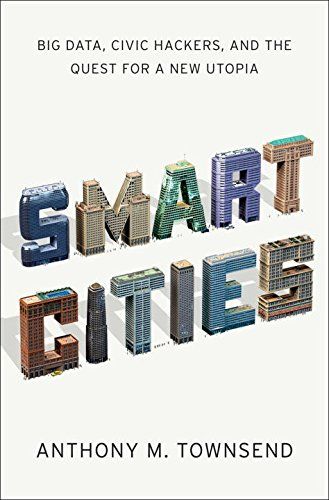
Smart Cities: Big Data, Civic Hackers, and the Quest for a New Utopia
Introduction: The City at a Crossroads
Introduction: The City at a Crossroads
Nova: Welcome to The Urban Blueprint, the show where we dissect the ideas shaping our concrete jungles. Today, we are diving deep into a book that perfectly captured the moment our cities decided to get a massive digital upgrade: Anthony M. Townsend’s "Smart Cities: Big Data, Civic Hackers, and the Quest for a New Utopia."
Nova: : Wait, Nova, "Quest for a New Utopia" sounds incredibly ambitious, maybe even a little naive. What exactly is the premise? Are we talking about flying cars and robot sanitation workers right out of the gate?
Nova: Not quite, but the ambition is real. Townsend, an urbanist and technology expert, wrote this right as the term "Smart City" was exploding. His core thesis is that we are witnessing a historic collision between two unstoppable forces: rapid global urbanization—more people moving to cities than ever before—and the massive proliferation of Big Data and mobile technology. The book asks: Who gets to design the city now that we can measure everything in real-time?
Nova: : That's a powerful framing. It suggests the blueprint for the 21st-century city isn't just being drawn up by architects and city planners anymore. It’s being coded. So, is Townsend ultimately optimistic about this digital takeover, or is he sounding an alarm bell?
Nova: That’s the brilliance of the book. It’s neither purely utopian nor purely dystopian. He presents a panoramic view, showing us the aspirations of the tech barons building these systems, the pragmatic needs of the mayors trying to manage crumbling infrastructure, and the disruptive energy of the civic hackers trying to reclaim the public sphere. It’s a story about power, data, and who gets to define what a 'good' city is.
Nova: : So, we're looking at a three-way tug-of-war for the soul of the metropolis. I’m ready to see who’s pulling hardest. Where does Townsend start this historical journey?
Nova: He starts by grounding us in history, showing us this isn't entirely new. He draws striking parallels between the challenges cities faced during the massive urbanization of the late 19th century, like the chaos that led to the first comprehensive US census in 1880, and the data crisis cities face today. We’re spinning out of control, and data is the proposed solution. Let's unpack that historical foundation next.
Key Insight 1: Learning from the Past's Urban Crises
The Historical Echo: Urbanization and the Data Imperative
Nova: Townsend argues that every major wave of urbanization brings a corresponding crisis of management, and technology is always the proposed fix. Think about the sanitation crises of the 1800s, which led to modern sewer systems and public health departments. The Smart City movement, he suggests, is the 21st-century version of that response to overload.
Nova: : That makes sense. When cities get too big, they become counter-intuitive, right? You can’t manage millions of people using intuition alone. But what’s the difference between the 1880s census and today’s Big Data streams?
Nova: The difference is speed, volume, and granularity. In the 1880s, data collection was slow, manual, and aggregated. Today, we have sensors everywhere—traffic flow, energy consumption, social media sentiment—generating a 'real-time city.' Townsend notes that this constant stream of data promises unprecedented efficiency, allowing us to optimize everything from traffic light timing to waste collection routes.
Nova: : Efficiency sounds great, but I immediately worry about the 'real-time' aspect. If the city is constantly watching and reacting, does that leave any room for the messy, inefficient, human parts of urban life? The spontaneous street market, the unexpected protest?
Nova: Exactly. That’s the tension he highlights. The promise is a perfectly tuned machine, but a city that is too perfectly tuned might lose its resilience, its capacity for surprise. He points out that historical urban progress often came from messy, bottom-up solutions that a top-down, data-driven system might immediately flag as inefficient and try to eliminate.
Nova: : So, the historical lesson isn't just that we need data, but that we need to be wary of that data is collected and applied. Is the data itself neutral, or is it inherently biased by the people who deploy the sensors and algorithms?
Nova: Townsend is very clear: the data is not neutral. It reflects the priorities of those collecting it. If the priority is traffic flow for commuters, the data will optimize for cars. If the priority is public safety, the data collection might disproportionately focus on certain neighborhoods. This brings us directly to the key players involved in this data collection and deployment.
Nova: : It sounds like the foundation of the Smart City isn't just fiber optics; it’s a philosophical debate about what we value in urban life, echoing debates we had over a century ago. I’m eager to meet the people Townsend profiles who are driving this new era.
Key Insight 2: Mapping the Power Dynamics
The Three Tribes: Barons, Mayors, and Hackers
Nova: Townsend breaks down the ecosystem into three main groups, or 'tribes,' vying for control over the Smart City narrative. First, you have the Technology Barons—the Googles, the Ciscos, the massive infrastructure providers. Their motivation is often to sell comprehensive, proprietary platforms to cities.
Nova: : The vendors, essentially. They see the city as the next great untapped market for their integrated operating systems. What's their vision for the city, according to Townsend?
Nova: Their vision is often one of seamless integration, a single pane of glass for city management. They are selling the 'utopia'—a city that runs like a well-oiled machine, often through closed systems. Townsend is critical here, noting that this approach risks locking cities into long-term dependencies on private corporations for their most essential functions.
Nova: : Okay, so they are the architects of the. Then we have the Mayors and City Managers. They are the ones signing the checks and dealing with the immediate political fallout. How do they fit in?
Nova: The Mayors are caught in the middle. They are desperate for solutions to aging infrastructure, budget shortfalls, and citizen demands for better services. They see Smart City tech as a necessary tool for fiscal responsibility and modernization. Townsend finds their adoption pragmatic, but he also notes they often lack the technical expertise to negotiate effectively with the Barons, leading to potentially unfavorable long-term contracts.
Nova: : That leaves the third group, the one that gives the book its punch: the Civic Hackers. Who are they, and why are they so important to Townsend’s analysis?
Nova: The Civic Hackers are the vanguard of what Townsend calls the 'new civics.' They are developers, designers, activists, and everyday citizens who believe that if the data about the city is being collected, it should be open, accessible, and usable by the public to solve local problems. They are the grassroots counter-force.
Nova: : I’ve heard of hackathons, but how does that translate into actual city governance? Give us a concrete example of what a civic hacker does that a city planner wouldn't.
Nova: A classic example Townsend explores involves public transit data. A city might use its own data internally to run bus schedules. A civic hacker, however, might take that raw schedule data, combine it with real-time GPS feeds from citizen smartphones, and build a superior, open-source transit app that the city itself never thought to create. Or, as one example suggests, they create tools like Dontflush. me—a crowdsourced alert system to warn residents when sewer systems are overloaded during heavy storms, prompting voluntary restraint. It’s about leveraging collective intelligence outside the formal bureaucracy.
Nova: : That’s fascinating. It’s democratizing the problem-solving process. It shifts the power from the centralized vendor or the slow-moving bureaucracy to the agile, motivated citizen. So, the Civic Hackers are essentially demanding transparency and participation in the digital infrastructure?
Nova: Precisely. They are demanding that the city's operating system be open source, or at least open data. They represent the pushback against the proprietary lock-in favored by the Tech Barons. This tension between the centralized, proprietary vision and the decentralized, open-source push is central to the book's narrative.
Key Insight 3: Examining the Promises and Perils
The Utopian Mirage and the Shadow of Control
Nova: Let’s pivot to the 'Utopia' part of the title. The promise of the Smart City is often framed as solving intractable problems: eliminating traffic jams, achieving zero waste, perfect public safety. Townsend examines the seductive nature of this techno-solutionism.
Nova: : Techno-solutionism—that’s a great term. It implies that every complex social problem has a corresponding technological fix, bypassing the need for difficult political or behavioral change. Is that Townsend’s main critique of the tech industry’s involvement?
Nova: It is. He argues that when you present a complex urban issue like housing affordability or social inequality as merely a data problem—a problem of inefficient resource allocation—you risk ignoring the underlying political and economic structures causing it. A perfectly optimized traffic grid doesn't solve why people can't afford to live near where they work.
Nova: : So, the technology becomes a distraction, a shiny object that lets politicians claim they are innovating without actually tackling the hard, messy work of governance and equity. What about privacy? When everything is measured, doesn't that create a surveillance state by default?
Nova: Townsend addresses this head-on. The more granular the data, the more powerful the optimization, but the greater the risk to individual autonomy. He notes that many early smart city projects were built on the assumption that citizens would trade privacy for convenience, often without fully understanding the trade-off. The data collected for traffic management can easily be repurposed for social scoring or predictive policing.
Nova: : That’s the dystopian shadow looming large. If the Tech Barons build the infrastructure and the Mayors manage it based on efficiency metrics, where does the citizen’s right to anonymity or simply to be 'inefficient' fit in?
Nova: That’s where the concept of the 'dumb city' comes back into play. Townsend suggests that a truly resilient city needs layers of redundancy and areas that are intentionally smart—spaces where data collection is minimal or non-existent. He points out that the most successful historical urban innovations often emerged from the margins, from the unmeasured spaces.
Nova: : It sounds like the challenge isn't just the smart city, but it. How do we ensure the data serves the citizen, rather than the citizen serving the data collection apparatus?
Nova: That leads us directly to Townsend's call to action. If the technology is inevitable, then the governance structure around it must evolve just as quickly. We need a new framework for digital citizenship, which he terms the 'New Civics.'
Key Insight 4: A Framework for Digital Citizenship
The New Civics: Governing the Digital Metropolis
Nova: The final, and perhaps most crucial, takeaway from the book is Townsend's proposal for a 'New Civics.' This isn't about replacing democracy with algorithms; it's about developing a new set of civic norms, laws, and expectations specifically tailored to a data-saturated urban environment.
Nova: : What does this 'New Civics' actually look like in practice? Is it a new city charter, or more of a cultural shift among users and leaders?
Nova: It’s both. Culturally, it means citizens must become digitally literate consumers of city services, understanding what data they generate and what rights they retain over it. Politically, it means city governments must become sophisticated negotiators, capable of demanding open standards and data ownership from private partners.
Nova: : I imagine the Civic Hackers are the early adopters of this New Civics, using their skills to model the desired behavior, like demanding open APIs for city data sets. But how do you scale that up to the entire population?
Nova: Townsend emphasizes the need for municipal leadership to actively champion this. Instead of just buying a pre-packaged 'Smart City solution,' mayors need to mandate open data policies as a prerequisite for any contract. They must treat public data as a public utility, as essential as water or electricity, and ensure the infrastructure built on top of it is interoperable.
Nova: : So, if the Tech Barons are selling proprietary pipes, the New Civics demands that the water—the data—flows through open channels, even if the Barons built the initial pump. That seems like a massive political lift, especially when efficiency is the immediate political win.
Nova: It is a lift, but Townsend suggests the alternative is a city that becomes increasingly opaque and controlled by external, non-accountable entities. He points to the need for new forms of digital public space—not just physical parks, but digital commons where data can be shared and debated safely.
Nova: : It’s about building digital infrastructure with the same long-term, public-good mindset we once applied to building bridges and subways. It’s a call for civic responsibility in the digital age, applied to the urban scale.
Nova: Exactly. It’s about moving beyond the initial excitement of the technology and focusing on the enduring human project of building a just and functional city. The technology is just the new material we are working with.
Conclusion: Building Smarter, Not Just Connected
Conclusion: Building Smarter, Not Just Connected
Nova: We’ve covered a lot of ground today, tracing the journey from the historical pressures of urbanization to the current digital frontier explored in Townsend’s book. The key takeaway is that the Smart City is not a destination; it’s an ongoing negotiation.
Nova: : Absolutely. We learned that the movement is driven by three distinct forces—the corporate vendors seeking integration, the pragmatic mayors seeking efficiency, and the civic hackers demanding transparency. The real battle is over who controls the narrative and the data.
Nova: And the danger, as Townsend warns, is falling for the trap of techno-solutionism—believing that better sensors automatically equal a better society. A city that is merely connected is not necessarily a city that is better for all its inhabitants.
Nova: : So, what’s our actionable takeaway for listeners who live in cities that are rapidly deploying smart tech? How do we participate in this 'New Civics'?
Nova: Be curious, and be demanding. Ask where the data is coming from, who owns it, and what decisions are being made based on it. Support local initiatives that push for open data standards. Recognize that your daily digital interactions in the city are contributing to the urban blueprint, and you have a right to influence that design.
Nova: : It’s a call to move from being a passive user of city services to an active co-designer of the digital urban environment. It’s about ensuring that the quest for a 'New Utopia' doesn't accidentally build a highly efficient cage.
Nova: Precisely. The future of the city depends not just on the quality of its fiber optics, but on the strength of its civic engagement. Anthony Townsend gave us the map for this new territory; now it’s up to us to navigate it wisely.
Nova: : A fantastic deep dive into a foundational text for understanding modern urbanism. Thank you, Nova, for guiding us through the data streams.
Nova: My pleasure. This is Aibrary. Congratulations on your growth!