

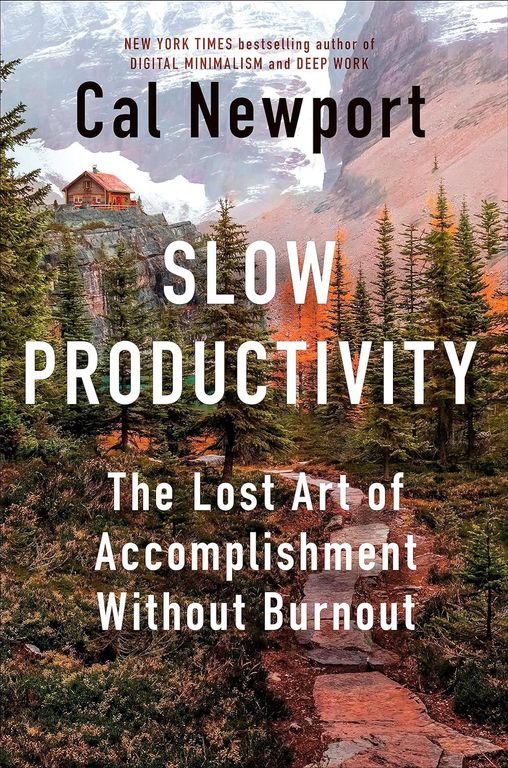
Slow Productivity
The Lost Art of Accomplishment Without Burnout
Introduction
Nova: Every single day, over 333 billion emails hit inboxes around the world. Knowledge workers check their email once every six minutes on average. And yet, at the end of the week, how many of us feel like we actually accomplished something meaningful? That gap between busyness and real accomplishment is exactly what Cal Newport tackles in his 2024 book, Slow Productivity: The Lost Art of Accomplishment Without Burnout.
Nova: Fair question. Newport himself frames this book as the synthesis of his entire body of work, stretching back to his early student advice books through Deep Work and A World Without Email. He identifies a core problem he calls pseudo-productivity, and then offers three principles to escape it: do fewer things, work at a natural pace, and obsess over quality. It sounds simple, but the way he unpacks these ideas challenges some deeply held assumptions about work.
Nova: It is the use of visible activity as a proxy for actual productive effort. Think about it: in a factory, you can measure how many widgets someone produces per hour. But in knowledge work, where we write reports, design strategies, write code, or analyze data, the output is much harder to measure. So we default to looking busy, filling calendars with meetings, firing off emails, and checking off shallow tasks.
Nova: Exactly. And Newport argues this is not just an individual failing, it is baked into modern workplace culture. The introduction of email, Slack, and instant messaging supercharged this dynamic. It became trivially easy to signal busyness without actually doing deep, meaningful work. That is the trap Slow Productivity aims to help us escape.
How We Got Here
The Pseudo-Productivity Trap
Nova: Let us dig into this idea of pseudo-productivity, because understanding it is key to everything else in the book. Newport traces the roots back to the shift from industrial work to knowledge work. In an agricultural or factory setting, productivity was straightforward: more crops per acre, more units per hour. You could see it, count it, measure it.
Nova: Precisely. Newport points out that because knowledge work lacks clear metrics, managers and workers alike defaulted to using visible busyness as a stand-in for effectiveness. Are you at your desk? Are you responding quickly to messages? Are you in lots of meetings? Those became the markers of a good worker.
Nova: Yes. Newport writes that the introduction of tools like email and Slack made it possible to visibly signal busyness with minimal effort, leading to more and more of the average knowledge worker's day being dedicated to talking about work rather than actually doing it. He cites a RescueTime study of 50,000 workers showing they check email every six minutes on average. That constant context switching has real cognitive costs.
Nova: That is right. And there is also the concept of attention residue: when you switch from one task to another, part of your attention stays stuck on the first task, degrading your performance on the next one. So a day with three genuine priorities can actually be worse than a day with two, because of all the cognitive switching costs. This is where Newport moves from diagnosis to prescription. If pseudo-productivity is the disease, Slow Productivity is the cure.
Principle One
Do Fewer Things
Nova: The first principle is deceptively simple: do fewer things. Newport defines it as striving to reduce your obligations to the point where you can easily imagine accomplishing them with time to spare, then leveraging that reduced load to fully embrace the small number of projects that matter most.
Nova: He introduces a concept called the overhead tax. Every time you agree to a new commitment, it does not just bring the work itself, it brings administrative overhead: emails, meetings, coordination, status updates. With enough commitments, you end up spending all your working hours just paying the overhead tax, leaving no time for the actual work. That is why people end up doing their real work early in the morning, late at night, or on weekends.
Nova: Exactly. And his proposed solutions include limiting your major commitments to a small active set, putting recurring tasks on autopilot by assigning them fixed time slots, and switching to what he calls a pull-based workflow, where work is pulled in as capacity allows rather than pushed onto people regardless of their current load.
Nova: Yes, and Newport has been advocating variations of this since his earliest books. He also makes a point that doing fewer things is not about accomplishing fewer things. By narrowing your focus to what matters most and doing it better, you actually accomplish more over the long term. In knowledge work, pushing people into larger workloads often reduces both the quantity and quality of their output. That is a fundamental insight that runs counter to how most organizations operate.
Principle Two
Work at a Natural Pace
Nova: The second principle is to work at a natural pace. Newport says: do not rush your most important work. Allow it to unfold along a sustainable timeline, with variations in intensity, in settings conducive to brilliance.
Nova: Newport acknowledges that. He traces this back to the loss of natural work rhythms. For most of human history, work had built-in seasonality. Hunter-gatherers had clearly defined periods of work and rest. Farmers had intense harvest seasons followed by quieter winters. Then the industrial revolution came along with the powered mill and the factory, and suddenly every day became a harvest day.
Nova: Right. One of my favorite stories from the book is about John McPhee, the legendary New Yorker writer. Back in 1966, McPhee was struggling with a long-form article. His solution? He spent nearly two weeks lying on his back on a picnic table under an ash tree, staring up into the branches, just thinking. In today's world, that would seem outrageously unproductive. But McPhee was one of the most productive nonfiction writers of his generation.
Nova: Newport also tells the story of Lin-Manuel Miranda, who first performed In the Heights in 2000, eight years before it hit Broadway and won a Tony. He gave his masterpiece time. Newport's practical advice here includes making five-year plans instead of quarterly ones, doubling your initial timeline estimates because we are naturally too optimistic, and introducing seasonal variation: periods of high intensity followed by periods of rest and recovery.
Nova: Yes. Newport suggests we stop positioning quiet quitting as a general protest against the meaninglessness of work, and instead see it as a specific tactic to achieve seasonality. Periodic deceleration. You do not actually quit. You just dial back temporarily to recharge, and over the long run, you are more productive for it.
Principle Three
Obsess Over Quality
Nova: The third principle ties everything together: obsess over quality. Newport defines it as obsessing over the quality of what you produce, even if this means missing opportunities in the short term, and leveraging the value of these results to gain more and more freedom over the long term.
Nova: Exactly. Newport tells the story of the musician Jewel. Early in her career, she refused to make a certain kind of commercial pop music that her label wanted. She insisted on her own sound, her own quality bar. It was a huge risk. But it paid off with an album that sold over 12 million copies. Steve Jobs did something similar when he returned to Apple, slashing the product line from dozens of computers down to just four, so the company could obsess over making each one excellent.
Nova: That is a very valid criticism and one the book does not fully resolve. Newport himself acknowledges multiple times that his advice works best for people with considerable autonomy over their work. But his framework offers a direction of travel. The idea is that by developing a refined sense of taste, the ability to distinguish between average and exceptional work, and then betting on yourself to deliver at that higher level, you gradually earn more freedom.
Nova: That is exactly the loop Newport describes. He writes that once you commit to doing something very well, busyness becomes intolerable. Quality becomes a filter. You choose work you can realistically do at a level you would defend. And Newport applied this to himself: in the book, he talks about using the writing of Slow Productivity as an exercise in becoming a better writer. He was genuinely trying to level up his craft.
Does It Actually Work?
The Criticism and the Reality Check
Nova: Now, we should talk about the pushback this book has received, because it is significant and worth engaging with honestly. Some reviewers have called the book unrealistic, even scathing in their assessments.
Nova: Yes, that review from Maestro Group made a sharp point. Newport gives the example of a sales director choosing between writing a detailed report and organizing a client conference. The reviewer's reaction was: who actually gets to make that choice? Most engineers, analysts, and developers are assigned their projects. They do not get to curate a portfolio.
Nova: Right. Another critique, from a reviewer on Epigrammetry, argued that the book is essentially a greatest hits compilation of Newport's earlier work, repackaged under a new banner. If you have already read Deep Work, Digital Minimalism, and A World Without Email, you have encountered most of these ideas before. The book functions more as a manifesto synthesizing his philosophy than as a practical how-to guide with fresh tactics.
Nova: I think it is for two audiences. First, people who have never read Cal Newport before and need a coherent entry point to his entire philosophy. Slow Productivity is the most accessible and consolidated version of his ideas. Second, even for longtime Newport readers, there is value in the reframing. The three principles provide a mental model you can use to evaluate every work decision. Should I say yes to this new project? Does it violate the fewer things principle? Am I being pressured into an unnatural pace? Is the quality bar high enough?
Nova: And Newport does offer genuinely practical tools: the overhead tax concept helps you evaluate new commitments more realistically. Autopilot scheduling reduces decision fatigue. Longer planning horizons reduce the pressure to look busy every single day. Office hours reduce asynchronous message ping-pong. These are small, actionable shifts that even someone without total autonomy can start experimenting with.
Conclusion
Nova: So where does all this leave us? Cal Newport's Slow Productivity is, at its core, an argument that our culture of constant busyness is not just unpleasant, it is counterproductive. The three principles, doing fewer things, working at a natural pace, and obsessing over quality, form a coherent philosophy for knowledge work that prioritizes meaningful output over visible activity.
Nova: That is beautifully put. And Newport would say that the rewards of this shift compound over time. When you consistently produce high-quality work at a sustainable pace, you build a reputation that gives you more autonomy. That autonomy lets you protect your time even more. It is a flywheel.
Nova: I will leave listeners with one of my favorite quotes from the book. Newport writes: to embrace slow productivity is to reorient your work to be a source of meaning instead of overwhelm, while still maintaining the ability to produce valuable output. That is the invitation. Not to do less, but to do what matters, well, at a pace you can sustain.
Nova: This is Aibrary. Congratulations on your growth!