

Navigating the Slippery Slope: A Thinker's Guide to Moral Fortitude
Golden Hook & Introduction
SECTION
Nova: It often starts with a small, justifiable decision. A tiny compromise made under pressure. "Just this once," we tell ourselves, "to get through this crisis." But then another crisis comes, and another compromise follows. Before we know it, we're standing somewhere we never intended to be, looking back up a steep, icy incline and wondering… how did I get here? That, right there, is the essence of the slippery slope.
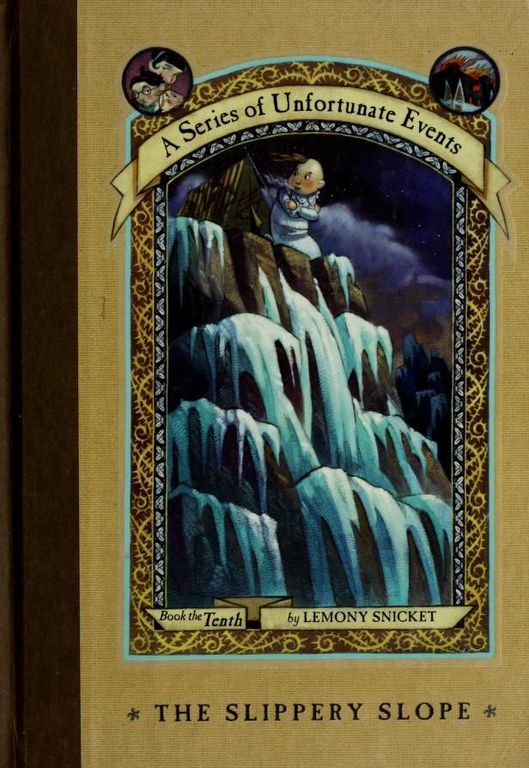
Nova: Welcome to the show. Today, we're exploring this powerful concept through a very unexpected lens: Lemony Snicket's "A Series of Unfortunate Events," specifically the tenth book, "The Slippery Slope." And I'm thrilled to have Jon, an educator with a PhD and a wonderfully analytical mind, here to help us deconstruct it.
jon: Thanks for having me, Nova. It's a fascinating topic. That feeling of incremental drift is something I think everyone, from students to professionals, can relate to.
Nova: Exactly. It's so universal. And today we'll dive deep into this from two perspectives. First, we'll explore the anatomy of that first, difficult compromise—the first step on the slippery slope. Then, we'll zoom out to discuss how to navigate a world where the lines between right and wrong are deliberately blurred, and what that means for our own integrity.
Deep Dive into Core Topic 1: The Anatomy of a Compromise
SECTION
Nova: So, Jon, let's start with that first step. In the book, the Baudelaire orphans, Violet and Klaus, are in a truly desperate situation. They've been separated from their baby sister, Sunny.
jon: And they're in the Mortmain Mountains, which are freezing and treacherous. Not a good spot to be.
Nova: Not at all. And they discover that Sunny has been captured by their arch-nemesis, the villainous Count Olaf, and his theatrical troupe. They're camped near the top of Mount Fraught. And here’s the critical detail: Sunny is being held in a birdcage, dangling from the very peak. The only way to get to her is by climbing a sheer, frozen waterfall.
jon: Which sounds impossible.
Nova: It is, unless you have special footwear—crampons, or spiked shoes, that can grip the ice. And of course, the only people who have those shoes are the villains. So Violet and Klaus are hiding, freezing, watching the villains go up and down the waterfall to their camp, and they are completely stuck. Their only conceivable path to saving their sister is to somehow get a pair of those shoes.
jon: So they can't fight them, and they can't go around them. Their options are incredibly limited.
Nova: Exactly. And that's when they make a momentous decision. They decide the only way is to disguise themselves as "volunteers" and join Count Olaf's troupe. They plan to pretend to be on his side, just to get close enough to rescue Sunny. It's a classic ends-justify-the-means dilemma. What's your take on that moment, Jon? As a thinker, how do you process that kind of forced choice?
jon: You know, it's a perfect illustration of what you could call 'situational ethics.' Their core moral framework—their understanding of right and wrong—hasn't fundamentally changed. They still know Olaf is evil. But the situation is so extreme, the stakes so high, that it forces a temporary override of their principles.
Nova: An override. I like that term. It's like a system rebooting in safe mode.
jon: Exactly. The immediate, primary goal—saving Sunny—becomes so paramount that it eclipses the abstract principle of 'do not associate with evil.' It's a survival mechanism, really. But it's a dangerous one, because it sets a precedent. It makes the next compromise easier.
Nova: And what does that do to a person's psyche? To their self-confidence? If you see yourself as a 'good' person, a resourceful person, but now you're actively dressing up and acting like one of the 'bad' people... that has to create some internal friction.
jon: It creates a huge amount of what psychologists call cognitive dissonance. You're holding two contradictory ideas in your head at once: 'I am a good person who stands for what is right,' and 'I am actively participating in a group that stands for what is wrong.'
Nova: Right. And your brain hates that.
jon: It's incredibly taxing. The mind will struggle to resolve that contradiction. You might start to rationalize. You might tell yourself, 'Well, maybe they're not bad,' or 'This is the only way, so it be the right thing to do.' And that process can slowly, subtly erode your motivation and your sense of self. Your identity becomes unstable because your actions are out of alignment with your values. You start to ask, 'Who am I, really?'
Nova: And for the Baudelaires, who are children, that question is everything. They've lost their parents, their home... their identity as 'good, noble children' is one of the few things they have left.
jon: Precisely. And we see this in education all the time. A student under immense pressure to get a certain grade might cheat on a test. Their goal—success—overrides their principle of academic integrity. It's not that they've become a bad person overnight. It's that the situation created a pressure that led to a compromise. But if they aren't able to reflect on that, it can become the first step on a very slippery slope of defining success by outcomes rather than by process.
Deep Dive into Core Topic 2: Navigating a World Without Clear 'Good Guys'
SECTION
Nova: And that question of 'Who am I?' gets so much more complicated as the book goes on. Because just as the Baudelaires are grappling with their own moral compromise, they discover that the 'good guys' they've been desperately searching for might not be so good after all. This is where the mysterious secret organization, V. F. D., really comes into focus.
jon: Ah yes, the Volunteer Fire Department. The great, shadowy force in the background of the entire series.
Nova: Exactly. While on the mountain, the Baudelaires meet another young person, Quigley Quagmire, who they thought had died in a fire. He is alive, and he is a member of V. F. D., the same secret society their parents belonged to. For a moment, it's this huge ray of hope. Finally, an ally! Someone from the 'good' side!
jon: The cavalry has arrived.
Nova: You'd think so. But as they piece together clues with Quigley, they learn that V. F. D. is not a straightforward force for good. They learn that V. F. D. members also use disguises. They also use secret codes. They also, it is heavily implied, set fires. The book deliberately makes it unclear which side started the schism that split the organization, suggesting a long, complicated war where both factions have committed terrible acts.
jon: It pulls the rug out from under them. And the reader.
Nova: It completely pulls the rug out. There is no cavalry of purely noble heroes coming to the rescue. The world isn't black and white; it's shades of smoky grey. Jon, as an INTP, an analytical thinker, you must love this kind of ambiguity.
jon: I do. Because it elevates the story from a simple morality play to a complex systemic analysis. It's a much more realistic, and frankly more interesting, model of the world. It suggests the world isn't divided into good people and bad people, but perhaps into competing systems, competing ideologies, both of which are inevitably flawed and have their own dark histories.
Nova: So what does that mean for someone trying to be innovative or motivated? If you can't trust the established 'good' path, where do you even start?
jon: Well, that's where true innovation comes from, isn't it? Breakthroughs don't happen by perfectly following the established 'good' path. They happen by questioning the entire system and its underlying assumptions. For the Baudelaires, the realization that V. F. D. is flawed is devastating, but it's also liberating.
Nova: How so?
jon: It forces a critical shift from an external locus of control to an internal one. They can no longer pin their hopes on an external organization, V. F. D., to save them and tell them what's right. They have to figure it out for themselves. They have to define their code.
Nova: So their motivation has to come from within, not from joining a team.
jon: Exactly. It's no longer about being on the 'right side'; it's about making the 'right choice' in the immediate moment, according to your own, newly-forged principles. And I would argue that's the ultimate source of genuine self-confidence and lasting motivation. It's not about getting validation from a group; it's about knowing your own moral 'why' and being able to defend it, even when the world around you is a confusing mess. It's about building your own compass instead of just looking for someone else's map.
Synthesis & Takeaways
SECTION
Nova: That is such a powerful way to frame it. Building your own compass. So, to bring it all together, we've looked at this from two angles. We started with the personal, psychological slip of making that first compromise under pressure...
jon: And then we zoomed out to the larger, philosophical slip of realizing the entire world is morally grey, and there are no perfectly 'good guys' to follow.
Nova: And the path forward, it seems, isn't about finding a way to stay on perfectly solid ground, because it doesn't exist. It's about learning how to climb on ice.
jon: That's a great way to put it. The path forward is about building resilience not against evil, necessarily, but against ambiguity itself. It's about being comfortable with the discomfort of not knowing, and still being able to act.
Nova: So for everyone listening, especially those of us who, like me, and I suspect like you, Jon, like to have things figured out... what's a practical way to apply this? How do we build that resilience?
jon: I think it's about practicing what you might call 'principled self-awareness.' It's about changing the questions we ask ourselves in difficult moments. Instead of just asking the simple binary question, 'Is this a good or bad choice?'...
Nova: Which, as we've discussed, is often an impossible question to answer.
jon: Right. Instead, we should ask a different set of questions. First: 'What core value am I prioritizing with this decision, and what value am I sacrificing?' Second: 'Is this choice a temporary tactic for survival, or is it in danger of becoming a permanent shift in my principles?' And maybe the most important question of all: 'Can I look at myself in the mirror and respect the person I am becoming by making this choice?'
Nova: Wow. That's a heavy set of questions.
jon: It is, but that internal dialogue is the safety harness on the slippery slope. It doesn't stop you from slipping—sometimes you have to. But it ensures you're aware of the slip, you understand the stakes, and you have a way to pull yourself back. It keeps you anchored to your own integrity, even when the world feels like it's sliding out from under you.
Nova: A safety harness on the slippery slope. I absolutely love that. Jon, this has been an incredibly insightful and thought-provoking conversation. Thank you so much for being here.
jon: It was my pleasure, Nova. A great topic.