

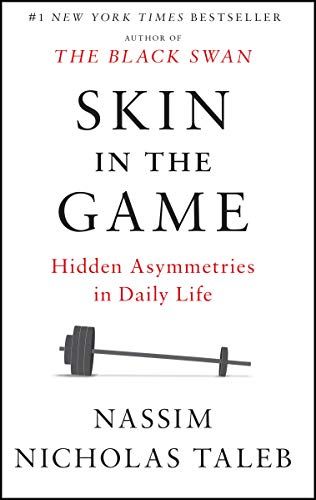
Skin in the Game
Hidden Asymmetries in Daily Life
Introduction
Nova: Welcome to Aibrary. I'm Nova.
Nova: : And I'm.
Nova: So here's a question: imagine you're building a house for someone. The house collapses, and the owner dies. What should happen to you, the builder?
Nova: : I mean... lawsuits? Jail time? Negligence?
Nova: How about death? That was the actual law under Hammurabi's code, nearly 3,800 years ago. If the house you built collapsed and killed the owner, you were put to death. That is the most literal form of skin in the game imaginable.
Nova: : Wow. So we're talking about a builder quite literally betting his life on his work. That's intense. But obviously we don't do that anymore.
Nova: And that's exactly the problem Nassim Nicholas Taleb addresses in his 2018 book "Skin in the Game: Hidden Asymmetries in Daily Life." Taleb argues that modern society has systematically removed this ancient principle from almost every domain. People make decisions, give advice, start wars, design policies, and profit enormously from all of it, while someone else entirely absorbs the consequences.
Nova: : So the book is basically asking: who pays the price when things go wrong, and why is the answer so often not the person who caused it?
Nova: Precisely. It's the fifth book in Taleb's Incerto series, which also includes The Black Swan and Antifragile. And it may be his most provocative yet. Today we're unpacking its most powerful ideas: moral symmetry, the Intellectual Yet Idiot, the tyranny of intolerant minorities, and why Taleb thinks most employees are, quote, "housebroken dogs."
Nova: : I feel personally attacked already. Let's get into it.
What Skin in the Game Actually Means
Symmetry, Pain, and Real Knowledge
Nova: At its core, skin in the game is dead simple. It means that if you stand to benefit from a decision, you must also bear some of the downside if things go wrong. Taleb calls this moral symmetry. He takes us back to Hammurabi, but also to Immanuel Kant's universal moral law, and to the Golden Rule: do unto others as you would have them do unto you.
Nova: : Right, the Golden Rule. That's pretty standard ethics.
Nova: And Taleb actually doesn't like it. He prefers what he calls the Silver Rule: do NOT treat others the way you would not like them to treat you.
Nova: : That sounds like the same thing, just phrased negatively.
Nova: It's subtly different, and Taleb thinks it's far more robust. The Golden Rule assumes you know what's good for others, and Taleb finds that arrogant and dangerous. The Silver Rule just says: don't cause harm. Even if you mess up applying it, at least you haven't hurt anyone. It's a via negativa approach: focus on avoiding the negative, rather than chasing an imaginary positive.
Nova: : So it's the ethical equivalent of "first, do no harm."
Nova: Exactly. And Taleb connects this to a Greek concept: pathemata mathemata, which means "learning through pain." He argues that true knowledge only comes when you have something real to lose. You can read a hundred books on public speaking, but you won't actually improve until you're standing on stage, sweating, with a real audience.
Nova: : That resonates. I remember Taleb even says that when he was a trader, he suddenly found probability theory fascinating because his own money was on the line. He writes that when there's skin in the game, a second brain manifests itself.
Nova: He uses the example of drug addicts. They become incredibly ingenious at finding ways to get drugs precisely because they have skin in the game. Their desire is real, the stakes are real, and suddenly the dullest intellect becomes a creative genius.
Nova: : Right. The flip side is that without skin in the game, we become lazy, sloppy, and frankly, stupid. Taleb openly admits that when he doesn't have skin in the game, he is, in his own words, "dumb."
Nova: And this is why he's so critical of experts and institutions. He says bureaucracies are constructions by which a person is conveniently separated from the consequences of his or her actions. It's not that these people are evil. It's that the system insulates them from feedback.
Nova: : The most vivid example he gives is the "Bob Rubin trade." Robert Rubin was a highly paid director at Citigroup, and when the bank had to be bailed out by taxpayers during the 2008 financial crisis, Rubin paid no financial penalty whatsoever. He got the upside, taxpayers got the downside. That's the asymmetry Taleb despises.
Nova: And here's his core prescription: if you're going to give advice, if you're going to make policy, if you're going to intervene in complex systems, you must have something to lose. Without that, you're not a wise person, you're a ticking time bomb.
When Credentials Replace Consequences
The Intellectual Yet Idiot
Nova: This brings us to maybe the most talked-about concept in the entire book: the Intellectual Yet Idiot, or IYI.
Nova: : I love this term. It sounds like an insult Taleb would hurl at a dinner party before flipping the table.
Nova: It's actually a very specific critique. The IYI is the well-credentialed, semi-intelligent class of people who, Taleb says, are "telling us what to do, what to eat, how to speak, how to think, and who to vote for." They have degrees from elite universities, they read The New Yorker, they attend TED talks. But they have never had real skin in the game.
Nova: : So they're smart on paper, but disconnected from consequences.
Nova: Exactly. Taleb says the IYI can't find a coconut on Coconut Island. They get first-order logic right but completely miss second-order effects. They advocated for removing Gaddafi because he was a dictator, without realizing that removal has devastating consequences. And when things blew up, they simply moved on to the next cause.
Nova: : And he's pretty ruthless about naming names, isn't he? Steven Pinker, Richard Thaler, Cass Sunstein, Thomas Piketty, Paul Krugman. He goes after all of them.
Nova: He does. He argues that behavioral economists like Thaler misunderstand what rationality even is. In a lab, people look irrational for overestimating risks. But in real life, you face multiple tail risks simultaneously, not one at a time. Overestimating risk when your survival is at stake is not irrational. It's what keeps you alive.
Nova: : Taleb's definition of rationality is fascinating. He says: what is rational is what allows the collective to survive over the long run. Not what looks good in a peer-reviewed paper.
Nova: And this is his deeper point about knowledge. He distinguishes science from scientism. Real science is tinkering, trial and error, contact with reality. Scientism is the elaborate theater of complexity that academics perform for each other, often completely detached from whether anything actually works.
Nova: : There's this killer line: "In academia there is no difference between academia and the real world. In the real world, there is."
Nova: That's it right there. He also notes that architects today build to impress other architects, not to satisfy the people who actually live in the buildings. Doctors prescribe treatments that look good on five-year survival charts, even when longer time horizons show they cause second cancers. The system rewards appearances because the people making the decisions never face the long-term consequences.
Nova: : And Taleb's solution? He says: don't tell me what you think. Just tell me what's in your portfolio. Words are cheap. Actions reveal true beliefs.
Nova: That's the ultimate IYI detector. If someone won't bet their own resources on their stated beliefs, their beliefs aren't worth your attention.
How Tiny Minorities Rule the World
The Most Intolerant Wins
Nova: Here's one of Taleb's most counterintuitive and powerful ideas: the minority rule. He argues that an intransigent minority, as small as three or four percent of a population, can impose its will on the entire majority.
Nova: : Wait. Three percent? How does that math work?
Nova: It's an asymmetry of preferences. Let me give you the example Taleb uses. Think about halal food. A person who only eats halal will never eat non-halal food. But a person who eats anything can eat halal without any problem. So if a catering company has even a small number of halal-only customers, it's easier to just make everything halal than to maintain two separate menus.
Nova: : So the minority wins not because they're powerful, but because their preferences are rigid and the majority's are flexible.
Nova: Exactly. Same with automatic versus manual cars. People who only drive automatic can't drive manual. People who can drive manual can also drive automatic. So over time, the market shifts toward automatic, not necessarily because of majority preference, but because of this asymmetry.
Nova: : Taleb applies this to something much bigger: religion. He points out that under Islamic law, if one parent is Muslim, the child is Muslim. And apostasy is punishable by death, meaning you can enter Islam but you can never leave it. That asymmetry, over centuries, creates an irreversible ratchet effect.
Nova: Right. And he extends this to GMOs. If just four percent of the population refuses to eat GMO food, and they're stubborn about it, they can force the entire food supply chain to adapt. One stubborn daughter in a family refusing GMOs means the family stops buying GMO food. The family hosts a barbecue, serves only non-GMO. The neighborhood notices. The local stores adjust. It cascades.
Nova: : But here's the darker side of this idea. Taleb says the most intolerant person imposes virtue on others precisely because of that intolerance. He argues that what we call civil rights progress often came from stubborn, intolerant minorities who refused to compromise.
Nova: And he's not necessarily celebrating that. He also warns that this same mechanism can destroy societies. He writes that the West is, in his words, "currently in the process of committing suicide" by tolerating intolerant minorities who don't share liberal values. His prescription: you must be intolerant of intolerance.
Nova: : So it's a double-edged sword. The minority rule can be a force for moral progress, as with civil rights. Or it can be a force for authoritarianism, as with radical ideologies that don't respect the rights of others.
Nova: Taleb's broader point is that this mechanism is structural, not ideological. It doesn't care about your values; it just amplifies whoever is most stubborn. And decentralization, like the American federal system, is one of the few protections against it, because it limits how far any one intolerant minority's influence can spread.
Freedom, Employment, and Honor
Dogs, Wolves, and the Soul in the Game
Nova: Now let's talk about one of the most provocative parts of the book. Taleb draws on Aesop's fable of the dog and the wolf. The dog boasts about all the comfort and luxury it has, almost convincing the wolf to join. Then the wolf notices the dog's collar and asks what it's for. When the wolf understands, he runs away and, Taleb says, is still running.
Nova: : So the dog has security but no freedom. The wolf has freedom but no security.
Nova: Taleb's question is brutally simple: which one are you? He argues that most modern employees are housebroken dogs. By showing up to an office every day at the same time for years, by suppressing their own schedules, by not punching anyone on the way home after a bad day, they are signaling submission and domestication.
Nova: : That feels harsh. Most people don't have the luxury of choosing to be a wolf.
Nova: Taleb would agree that being a wolf is riskier. He's not saying everyone should quit their jobs. He's saying we should be honest about the trade-off. The dog gets comfort but gives up freedom. And the more you have to lose, the more vulnerable you are. He writes: "What matters isn't what a person has or doesn't have; it is what he or she is afraid of losing."
Nova: : There's an even deeper layer here though, isn't there? He talks about something beyond skin in the game called "soul in the game."
Nova: Yes. Soul in the game is when you do something for existential reasons first, and commercial reasons second. Taleb's prime example is the artisan. An artisan will not sell a defective product even if no one would ever know, because it hurts their pride. They have sacred taboos, things they would not do even if it were profitable.
Nova: : He mentions that products bearing the owner's name send a powerful signal. When a company has someone's name on the door, that person has something to lose. Their reputation is on the line.
Nova: And he contrasts this with the modern entrepreneur who raises venture capital, cashes out by selling to someone else, and never bears the long-term consequences. Taleb says many people mistaken for entrepreneurs actually have no real skin in the game; their goal is to exit, not to build something that lasts.
Nova: : He also ties this to honor. He writes that honor means there are some actions you would categorically never do, regardless of material rewards. She wouldn't sell her body for five hundred dollars, but she also wouldn't do it for a million, or a billion. And there are things you would do unconditionally, regardless of consequences.
Nova: He invokes the Spartan mother sending her son to war: "With it or on it," meaning return with your shield or be carried home dead on it. Only cowards throw away their shields to run faster. Taleb's point is that modernity has eroded this sense of unconditional honor. People now fit their ethics to their profession, rather than finding a profession that fits their ethics.
Nova: : And that connects back to financial independence. Taleb argues that people who aren't financially independent become morally dependent. They have to rationalize the ethics of whatever organization employs them.
Nova: Which is why Taleb says the highest form of freedom is to have nothing to lose, and the highest status is that of a free person who voluntarily adopts the mores of the lowest class. He points out that the truly powerful can curse on Twitter, can break social rules, because they don't depend on anyone's approval.
Conclusion
Nova: So let's bring this together. Taleb's "Skin in the Game" is really a unified moral and practical philosophy. At its heart is a single demand: if you want to play the game, you have to be in the game. You cannot separate the rewards from the risks, the advice from the consequences, the power from the accountability.
Nova: : And the book is relentless in exposing where we fail at this. The Bob Rubin trades of high finance. The IYIs who design policies from ivory towers. The journalists and pundits who shape public opinion without ever being held responsible for being wrong. The virtue signalers who claim solidarity with the oppressed while consolidating their own privileges.
Nova: But there's also a constructive vision here. Taleb celebrates the artisans, the small business owners whose names are on the door, the people who do more than they talk, and the ones who take risks for their opinions. He reminds us that the Lindy effect, time itself, is the ultimate judge. What survives across generations, what people keep doing and believing because it works, that is real knowledge.
Nova: : A few practical takeaways stand out. One: don't take advice from anyone who gives advice for a living, unless there's a penalty for being wrong. Two: if you want to understand what someone really believes, ignore their words and look at their actions and their portfolio. Three: read good books twice rather than skimming a hundred surface-level summaries. Deep repetition beats shallow variety.
Nova: And perhaps the most uncomfortable takeaway: examine your own life. Where are you making decisions that affect others without bearing any downside? Where are you the dog, trading freedom for comfort, and is that trade worth it?
Nova: : Taleb's parting challenge is that intellectual and ethical freedom requires the absence of the skin of others in your game. That's why the truly free are so rare. It's easier to let someone else take the fall.
Nova: But the book ultimately argues that a life lived with skin in the game, with real stakes and real consequences, is the only life worth living. Not because it's easier, but because it's real. As Taleb puts it, if you do not take risks for your opinion, you are nothing.
Nova: : This is Aibrary. Congratulations on your growth!