

The Path Beyond the Buddha
Golden Hook & Introduction
SECTION
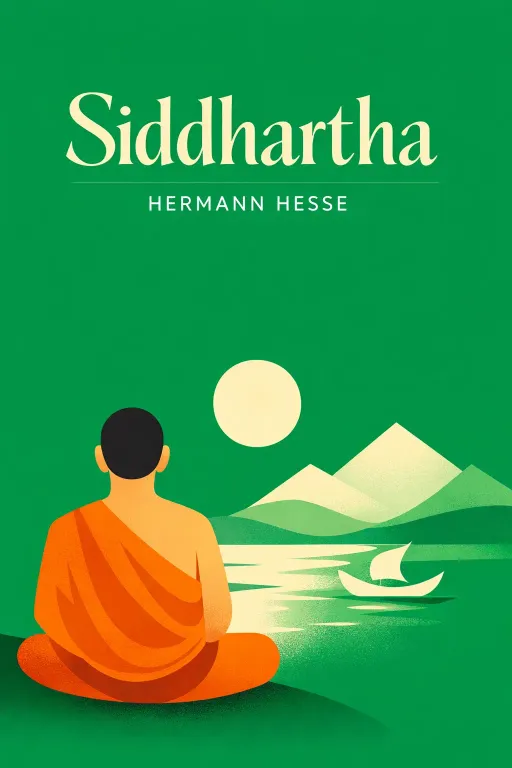
Michael: The most common spiritual advice is "find a good teacher." What if that's the worst advice you could follow? What if the only path to real wisdom is to reject every teacher you meet, even the Buddha himself? Kevin: Whoa, hold on. That sounds like a recipe for disaster, not enlightenment. You’d just be wandering in the dark, completely lost. Michael: Or you might just find yourself. That's the radical question at the heart of Hermann Hesse's masterpiece, Siddhartha. Kevin: Ah, Hesse, the Nobel Prize winner, right? I've heard this book is a staple in philosophy classes, but also pretty controversial for a slim little novel. Michael: Exactly. It's widely praised for its beautiful, lyrical style, but it also sparked a huge debate for how a Western author framed Eastern spirituality. Hesse essentially asks if you can find enlightenment by walking away from the enlightened. Kevin: I love that. It’s a challenge right from the start. So where does this journey of rejection begin?
The Paradox of the Path: Why You Can't Be Taught Wisdom
SECTION
Michael: It begins in a place of seeming perfection. Siddhartha is a Brahman's son, handsome, intelligent, loved by everyone. He's mastered all the rituals and meditations. He should be the happiest guy in town. But he’s not. Kevin: He’s got that spiritual itch. The feeling that there must be something more. Michael: Precisely. He feels a deep inner void. Hesse writes that despite all the love and knowledge poured into him, "The vessel was not full, the spirit was not content, the soul was not calm, the heart was not satisfied." The wisdom of his elders feels like theory, not lived truth. Kevin: Okay, so he's the classic overachiever who's still unhappy. I can relate to that. So he decides to leave his comfortable home. But his first move is to join the Samanas, these extreme ascetics. He goes from one extreme to another. Michael: He really does. He and his friend Govinda join these wandering mendicants who practice severe self-denial. Siddhartha gives away his clothes, fasts for weeks on end, and learns to control his breath until his heartbeat slows to a crawl. He even practices these intense meditations where he feels his soul leave his body and become a heron, feeling its hunger, flying, and eventually dying a heron's death. Kevin: That is intense. He’s really committing to the idea of killing the self. Does it work? Michael: He masters it. He becomes incredibly skilled at detaching from his body and his feelings. But he comes to a stunning realization. All these practices—the fasting, the meditation—they’re just temporary escapes. He brilliantly compares it to a common ox-cart driver who gets drunk on rice-wine at an inn. Kevin: How so? Michael: He says both the ascetic and the drunkard are just finding a "short escape of the agony of being a self." It’s a numbing agent. The drunkard wakes up with a hangover, and Siddhartha wakes up to find his old self still there, still thirsty, still suffering. It doesn't lead to permanent wisdom. Kevin: That's a powerful and kind of insulting analogy for holy men. So he’s disillusioned again. But then comes the big moment. He hears rumors of Gotama, the Buddha. The actual Buddha, who has achieved Nirvana. And he goes to see him. Michael: He does. And this is the most pivotal scene in the first part of the book. He and Govinda listen to the Buddha's teachings. Govinda is instantly converted. He sees the logic, the clarity, the path to salvation, and he joins the Buddha's community of monks. Kevin: And Siddhartha? Michael: Siddhartha is deeply moved, but not by the teachings. He is moved by the man himself. He says, "This man, this Buddha was truthful down to the gesture of his last finger. This man was holy." He has never venerated a person so much. Kevin: But he doesn't join. Why? If you're standing in front of the most enlightened person on Earth, why would you walk away? That seems incredibly arrogant. Michael: It's the core of his philosophy. He approaches the Buddha and respectfully points out what he sees as a "gap" in the otherwise perfect teachings. He argues that the Buddha's doctrine explains the world, cause and effect, the chain of being—but it cannot explain the one thing that matters most: the Buddha's own experience of enlightenment. Kevin: What do you mean? Michael: Siddhartha tells him that this experience, the "mystery of what the exalted one has experienced for himself," cannot be conveyed through words or a doctrine. It’s a famous line from the book: "Knowledge can be conveyed, but not wisdom." He believes wisdom has to be lived, experienced directly. Kevin: Wow. The audacity. So he respects the destination but rejects the map that everyone else is using. Michael: Perfectly put. He recognizes that the Buddha found his path through his own unique, unteachable search. And so, Siddhartha concludes, he must do the same. He decides to depart from all teachings and all teachers to reach his goal by himself, or die trying. He chooses radical self-reliance over even the most perfect doctrine.
The Sacred Detour: Finding Enlightenment in Sin and Samsara
SECTION
Kevin: That’s a lonely path. After leaving the Buddha, and his best friend Govinda, where does he even go? He’s rejected religion, he’s rejected asceticism. What’s left? Michael: What’s left is the world. And that self-reliance leads him to the most unexpected place imaginable: the city. After rejecting all the spiritual teachers, his inner voice tells him he must now learn from himself, and to do that, he has to engage with the world of the senses he’d spent years trying to suppress. Kevin: So he goes from a meditating ascetic to... what, a man about town? This is where he meets the famous courtesan, Kamala, right? Michael: Exactly. He sees her in her rich sedan chair and is immediately captivated. He realizes his shaggy, unkempt Samana look isn't going to work, so he gets a shave, oils his hair, and approaches her. He boldly tells her he has come to learn the art of love from her. Kevin: That’s quite a pivot. What does she say to this homeless-looking guy with a lofty goal? Michael: She's amused but also intrigued. He has no money, no fine clothes. She asks him, "What can you give? What have you learned?" And he gives this incredible, unforgettable answer: "I can think. I can wait. I can fast." Kevin: He’s using his spiritual resume for a secular job interview. I love that. Michael: He’s repurposing his ascetic training. He explains that these skills allow him to be calm, patient, and never desperate, which gives him immense power. Kamala is impressed by his confidence and his poetic mind, and she agrees to teach him, but on one condition: he must become a rich man to be worthy of her company. Kevin: And so begins his dive into the material world. He starts working for a merchant named Kamaswami. But this is where it gets tricky for me, Michael. The book says he becomes entangled in "Sansara"—the cycle of worldly life. He gets rich, he learns the art of love, but he also becomes lazy, greedy, and a compulsive gambler. He has a dream where the "singing bird in his heart," which represents his spirit, dies. How is this a spiritual path? It just sounds like he completely lost his way. Michael: That is the "sacred detour," and it's arguably the most controversial and fascinating part of the book. Many critics point to this section as an example of Hesse’s Western psychological framing, this idea of a journey into the shadow self to find wholeness. Kevin: Right, it feels very Jungian. But from a traditional Eastern perspective, isn't he just accumulating bad karma? Michael: He is. But Hesse's argument is that Siddhartha had to experience this. He couldn't just intellectually reject the world; he had to live it, to feel its pleasures and, more importantly, its poisons. He had to become a "fool," to "sin," to feel the depths of worldly attachment and the soul-crushing disgust that followed. He had to fully live the life of the "childlike people"—as he calls them—to finally develop true compassion for them, instead of just looking down on them with intellectual superiority. Kevin: So the idea is you can't truly renounce what you don't fully understand? You have to get your hands dirty, feel the burn, before you can genuinely let it go. Michael: Precisely. He had to let the "rich, greedy Siddhartha" live and breathe until that self literally died of its own exhaustion and emptiness. The game of Sansara, he realizes, is a game you can play over and over, but it never ends, and it never satisfies. It's only after he hits absolute rock bottom—feeling so disgusted with his life that he wanders to the river to drown himself—that he is finally ready for his true, final awakening.
The Symphony of Oneness: Listening to the River and Finding 'Om'
SECTION
Kevin: So he's at the edge of the river, about to end it all. What stops him? Michael: Just as he’s about to let himself fall into the water, a sound from deep within his soul, a word he has known since he was a boy, arises: "Om." The sound of perfection, of unity. It shocks him back to his senses. He realizes the foolishness of trying to destroy his body when his spirit is eternal. He collapses and falls into a deep, restorative sleep. Kevin: A spiritual reboot. And when he wakes up, he’s a new man. This is where he meets the ferryman, Vasudeva, again, right? Michael: Yes, the same kind ferryman who had taken him across the river years before. Siddhartha decides to stay with him, not as a student in the old sense, but as an assistant, a listener. And the river becomes his final, greatest teacher. Kevin: Okay, the river as a teacher. You have to unpack that for me. What does that actually mean? Is he just sitting there, or is something more profound happening? Michael: Vasudeva teaches him the art of listening. Not just with his ears, but with his whole being, without judgment. And as Siddhartha listens to the river, he starts to perceive its secrets. He sees that the river is constantly flowing, always changing, yet it is always there. This makes him realize that time itself is an illusion. Kevin: How so? Michael: He understands that the river is "everywhere at once"—at its source in the mountains, at the waterfall, at the mouth of the sea. For the river, there is only the present moment. Past and future are just shadows. And he sees his own life the same way—the boy Siddhartha, the ascetic, the rich man—they aren't separate stages, but all present at once within him. Kevin: That's a beautiful image. It's about seeing the whole pattern of life at once, not just the single thread you're on. Michael: Exactly. But the lesson gets even deeper, and more painful. Years later, Kamala, on her own pilgrimage to see the dying Buddha, arrives at the ferry. She is bitten by a snake and dies in Siddhartha's arms, but not before leaving him with their son—a son he never knew he had. Kevin: Oh, wow. So his past literally comes back to him. Michael: And it breaks him. This pampered, resentful boy wants nothing to do with Siddhartha's simple life. He is cruel and defiant. And Siddhartha, for the first time, feels a blind, foolish, suffering love. He feels the pain of attachment he had always avoided. Kevin: So the man who walked away from his own father now has to face the pain of being a father himself. Michael: Yes. The cycle repeats. At one point, his son runs away, and Siddhartha is about to chase him, when he looks in the river and sees his own reflection, which morphs into the face of his own father, who suffered the same pain when he left. The river, he says, "laughed" at him. It’s a moment of cosmic irony. Kevin: So his own pain is what finally connects him to everyone else's pain. His wound becomes his wisdom. Michael: That's it. His wound had to "blossom." And in that moment of acceptance, he returns to the river and truly listens. He hears not just the water, but all the voices of the world in its flow—voices of joy and sorrow, of warriors and kings, good and evil, a thousand voices. And he realizes they all merge. Everything together—all the suffering, all the pleasure, all good and evil—was the world. It was the music of life. And when he listened without clinging to any single voice, he heard that the "great song of the thousand voices consisted of a single word, which was Om: the perfection." Kevin: The unity of everything. He finally found it. Not by rejecting parts of life, but by hearing them all at once as a single, perfect harmony.
Synthesis & Takeaways
SECTION
Michael: And that is the ultimate realization. In the end, he meets his old friend Govinda, who is still a monk, still searching. Govinda asks for a teaching, and Siddhartha explains that wisdom can't be taught, but he can share his central belief. He says, "love, oh Govinda, seems to me to be the most important thing of all." Kevin: After all that searching, it comes down to love? Michael: An all-encompassing love. He says he's no longer interested in despising the world or explaining it. He says, "I'm only interested in being able to love the world, not to despise it... to be able to look upon it and me and all beings with love and admiration and great respect." He stops judging and starts loving the stone, the river, the sinner, the saint—because he finally understands they are all part of the same perfect, unified 'Om'. Kevin: That's a profound shift. It’s not about purification by subtracting the 'bad' parts of life, but about achieving completion by adding and accepting everything. You have to embrace the entire symphony, not just the pretty melodies. Michael: A beautiful way to put it. The book suggests that true holiness isn't about being without sin, but about seeing the perfection that contains both sin and grace simultaneously. Kevin: It really leaves you thinking. It’s a challenging idea, that the path isn't a straight line up, but a winding river that flows through every kind of terrain. Michael: And it leaves us with a question to reflect on: What 'teachers' or 'doctrines' in our own lives, the ones we follow so faithfully, might we need to walk away from to truly find our own path? Kevin: A challenging thought indeed. We'd love to hear what our listeners think. Join the conversation on our social channels and let us know your perspective on this timeless book. Michael: This is Aibrary, signing off.