

Personalized Podcast
Golden Hook & Introduction
SECTION
Nova: What if the biggest obstacle to your creative vision isn't actually a lack of funding, but our refusal to show the world what we can do before they write us a check? Think about it. We spend months, sometimes years, drafting proposals, waiting for gatekeepers to nod, and begging for resources. But what if we flipped the script entirely? What if we started treating our vision as an ongoing, recorded action?
AHUA EL Bey: Exactly, Nova. It’s about shifting the power dynamic. When you stop asking for permission and start creating public evidence of your capacity, the entire conversation changes. You aren't a supplicant anymore; you are an executor.
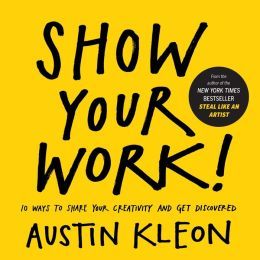
Nova: Oh, I love that word—executor! Welcome to the show, everyone. I’m Nova, and today we have a truly special guest, creative strategist and director AHUA EL Bey. Today, we are diving deep into Austin Kleon’s brilliant book,, but we aren't just talking theory. We are looking at how these concepts are being deployed right now on the streets of Chicago through AHUA’s groundbreaking initiative, THE SWIMMER.
AHUA EL Bey: It’s great to be here, Nova. You know, Kleon’s book really resonates with the core philosophy of THE SWIMMER. It’s all about moving away from the myth of the 'lone genius' and embracing the reality of the 'documentarian.'
Nova: Yes! And today, we’re going to tackle this from two powerful perspectives. First, we’ll explore how shifting from a 'creator' to a 'documentarian' turns your mockups and ideas into undeniable public evidence. And then, we’ll discuss how to bypass traditional gatekeepers entirely by using high-fidelity execution to align with partners, rather than begging for funding. Sound like a plan?
AHUA EL Bey: Let’s dive right in.
Deep Dive into Core Topic 1
SECTION
Nova: Alright, so let’s start with this idea of the 'documentarian.' In, Austin Kleon has this fantastic chapter where he says, 'Become a documentarian of what you do.' He argues that we should stop worrying so much about the final, perfect product and start sharing the process. But AHUA, you’ve taken this concept and given it a massive, strategic upgrade with your recent River North visual presentation. Tell us about that.
AHUA EL Bey: Well, Nova, on August 9, 2026, THE SWIMMER Department produced five visual placements spanning from North Clark Street to Wacker Drive in Chicago. Now, if you walked down those streets that day, you wouldn't have seen physical billboards installed yet. These were high-fidelity visual presentations—mockups, if you will. But here is the crucial distinction: we did not frame this as a 'proposal.' We framed this document as an informational, investigative, and documentary record. It is public evidence of brand identity executed at scale.
Nova: That is such a subtle but incredibly powerful shift! Hmm. So, instead of going to an agency and saying, 'Hey, here’s a pitch deck of what we do if you give us money,' you’re saying, 'Look at this. This is a recorded action of what our brand identity looks like when executed at scale.'
AHUA EL Bey: Precisely. We call it Look 07: Simple Form. By placing our brand identity onto the actual architecture of River North—digitally, with absolute precision—we created an archival record. We are showing our work in motion. We are showing that we have the Chicago-first execution capacity. We aren't asking, 'Can we do this?' We are showing that we did it in the digital space, and we are ready to align with those who recognize that capacity.
Nova: It’s like Kleon says in the book: 'Your work doesn't speak for itself. You have to speak for it.' But you’re taking it a step further. You’re letting the speak, even if that execution is currently in the form of high-fidelity visual evidence. It paints such a vivid picture. I mean, just imagining those five River North images—Exhibit A through E—stretching from Clark to Wacker. It feels real because the visual presentation is so precise.
AHUA EL Bey: It has to be precise, Nova. If the mockup is sloppy, the vision is sloppy. But when you execute at that level of fidelity, it ceases to be a 'what-if' and becomes a 'when.' It’s about creating a portfolio alignment. We are documenting our capacity so that cultural patrons and institutions don't have to guess what partnership looks like. They can see it. It’s right there in Exhibit A.
Nova: Right! It reminds me of how Kleon talks about 'sharing your scraps.' He says that by sharing the small pieces of your process every day, you build a bond with your audience. In your case, these visual presentations are the 'scraps,' but they are incredibly high-value scraps. They are strategic assets.
AHUA EL Bey: Exactly. They aren't just behind-the-scenes selfies. They are purposeful artifacts. Every image we released was designed to align with partners who recognize the work in motion. We are documenting the journey, but we are doing it with institutional gravity.
Nova: I love that phrase—'institutional gravity.' It’s like you’re creating a pull that people can’t ignore. Let’s talk about how that actually works in practice, because I think a lot of creators get stuck in the 'pitch' phase forever. They get tired, they get demoralized, and they feel like they’re constantly begging. How does showing your work change that dynamic?
AHUA EL Bey: When you are pitching, you are asking for permission to exist. You are saying, 'Please validate me.' But when you publish a document like THE SWIMMER Exhibit Notice, you are stating a fact. You are saying, 'This is a recorded action.' You are inviting people to join a train that is already moving. If they don't get on, the train keeps rolling anyway. That completely changes your posture. You go from a posture of lack to a posture of abundance and execution.
Nova: That is so liberating! We don't need to wait for a green light to start showing what we’re capable of. We can build our own green lights.
Deep Dive into Core Topic 2
SECTION
Nova: This leads us beautifully into our second core topic, which is all about bypassing the gatekeepers through cultural alignment. In, Kleon introduces this wonderful concept called 'Scenius.' It’s a term coined by musician Brian Eno to describe the collective intelligence of a community, rather than the isolated genius of an individual. Kleon argues that we should stop trying to be lone geniuses and instead contribute to a 'scenius.' AHUA, your 'Chicago-first' doctrine feels like a direct application of this. How does THE SWIMMER tap into that collective energy?
AHUA EL Bey: The Chicago-first doctrine is built on the idea that our city has an untapped, world-class execution capacity. We don't need to look to New York or Los Angeles for validation. We have the architecture, we have the cultural patrons, and we have the creative force right here. THE SWIMMER is not swimwear—it’s a doctrine of execution. It’s about aligning the creative class with the institutional class of Chicago to produce work at scale.
Nova: Wow. 'THE SWIMMER is not swimwear.' That is going to blow some minds! But it makes total sense. It’s a metaphor for diving in, for navigating the currents of the city, and for executing with fluid grace.
AHUA EL Bey: Exactly. And by publishing these visual presentations as public evidence, we are signaling to the 'scenius' of Chicago. We are saying to the cultural patrons, the institutions, and the partners: 'We see the city the way you see it. We have the capacity to execute at this scale. Let’s align.' We never once say, 'We are looking for funding.' Because that phrase immediately positions you as needy. Instead, we document the work in motion, and we let the alignment happen organically.
Nova: That is a masterclass in psychology right there. 'Looking for funding' sounds like a problem you want someone else to solve. But 'documenting execution capacity' sounds like an opportunity someone would be lucky to join. It’s brilliant! Kleon talks about this in his chapter 'Sell Out,' where he argues that there’s nothing wrong with wanting to be compensated for your work, but the way to do it is by being so good, and so visible, that people want to buy in.
AHUA EL Bey: Yes, and to buy in, they have to trust that you can actually deliver. That’s why high-fidelity mockups are so crucial. They bridge the gap between imagination and reality. When an institution looks at our River North placements, they aren't looking at a abstract concept. They are looking at a highly realistic, archival record of what is possible. It reduces the perceived risk of partnership to almost zero.
Nova: Hmm, that makes so much sense. You’re essentially de-risking the collaboration. They can see the final look—Look 07—and they know exactly what they are aligning with. It’s like Kleon’s advice: 'Share your trade secrets.' By showing exactly how you would execute, you prove that you aren't afraid of someone stealing your idea, because the value isn't just in the idea—it’s in your unique capacity to execute it.
AHUA EL Bey: Absolutely. Ideas are cheap, Nova. Execution is everything. Anyone can have an idea for a billboard on Clark Street. But producing five precise visual placements, documenting them in an investigative case file, and publishing them as public evidence of brand identity at scale? That requires a specific doctrine. That requires THE SWIMMER.
Nova: I love how you’ve turned what could have been a simple portfolio update into a 'case file' and an 'exhibit notice.' It gives the entire project this sense of urgency and importance. It feels like an investigation into what is possible in our city.
AHUA EL Bey: It is an investigation. We are investigating the limits of creative execution in Chicago. And by documenting that investigation publicly, we invite others to participate in the findings. We are building a community of patrons who don't just want to fund art, but who want to be part of a recorded action.
Synthesis & Takeaways
SECTION
Nova: This has been such an eye-opening conversation, AHUA. We’ve covered so much ground, from Austin Kleon’s core principles of documenting the process to your incredible real-world execution of THE SWIMMER in Chicago. If we were to synthesize the big takeaways for our listeners today, what would they be?
AHUA EL Bey: I think the first takeaway is to stop pitching and start documenting. Don't wait for someone to give you a budget to show what you can do. Use high-fidelity visual presentations to create public evidence of your capacity right now.
Nova: Yes! Turn your 'what-ifs' into 'recorded actions.' And the second takeaway has to be about alignment over funding. Instead of asking for money, show your work in motion and let your execution capacity attract the right cultural patrons and institutions naturally. Build your own 'scenius' right where you are, just like the Chicago-first doctrine.
AHUA EL Bey: Exactly, Nova. When you show your work at scale, you aren't just sharing art—you are establishing a brand identity and an archival record of what is possible.
Nova: Well, there you have it, folks. If you’ve been waiting for permission to launch your next big project, let this be your sign to dive in. Stop waiting, start documenting, and show the world your work. AHUA, thank you so much for sharing your strategic brilliance with us today.
AHUA EL Bey: Thank you, Nova. It’s been a pleasure. Keep swimming, everyone.
Nova: And to all our listeners, thank you for tuning in. We’ll see you next time!