The Apprenticeship Advantage: How Mastering Crafts Builds Real Wealth.
Golden Hook & Introduction
SECTION
Nova: We’ve been told for decades to get a degree, sit at a desk, and tirelessly climb the corporate ladder for success. It’s the default path, the 'smart' path, right?
Atlas: Absolutely. That’s the narrative drilled into us from kindergarten! Get good grades, go to college, get a 'good' job, which almost invariably means a desk job. Anything else is often seen as a fallback.
Nova: Exactly. But what if that conventional wisdom is actually steering us away from something profoundly more satisfying, intellectually stimulating, and dare I say it, financially secure? What if the real path to wealth, satisfaction, and independence actually involves getting your hands dirty?
Atlas: Ooh, now is a contrarian take! You’re flipping the whole script on what 'valuable' work truly means. I can already feel some eyebrows raising out there. Are we talking about a philosophical rebellion against the knowledge economy?
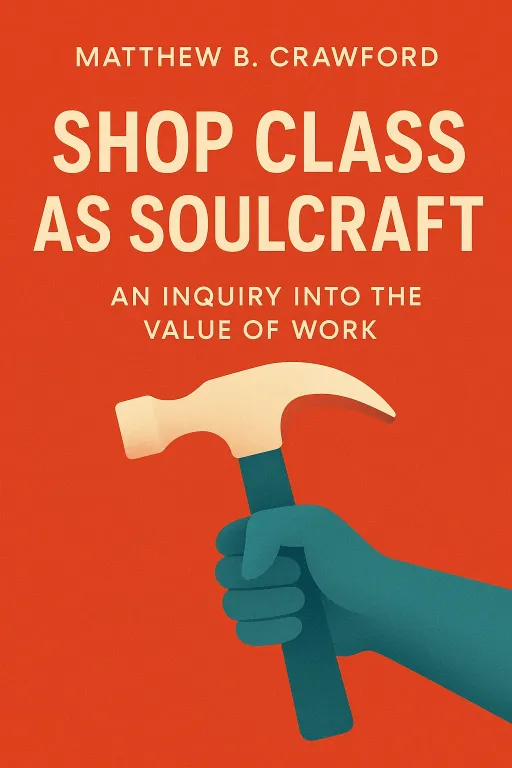
Nova: In a way, yes! And it’s beautifully articulated in a book that completely reshaped my perspective: by Matthew B. Crawford.
Atlas: . I love that title already. And Matthew B. Crawford, that name sounds… academic. Is this some ivory tower philosopher telling us to pick up a wrench?
Nova: Well, that's precisely what makes the book so compelling! Crawford himself is a philosopher, holds a Ph. D., and actually left a prestigious think tank job to open a motorcycle repair shop. This isn't just theory; it's a lived experience. It was a New York Times bestseller because it hit a nerve, challenging the prevailing wisdom of our knowledge-based society.
Atlas: Wow. A philosopher who became a mechanic. That’s not a career pivot you hear every day. It definitely lends him some serious street cred when talking about the value of manual labor. So, what’s the core argument he’s making that challenges this desk-job-or-bust mentality?
Nova: Well, it really boils down to two profound insights, Atlas. First, the incredible intellectual and moral richness that manual labor offers, which is often completely overlooked. And second, how this precise type of hands-on mastery can actually be a surprisingly robust blueprint for building real, tangible wealth and financial independence.
Atlas: Okay, so we’re not just talking about a 'feel-good' story, but something with actual intellectual depth and a financial payoff. I’m eager to dig into that. Let’s start with that first point: the intellectual richness. Because for many, 'shop class' brings to mind rote tasks, not deep thought.
The Intellectual & Moral Richness of Manual Labor
SECTION
Nova: Precisely. Crawford argues that skilled trades are anything but rote. Think about a master mechanic diagnosing a complex engine problem. It’s not just following a checklist. It's a detective story, a constant process of hypothesis testing. There's a subtle language of symptoms, sounds, smells, and vibrations.
Atlas: Right. Like, the car's making a weird hum, and it could be six different things, all interconnected. You have to isolate the variable.
Nova: Exactly! You're engaging in critical thinking, pattern recognition, and problem-solving that's as rigorous, if not more so, than many abstract intellectual pursuits. You're constantly learning, adapting, and innovating because every problem is slightly different. There's no one-size-fits-all solution.
Atlas: That makes sense. It’s not just about turning a wrench; it's about understanding complex systems and applying knowledge. But wait, isn’t that just... vocational training? Where’s the 'moral richness' or the 'soulcraft' part in all this greasy work?
Nova: That's where it gets really interesting. The moral richness comes from several places. First, the direct connection to reality. In knowledge work, you often deal with abstract concepts, data, and endless meetings. The results can feel nebulous, disconnected from tangible impact.
Atlas: I can definitely relate to that. Sometimes you push pixels around all day, and you wonder, 'What did I actually?'
Nova: Right? But when you fix a leaky roof, build a beautiful piece of furniture, or bring a broken engine back to life, the result is immediate, undeniable, and profoundly satisfying. You've created something, or restored something, that has real-world utility. There's an inherent honesty to the work.
Atlas: So, it’s about the tangible proof of your effort. You can point to it and say, 'I made that work.' That’s going to resonate with anyone who struggles with feeling disconnected from their labor.
Nova: And it fosters independence. When you understand how things work, and you possess the skills to repair or create them, you’re less dependent on others. You gain a sense of self-reliance and competence that’s incredibly empowering. Crawford talks about how this kind of work cultivates a virtue of attentiveness and responsibility. You can't cut corners; reality has a way of exposing shoddy work immediately.
Atlas: That gives me chills, actually. The idea that by mastering something physical, you gain a kind of freedom, a self-sufficiency that abstract work often doesn't provide. It’s like, the more you know how to, the less you need to on others for basic functions.
Nova: It's a profound path to mastery, problem-solving, and a direct connection to reality, as the book puts it. It’s about being fully present and engaged with the material world. It’s the antithesis of passive consumption.
Craftsmanship as a Blueprint for Real Wealth
SECTION
Nova: Now, if manual labor is so intellectually rich and personally empowering, providing such independence, what about the money? Can 'dirty hands' really lead to 'clean money' and true financial independence in today's economy?
Atlas: That's the million-dollar question for many of our listeners, Nova! We're constantly told that trades don't pay as well as 'knowledge work,' that they’re a fallback for those who can't get a degree. How does craftsmanship build wealth, not just a stable paycheck?
Nova: That’s a crucial distinction, and Crawford argues that highly skilled tradespeople are often in incredibly high demand. Think about it: as more people shift to abstract work, the pool of truly competent, master craftspeople shrinks. This scarcity means they can command premium prices.
Atlas: So, we're not just talking about a stable job, but potentially building a thriving business? Like a highly skilled artisan who's booked solid for months, or a specialized technician who's the only one in town who can fix a particular machine?
Nova: Exactly! A master plumber who can troubleshoot complex systems, or an expert electrician who specializes in intricate installations for high-end homes, or an incredibly skilled woodworker creating custom pieces. They're not just selling labor; they're selling expertise, problem-solving, and often, artistry. Their skills are resilient, often recession-proof, and difficult to automate.
Atlas: That’s a fascinating reframe. The wealth isn't just salary; it's the control over your work, your schedule, your pricing. It's building a skill that creates tangible value, something that AI can't easily replicate or offshore.
Nova: Precisely. And this leads to a different kind of financial independence. It's not just about accumulating abstract capital, but about having a skill set that gives you genuine autonomy. You can often set your own hours, choose your projects, and directly see the fruit of your labor translate into financial reward. It's a very direct and transparent connection between your effort, your skill, and your prosperity.
Atlas: That makes me wonder, could this be a more secure path to wealth for many people than the traditional corporate grind? If you're building a unique, tangible skill, you're not as vulnerable to layoffs or corporate reshuffles. You have a direct market for your expertise.
Nova: Absolutely. It offers a kind of economic resilience. And it connects directly to the idea of "The Apprenticeship Advantage" – it's a continuous journey of learning and refining your craft, which always increases your value. You're not just earning; you're building capital in yourself, in your skills, and in your reputation.
Synthesis & Takeaways
SECTION
Nova: So, what we've discovered is that the apprenticeship advantage isn't just about learning a trade. It's about cultivating a mindset of mastery, problem-solving, and tangible creation that offers both profound personal satisfaction and a robust, resilient path to financial independence. It’s about reconnecting with the inherent human drive to make and fix things.
Atlas: That’s a powerful insight. It really challenges the notion that true success only comes from abstract, intellectual work. This perspective suggests a more grounded, perhaps more fulfilling, and surprisingly secure way to build a future.
Nova: It’s empowering to realize that the deep satisfaction you get from crafting something with your hands isn't just a hobby; it's a powerful asset in your pursuit of financial independence. It's a path to mastery that yields both intellectual and material rewards.
Atlas: That’s really inspiring. For our listeners who are feeling that pull towards more tangible work, or who just want to reconnect with that sense of creation, what’s one small, concrete step they can take this week to begin exploring this idea?
Nova: I love that question. Here's a simple challenge from the book's spirit: plan just one hour this week to engage in a hands-on activity. It could be fixing a small repair around the house, starting a simple craft project, or even just learning a new basic physical skill, like changing a tire.
Atlas: I love that. Even just assembling IKEA furniture with a new appreciation for the process, or trying to fix that leaky faucet. It's about reconnecting with the tangible, feeling that immediate satisfaction of cause and effect. It’s a healing moment for the modern, disconnected soul.
Nova: Exactly! Reconnect with the tangible satisfaction of creating, even in a small way. It's a crucial step towards understanding the full apprenticeship advantage.
Atlas: Such a fantastic and thought-provoking discussion. It really makes you rethink what it means to work, to create, and to build lasting wealth.
Nova: It truly does. Thank you for joining us on this journey of discovery.
Atlas: Always a pleasure.
Nova: This is Aibrary. Congratulations on your growth!