

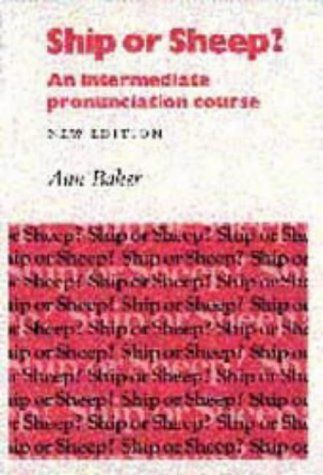
Ship or sheep?
Introduction
Nova: Welcome back to Aibrary. Today we're diving into a book that has been quietly shaping the way millions of people speak English for nearly fifty years. It's called Ship or Sheep? by Ann Baker, and here's a wild fact: this book was first published in 1977 and is still in print today, now in its third edition, published by Cambridge University Press, which by the way dates back to 1534.
Nova: Exactly that, and it's actually genius. The title itself is the lesson. Ship with a short i sound and sheep with a long ee sound. For millions of English learners around the world, these two words sound almost identical, and that confusion can lead to some pretty awkward conversations.
Nova: Right. And that's the whole premise of the book. Ann Baker built an entire pronunciation course around what linguists call minimal pairs, words that differ by just one sound. Ship and sheep. Tree and three. Pen and pan. Cup and cap. The book systematically walks learners through every single English vowel and consonant sound that causes trouble.
Nova: That's a perfect way to put it. And just like a fitness program, it comes with diagnostic tests, structured exercises, and even a physical mask you cut out from the back of the book to cover the written words so you're forced to really listen. Today we're exploring why this book has endured for decades and what makes its approach so remarkably effective. I'm Nova.
Origins and Evolution
The Book That Started in Tehran
Nova: So here's a detail that surprised me: Ann Baker didn't develop this book in some Cambridge ivory tower. The very first classroom tryouts happened at the British Council in Tehran. She was teaching English pronunciation to Iranian students and kept running into the same problem. Learners could read English, they could write it, but when they opened their mouths, native speakers couldn't understand them.
Nova: Exactly. And Baker realized that the problem wasn't vocabulary or grammar. It was that English contains sound distinctions that simply don't exist in many other languages. A Persian speaker, a Japanese speaker, a Spanish speaker, they each have a completely different set of sounds they need to learn to hear and produce.
Nova: She did. The first edition of Ship or Sheep came out in 1977. Then a second edition in 1981, and the current third edition in 2006, now in full colour with four audio CDs. The book has 234 pages, 50 units, and covers every single English vowel and consonant through the International Phonetic Alphabet. Section A handles vowels, 22 units. Section B handles consonants, 28 units. And woven throughout are seven review units that consolidate everything.
Nova: That's what's clever about the design. At the front there are diagnostic tests that help you identify which sounds you specifically struggle with. You can then target just those units. The book also comes with what's called a List of Likely Errors, organized by the learner's mother tongue. So if you're a Korean speaker, the book tells you which English sounds are going to be hardest for you, and you go straight there.
Nova: And let me mention the companion volume: Tree or Three?, also by Ann Baker. That's the elementary-level version for beginners. Ship or Sheep is aimed at intermediate learners, roughly B1 to B2 on the European framework. Together they form a two-level pronunciation program that's been used in classrooms from Sydney to Sao Paulo.
Core Methodology
The Minimal Pair Revolution
Nova: Let's get into the actual method, because this is where it gets fascinating. The centerpiece of every unit is something called a minimal pair exercise. You hear two words that are identical except for one sound. Ship, sheep. Bit, beat. Live, leave. And you have to identify which one you're hearing before you ever try to say it yourself.
Nova: That's Baker's key insight, and it's backed by decades of research in second language acquisition. If you can't hear the difference between two sounds, you will never be able to produce the difference. Your brain literally doesn't register them as distinct. So every unit begins with listening discrimination before any speaking happens.
Nova: Exactly. Page 185 of the book has a mask you cut out. You place it over the written words so you can only see pictures representing the words, like a drawing of a ship and a drawing of a sheep. You listen to the audio, you point to the picture you think you heard, and only then do you remove the mask and check. It forces your brain to stop relying on spelling, which in English is famously unreliable, and start truly hearing the sounds.
Nova: That's exactly the trap Baker wants to break. The mask breaks the visual dependency. After the listening phase, you move to repetition, then to dialogues that embed the target sound in natural conversation. One unit on the short i sound, for example, has a dialogue called "A Funny Librarian" full of words like "hill," "still," "silly," and "fifty." The dialogues are deliberately playful.
Nova: It is. And beyond the dialogues, there are card games you can photocopy and cut out, dictation exercises, pair work if you're in a class, and even exercises where you stand in front of a mirror. The book includes diagrams of lip and tongue positions, and you use a small mirror to check whether your mouth is actually doing what it's supposed to. Unit 1, the sheep unit, shows you the spread lip position for the long ee sound. Unit 2, the ship unit, shows the more relaxed position for the short i.
Nova: And that's probably why it's still in print after nearly fifty years.
Structure and Content Deep Dive
Inside the 50 Units
Nova: Let's walk through what you actually encounter when you open one of these units. The book is divided into two major sections. Section A covers vowels. It starts with the long ee sound in sheep, then the short i in ship, then moves through pen, man, cup, heart, clock, ball, book, boot, and on into diphthongs, those gliding vowel sounds like the ei in male, the ai in fine, the oi in boy.
Nova: Depending on the accent, English has between 14 and 21 vowel sounds. Compare that to Spanish, which has five. This is why English pronunciation is uniquely challenging. And Section B covers consonants. It starts with p and b, the difference between "pack" and "back." Then t and d, k and g, s and z, and some of the really tricky ones like the th sounds. Unit 42 covers the unvoiced th in "thin" and unit 43 the voiced th in "the feather."
Nova: Exactly. And then there are units on m, n, and ng, which are particularly important because in some languages like Japanese, speakers don't distinguish between n and ng at the end of words. So "sin" and "sing" sound the same. Baker isolates these contrasts and drills them.
Nova: Every few units, you hit a review unit that brings together all the sounds covered so far. The reviews include card games like "Pick Up Pairs," where you match words with the same vowel sound, and "Pick Up Same Sounds," where you group words by a shared consonant. These are designed to be played with classmates but can also be done solo. By the time you reach the final overview at the end, you've systematically covered every phoneme in standard British English.
Nova: Yes, the audio uses a standard southern British accent, what some people call BBC English or Received Pronunciation. That's both a strength and a limitation. For learners aiming to work or study in the UK, it's ideal. For those targeting American English, the vowel system is quite different, and they might need supplementary materials.
Nova: Absolutely. Learning to hear fine phonetic differences is a universal skill. Once you've trained your ear with minimal pairs, you can apply that awareness to any accent.
Critical Assessment
Strengths, Limitations, and Real-World Impact
Nova: Let's talk honestly about what this book does brilliantly and where it falls short. On the strength side, the systematic approach is the book's superpower. It doesn't just throw random pronunciation tips at you. Every unit follows the same predictable structure: diagnostic warm-up, listening discrimination, minimal pair contrast, dialogue practice, and games. Learners know exactly what to expect.
Nova: Right. Another strength is the companion audio. Having native-speaker recordings you can listen to, pause, rewind, and shadow is essential for self-study. And the fact that Cambridge University Press has kept this book in print through three editions with an accompanying website tells you something about demand.
Nova: Two main ones keep coming up in reviews globally. First, the design is fairly plain and academic. The third edition added colour, but the layout remains quite text-dense. For learners used to glossy, app-based learning, it can feel dry. Second, and more significantly, getting maximum value from the book really benefits from having a teacher or at least a conversation partner. Pronunciation involves muscle movements in your mouth, tongue, and throat that are hard to self-assess. The mirror helps, but it's no substitute for feedback.
Nova: Not entirely, which is why many teachers use it as a classroom resource rather than a self-study course. That said, the book has had an enormous impact on the field. It's cited in countless academic papers on pronunciation teaching. Universities from Vietnam to the Czech Republic have built pronunciation syllabi around it. It introduced the minimal pair technique to a generation of English teachers who had previously been taught that pronunciation would just take care of itself.
Nova: The research says no, not for adults. Children can acquire native-like pronunciation through exposure alone. But after a certain age, usually around puberty, most learners need explicit instruction to perceive and produce new sounds. Baker understood this intuitively, and modern phonetic research has confirmed it. Your brain's sound categories get locked in during childhood, and you need deliberate practice to create new ones. That's exactly what Ship or Sheep provides.
Practical Guide and Legacy
How to Use It Today
Nova: So if someone listening wants to try Ship or Sheep, what's the smartest way to approach it in 2026? First, don't try to swallow the whole book. Do the diagnostic test at the front. It takes about twenty minutes. You'll get a clear map of exactly which sounds you need to work on.
Nova: Precisely. Most learners don't struggle with all 43 sounds. Maybe you have trouble with the th sounds, or you confuse ship and sheep, or your r sounds too much like an l. Focus on those units. Spend fifteen to twenty minutes a day. Use the mask. Listen first, then repeat. Record your voice and compare it to the audio. The book's introduction actually recommends a four-step cycle: mask on, listen and repeat. Mask off, read aloud. Mask on, remember and say aloud. Mask off, read to check.
Nova: Also, use the mirror. Unit 1 opens with a diagram of the mouth for the long ee sound, showing the lips spread, the tongue high and front. Stand in front of a mirror and check if your mouth matches the picture. This feels awkward at first, but it's incredibly effective. And when you do the dialogues, pay attention to the intonation arrows. Baker marks every dialogue with rising and falling patterns, and she bolds the stressed syllables in sentences. Pronunciation isn't just individual sounds. It's rhythm, stress, and melody too.
Nova: Exactly. And on that note, if you're a complete beginner, start with Tree or Three? instead. Ship or Sheep assumes you already have basic vocabulary and can handle intermediate-level conversations. Tree or Three is designed for elementary learners and uses simpler language while teaching the same sound system.
Nova: I'd argue it holds up better than most. Pronunciation apps are great for feedback, but they rarely provide the structured, cumulative curriculum that Baker designed. They give you isolated exercises without a roadmap. Ship or Sheep gives you a complete system. The audio CDs might feel dated compared to an app, but the pedagogy is rock solid. And Cambridge has supplemented the book with online resources on their website, including extra practice materials.
Nova: That's exactly right. Minimal pair training works. It worked in 1977 in Tehran, and it works today on your phone or in your living room.
Conclusion
Nova: So what have we learned? Ship or Sheep by Ann Baker is far more than a clever title. It's a meticulously engineered pronunciation course built around one core principle: you must learn to hear the difference before you can speak the difference. Across 50 units, it trains learners in every English vowel and consonant, using minimal pairs, mirror work, a physical mask, dialogues, card games, and diagnostic tests tailored to your native language.
Nova: And it's democratic in the best sense. It doesn't require expensive technology or a native-speaker tutor. A book, a mirror, a CD player or phone, and the discipline to practice for fifteen minutes a day. That's it. The book acknowledges that learning pronunciation is difficult, sometimes embarrassing, and requires sustained effort. There are no shortcuts. But it also proves that with the right method, anyone can improve.
Nova: The mask. That simple piece of paper from page 185 captures the entire philosophy. Cover the words. Listen to the sound. Point to the picture. Train your ear before your mouth. It's a metaphor for all language learning, really. Don't let your eyes, or your assumptions, or your native language habits, get in the way of truly hearing what's being said. Once you can hear it, you can say it.
Nova: This is Aibrary. Congratulations on your growth.